
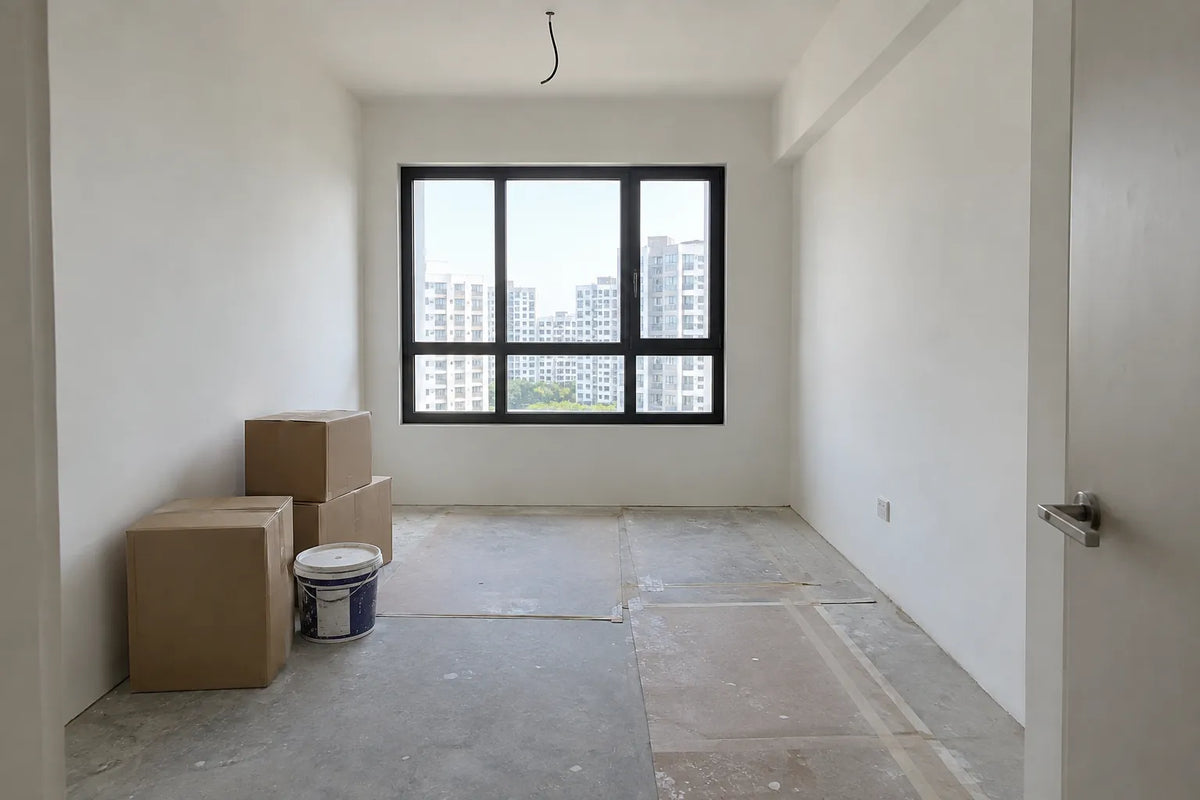

You have seen the photos: a glowing recessed strip tracing the living room ceiling, downlights floating in a crisp white plane, not a single wire in sight. Then your contractor quotes a figure that makes you blink. False ceiling and cove lighting can transform an HDB flat — or quietly swallow a few thousand dollars you meant for the kitchen.
The trouble is that "false ceiling" hides three very different jobs at three very different price points. This 2026 guide breaks down false ceiling and cove lighting costs in Singapore, room by room, so you know exactly what you are paying for before you sign anything.
Key Takeaway: A simple L-box with cove lighting in one HDB living room typically costs SGD 800–2,000, while a full living-room false ceiling runs SGD 2,500–5,000 or more — because an L-box uses roughly 30% less plasterboard and labour than a full ceiling. HDB does not require a renovation permit for a false ceiling. However, HDB requires a minimum clearance height of 2.4 metres from finished floor level (not applicable to toilets and bathrooms), and no gas pipe may ever be enclosed within one, per HDB renovation guidelines (2026). RCS holds HDB Licence HB-11-5877Z and BizSafe Level 3. Spend on a false ceiling only where it genuinely hides aircon trunking or shapes light — not for appearance alone. Prices are indicative Singapore market estimates only. Verify current HDB requirements and package prices before signing.
What Is a False Ceiling and Why Do HDB Owners Add One?
A false ceiling is a secondary ceiling built below the original concrete slab. HDB owners add one primarily to conceal aircon trunking, pipes, and wiring — and secondarily to shape lighting. The cost depends mostly on coverage area and depth, not the aesthetic finish alone.
What a False Ceiling Actually Is in an HDB Flat
A false ceiling is a lightweight layer — usually plasterboard on a metal frame — fixed below your original concrete slab. It creates a concealed gap that hides aircon fan-coil trunking, electrical conduits, and drainage pipes that would otherwise run visibly along your walls and ceiling edge. HDB does not require a renovation permit for false ceilings, but the work must be performed by a contractor listed in HDB's Directory of Renovation Contractors, and two non-negotiable technical rules apply under HDB renovation guidelines (2026): the false ceiling must maintain a minimum clearance height of 2.4 metres from the finished floor level (not applicable to toilets and bathrooms), and no gas pipe may be enclosed within a false ceiling under any circumstances. These rules mean that low-ceiling HDB flats near 2.5m need careful planning before committing to any false ceiling scope — the margin is narrow. The concealed gap also creates a clean plane for recessed downlights, but every false ceiling lowers usable height by roughly 100mm–250mm. Plan this trade-off early. Our HDB renovation cost guide for Singapore 2026 helps you frame the ceiling budget against the wider project.
What Cove Lighting and an L-Box Mean
Cove lighting is a hidden LED strip installed in a recessed ledge that washes indirect light upward or downward across the ceiling plane. An L-box is a small false-ceiling border — shaped in cross-section like the letter "L" — running along the room perimeter only. It carries the cove strip and often a row of downlights, but covers only the room edge rather than the full ceiling plane. Because an L-box covers the perimeter only, it uses roughly 30% less plasterboard and labour than a full false ceiling — which is why it costs meaningfully less for a very similar visual result. The glowing-border effect you see in Singapore HDB renovation photos is almost always an L-box or cove pelmet, not a full false ceiling spanning the entire room. For most HDB living rooms, an L-box delivers the signature cove-lighting look at a fraction of full-ceiling cost. Understanding this single distinction alone can save you thousands of dollars before your first contractor meeting.
Why HDB Flats Need False Ceilings More Than You Think
Most HDB BTO flats route aircon fan-coil trunking and refrigerant piping along the ceiling edge — and exposed trunking looks noticeably bulky against a clean finished wall. An L-box or false ceiling hides that trunking completely, which is the practical reason most Singapore owners install one beyond aesthetics alone. The work overlaps with both the aircon and electrical scope, meaning trade sequencing directly affects cost. Many owners overlook this overlap and pay avoidable rework charges when trades clash mid-project. Our guide on hidden HDB renovation costs in Singapore 2026 identifies exactly which overlap charges to confirm upfront before signing.
False Ceiling and Cove Lighting Cost by Room and Type — Singapore 2026
The table below shows typical 2026 Singapore market price ranges for HDB flat false ceiling and cove lighting by room and ceiling type.
These are indicative market estimates only, not binding quotes from RCS or any contractor. Actual prices vary based on room dimensions, ceiling depth, plasterboard specification, lighting count, and individual site conditions. Always obtain a written, itemised quotation from a licensed HDB contractor before making any budget decision.
LED cove lighting strips and drivers add approximately SGD 8–20 per foot run on top of the ceiling structure price, depending on strip quality and driver brand. Cove pelmet boxing per room typically runs SGD 130–450 depending on room size and design complexity. Always confirm explicitly whether the LED strip, driver, and dimmer switch sit inside or outside the ceiling structure quote — this is the most common Singapore false ceiling quote ambiguity that inflates final bills.
L-Box vs Full False Ceiling: Which Should You Choose for Your HDB Flat?
An L-box delivers the cove-lighting look for significantly less cost, while a full false ceiling hides more overhead services. The correct choice depends on how much trunking you must conceal and whether your ceiling height can absorb the drop while remaining above HDB's 2.4m minimum.
When an L-Box Is Enough
An L-box suits most HDB living rooms and bedrooms where the primary goal is cove lighting and edge trunking concealment. Covering only the perimeter preserves the full central ceiling height and cuts both material and labour cost sharply compared to a full ceiling. The glowing-border lighting effect in Singapore renovation photographs comes entirely from the L-box recess — no full ceiling is needed to achieve it. In a standard 2.6m HDB BTO flat, an L-box preserves most of the original ceiling height at the room centre, which matters significantly in compact rooms. Downlights fit within the L-box border for ambient and task lighting without requiring a full ceiling span. Choose the L-box when your aircon trunking runs along the walls rather than crossing the room centre overhead. For most Singapore owners planning a living room renovation in 2026, the L-box is the sensible, cost-effective default.
When a Full False Ceiling Earns Its Cost
A full false ceiling makes sense when aircon trunking, drainage pipes, or a concealed fan-coil unit crosses the room centre rather than running only at the perimeter. It also suits a gallery-style ceiling with many recessed downlights positioned across the full ceiling plane. The full flat surface hides every overhead service and gives complete freedom to position downlights anywhere. The trade-off is cost and a loss of 150mm–250mm of ceiling height across the entire room — and HDB's 2.4m minimum clearance must be met throughout after the drop. In a standard 2.6m BTO flat with a full false ceiling at 200mm depth, the finished height can reach approximately 2.4m — exactly at the minimum, with no further margin. Measure your slab height precisely before committing to any false ceiling depth. A master bedroom renovation in Singapore 2026 aiming for a hotel-style finish often justifies this investment where ceiling height is adequate.
The Hybrid Approach Most Singapore HDB Flats Use
The most common real-world false ceiling layout in Singapore HDB flats combines both: a deeper full-ceiling section near the aircon fan-coil ledge, transitioning to a slim L-box across the rest of the room perimeter. This hybrid conceals the bulkiest overhead services while preserving central ceiling height elsewhere. It balances concealment, usable room height, and cost in one practical design. Your contractor builds the deeper box only where the aircon unit profile and pipe runs demand it — the remaining perimeter uses the slimmer L-box for the cove lighting effect. Discuss the aircon indoor unit position first, because it dictates exactly where the deep ceiling section must go and defines the whole design from that point.
When a False Ceiling Is NOT Worth the Cost in Singapore
A false ceiling is not always money well spent. In several common HDB situations, it lowers your ceiling uncomfortably, complicates future maintenance, or consumes budget that would work harder elsewhere.
Low Ceilings and Budget Resale Renovations
Skip a full false ceiling in older HDB resale flats with already-low ceilings, and in budget renovations where height matters more than overhead concealment. Some older HDB blocks have original ceiling heights closer to 2.5m — a full false ceiling at 200mm depth brings the finished height to 2.3m, which falls below HDB's 2.4m minimum clearance requirement and is not permitted. Even where it just meets the minimum, the room feels noticeably compressed daily. In these flats, a slim L-box adds the cove lighting effect while preserving most of the original height. Surface-mounted track lighting is another low-cost alternative that requires no ceiling structure. Resale buyers in Singapore rarely pay measurably more for a concealed false ceiling over a well-finished open ceiling — so the spend seldom returns at sale. Our HDB 4-room resale renovation cost guide for Singapore 2026 shows where each dollar works harder.
Rooms With No Services to Conceal
Skip the false ceiling entirely in rooms where no aircon trunking, drainage pipes, or electrical conduits run overhead. A study, storeroom, or common bedroom served by a single ceiling light needs none of the concealment function that justifies a false ceiling's cost. Without services to hide, you are paying purely for a cosmetic lower plane — and that budget almost always buys more daily value elsewhere in the flat. Reserve false ceiling spend for the living room and master bedroom, where trunking concealment and layered lighting create real, lasting value.
The Maintenance and Access Trade-Off
A fully sealed false ceiling can significantly complicate access to concealed pipes, wiring, and aircon service valves later in the flat's life. If a concealed condensate drain blocks or a junction box needs servicing, opening a plasterboard ceiling to reach it is a costly and disruptive repair job. Always ask your contractor to install a dedicated access panel near aircon pipe joints, drainage traps, and key electrical junctions before the ceiling boards are sealed. A properly fitted access hatch costs a small fraction of the repair bill it prevents. Practical, targeted concealment — not total enclosure of every service — is the smarter long-term approach in Singapore HDB flats.
False Ceilings and Aircon Trunking Concealment: Getting the Sequence Right
Aircon trunking concealment is the single biggest practical reason HDB owners build a false ceiling. Getting the trade sequence right prevents costly rework and exposed pipes after handover.
How Concealed Trunking Changes the Ceiling Cost
Concealed trunking needs a deeper false-ceiling section to house the fan-coil pipes, refrigerant lines, and condensate drain. This deeper box uses more framing and plasterboard, raising the price versus a slim L-box. The aircon refrigerant pipes, drainage pipe, and wiring all sit in that hidden gap — your contractor must build the ceiling depth to match the aircon unit's installation profile precisely. Concealed trunking looks significantly cleaner than exposed PVC casing but costs more. Many Singapore owners accept exposed PVC trunking in bedrooms and conceal it only in the living room — this split keeps the most visible areas clean without a whole-flat ceiling scope.
Why Trade Sequence Between Aircon and Ceiling Matters
The aircon piping and trunking must be fully laid before the false ceiling closes — if the ceiling boards are installed first, the aircon team cannot route pipes through the sealed gap without reopening it. This trade clash is one of the most common sources of rework charges and schedule delays in Singapore HDB renovations. The correct sequence is: aircon first-fix piping and trunking → electrical conduit and first-fix wiring → ceiling boarding and plastering → lighting final-fix and commissioning. Coordinating all trades under one licensed contractor removes the blame-shifting that drives up cost when clashes occur. For sequencing in the context of your permit timeline, our HDB renovation permit and APEX fees guide for Singapore 2026 explains the approval timing for each stage.
Concealed vs Exposed Trunking: Which to Choose
Concealed trunking gives a seamless, premium look while exposed PVC casing costs less and allows easier future servicing. Concealed runs require a false ceiling or L-box and add to the overall lighting and boarding scope. Exposed PVC casing simply boxes the pipe along the wall in white, which keeps ceiling height intact and reduces both material and labour cost significantly. Concealed trunking suits feature areas like the living room and master bedroom. Exposed casing suits bedrooms and service areas where cost control matters more than finish. Match the method room by room rather than applying one approach throughout the flat — this is where real budget savings appear on ceiling scope.
Cove Lighting: Strips, Colour Temperature, and Running Cost
Cove lighting cost depends on LED strip quality, total run length, and the driver specification. Good strips with the right colour temperature lift a room; cheap strips fail early and look uneven within months.
Choosing LED Strips and Colour Temperature for Singapore HDB Flats
Select LED strips by brightness (measured in lumens per metre), colour temperature, and warranty length — not by the lowest unit price. For HDB living rooms in Singapore, 3000K–4000K delivers a warm, even ambient glow that flatters most interior palettes and feels appropriate for daily residential use. Cheap strips often show visible LED dot-spotting or fade unevenly within the first year, which is particularly obvious in cove recesses viewed at an angle. A quality strip with a properly matched driver runs consistently and dims smoothly over its full lifespan. Confirm the driver's wattage rating matches the total strip run length, or the circuit flickers and the driver overheats. Always ask whether the quote includes a dimmer switch and a branded, warranted driver — these small specifications decide whether your cove lighting looks premium or patchy after six months. A renovation consultation at SGD 150 can confirm the right lighting specification before any works begin.
How Much Cove Lighting Adds to Running Cost
Modern LED cove lighting draws very little power, so nightly running cost stays negligible for most Singapore households. A typical living-room cove strip run consumes approximately the energy equivalent of a few standard light bulbs, even when left on throughout the evening. LED efficiency means your monthly electricity bill changes minimally versus standard downlights. The meaningful cost is the upfront investment: strip quality, driver, dimmer, and the plasterboard recess to house them. Choose energy-efficient strips rated for Singapore's tropical ambient temperature, and the long-term running cost is genuinely not a reason to scrimp on installation quality. Focus your decision on warranted install quality — not electricity cost.
How to Budget and Verify Your False Ceiling Quote in Singapore
A transparent, trustworthy quote lists coverage area, plasterboard type, ceiling depth, lighting count, driver specification, and access panel provision. A vague "false ceiling: lump sum" line hides scope gaps that surface mid-project as additional charges.
What a Transparent False Ceiling Quote Must Include
A complete, trustworthy quote states: the ceiling coverage area in square feet, the L-box or full-ceiling dimensions in running feet, the plasterboard type and thickness, the number and type of downlights included, the LED strip length and colour temperature, the driver brand and wattage, whether a dimmer is included, and the provision and location of any access panels. It separates the cove strip and driver as explicit line items rather than bundling them into the ceiling structure price. This level of detail lets you compare two contractor quotes genuinely fairly — on specification, not just price. Ask for the height drop figure and access panel positions in writing before signing. RCS lists all ceiling and lighting works line by line within fixed package pricing, removing guesswork from the scope comparison. Cross-check your quote against our HDB renovation cost guide for Singapore 2026 to identify which contractor is quoting transparently.
Bundling Ceiling Work Into a Whole-Flat Renovation Package
Bundling false ceiling and lighting work into a whole-flat renovation package typically costs less than commissioning a standalone ceiling job, because a package coordinates the aircon, electrical, and ceiling trades under one contractor and one sequential schedule. This coordination prevents the trade-sequence clashes that generate rework charges on independently managed jobs. RCS move-in BTO packages start at SGD 7,390 for a 4-room flat, with project management and 3D rendering included. Whole-flat HDB BTO renovation packages by RCS fold ceiling and lighting into the wider coordinated scope. Single-contractor accountability also means one point of contact when a sequencing issue arises — rather than two separate firms pointing at each other.
FAQ: False Ceiling and Cove Lighting for HDB Flats in Singapore 2026
How much does a false ceiling cost for an HDB living room in Singapore in 2026?
A living-room L-box with cove lighting typically costs SGD 800–2,000 in 2026. A full living-room false ceiling runs SGD 2,500–5,000 or more. The final figure depends on coverage area, plasterboard type, ceiling depth, and downlight count. Always confirm whether the LED strip, driver, and dimmer are included in the quoted price. These are indicative market estimates — obtain a written quote for your specific room dimensions.
Is an L-box cheaper than a full false ceiling in Singapore?
Yes, significantly. An L-box covers only the room perimeter and typically costs around 30% less than a full false ceiling of the same length because it uses less plasterboard, less framing, and less installation labour. The cove-lighting effect comes entirely from the L-box recess — a full ceiling is not needed to achieve it. Choose a full false ceiling only when you must conceal trunking that crosses the room centre overhead.
What is HDB's minimum ceiling height rule for false ceilings?
HDB requires a minimum clearance height of 2.4 metres from the finished floor level for any false ceiling installation, per HDB renovation guidelines (2026). Cornices and pelmets have a separate minimum of 2.1 metres. This rule means that in HDB flats with original slab heights near 2.5m–2.6m, a full false ceiling may consume most or all of the permitted height margin. Verify your slab height before specifying any false ceiling depth.
Can I enclose a gas pipe inside a false ceiling?
No. HDB regulations explicitly prohibit enclosing gas pipes within false ceilings, per HDB renovation guidelines (2026). Gas pipes must remain accessible for inspection and maintenance at all times. Any false ceiling design that would enclose a gas pipe is non-compliant and must be redesigned before works commence. Confirm this with your contractor during the design stage, before any boarding begins.
Does a false ceiling require an HDB renovation permit?
False ceiling installation itself does not require an HDB renovation permit, but the works must be carried out by a contractor listed in HDB's Directory of Renovation Contractors and must comply fully with HDB's renovation guidelines, per HDB (2026). HDB also requires non-combustible materials for false ceilings, cornices and pelmets. Associated works such as electrical rewiring and aircon installation may require their own approvals. Always confirm the full permit requirements for your specific renovation scope with your contractor before works begin.
Should the aircon or false ceiling be installed first?
The aircon piping, refrigerant lines, and trunking must be installed and routed before the false ceiling boards are sealed. If ceiling boards are installed first, the aircon team cannot route pipes through the sealed gap without opening and repairing the ceiling. The correct sequence is: aircon first-fix → electrical first-fix → ceiling boarding → lighting final-fix. Coordinating both trades under one licensed contractor keeps this sequence tight and avoids rework charges.
Is cove lighting expensive to run every night in Singapore?
No. Modern LED cove lighting is highly energy-efficient and adds negligible cost to your monthly electricity bill even when used nightly. The meaningful cost is upfront — the LED strip, driver, dimmer, and the plasterboard recess. Choose quality strips rated for tropical ambient temperatures with a proper warranty. Focus your budget on installation quality, not electricity cost.
Plan Your HDB False Ceiling and Cove Lighting With a Licensed Contractor
False ceiling and cove lighting earn their cost where they hide trunking and shape layered light. An L-box delivers the signature glowing-border look for far less than a full false ceiling — choose the full version only where overhead services genuinely demand it. Coordinate aircon, electrical, and ceiling trades under one contractor, install access panels at every service junction, and confirm your ceiling depth meets HDB's 2.4m minimum clearance before any boarding begins.
RCS works as a direct HDB-licensed renovation contractor under Licence HB-11-5877Z, BizSafe Level 3, with fixed-price BTO and resale packages that fold ceiling, lighting, and aircon coordination into one sequenced, accountable scope. Confirm coverage area, board type, lighting count, and access panel positions in writing before any deposit is paid.
Book a renovation consultation with RCS at SGD 150 to map the right ceiling design for every room before works begin.
Sources
-
HDB Renovation Guidelines — Building Works — minimum clearance height 2.4m, no gas pipe in false ceiling, contractor licensing requirements
-
BCA Singapore — workmanship and material standards
-
NEA Singapore — noise and working hour regulations
Disclaimer: All price ranges in this article are indicative Singapore market estimates for 2026 and are not binding quotations from RCS Renovation Specialists or any other contractor. Actual costs vary based on room dimensions, ceiling depth, plasterboard specification, lighting count, driver quality, and individual site conditions. HDB renovation guidelines, minimum clearance requirements, and permit rules are subject to change — verify all current requirements directly with HDB at hdb.gov.sg before commencing any renovation works. The statement that false ceiling installation does not require an HDB permit is accurate as of October 2026 but is subject to change; confirm with HDB for your specific scope. This article is published for general information purposes only and does not constitute professional renovation, structural, electrical, or legal advice. RCS Renovation Specialists (HDB Licence HB-11-5877Z, BizSafe Level 3) accepts no liability for decisions made solely on the basis of this content without independent professional verification. Always obtain a written, itemised quotation from a licensed HDB contractor and confirm current regulatory requirements before signing any renovation contract.
Published by RCS Renovation Specialists — HDB-licensed renovation contractor in Singapore. Last reviewed October 2026.