

On 28 July 2026 the Government removed the 15-month wait-out period for private residential property owners buying a non-subsidised HDB resale flat, with immediate effect. If you are selling a condominium and moving to a resale flat, you can now buy without waiting out more than a year in between.
That changes your property timeline. It also changes your renovation timeline, and most people planning this move have not yet worked out what that means in practice.
Key Takeaways
- The 15-month wait-out for private property owners buying a non-subsidised HDB resale flat was removed on 28 July 2026, with immediate effect.
- The 30-month wait still applies if you want a subsidised flat, or a resale flat with housing grants.
- You must still dispose of all private property within 6 months of completing the resale purchase, and obtain an HFE letter.
- A whole-house resale renovation runs S$28,990 to S$41,590, depending on flat size and whether you hack or lay vinyl.
- Hacking adds roughly S$5,000 to S$8,700 over the vinyl route on the same flat.
- Renovating an HDB flat is governed by HDB, not an MCST — different approvals, different hours, and a licensed-contractor requirement you did not have in a condo.
What Changed on 28 July 2026?
Private residential property owners and ex-owners buying a non-subsidised HDB resale flat are no longer required to wait 15 months after disposing of their private property.
The measure had been in place since September 2022, introduced to cool the resale market. It was lifted after several quarters of moderation: HDB resale price growth slowed from 10.4 per cent in 2022 to 2.9 per cent in 2025, and prices declined in the second quarter of 2026 for the second consecutive quarter.
Who Does the Removal Actually Cover?
It covers private property owners and ex-private property owners purchasing a non-subsidised HDB resale flat — that is, a resale flat bought without housing grants.
If that describes your move, the waiting period between selling your condo and buying your flat is gone. If it does not, read the next section carefully before you plan anything.
What Has Not Changed: the 30-Month Rule
If you intend to buy a subsidised flat, such as a BTO, or a resale flat with housing grants, the existing requirement to wait 30 months after disposing of your private property remains unchanged.
This is the detail most easily missed in the headlines. The removal is specific to non-subsidised resale purchases. Taking a grant changes which rule applies to you, so decide on grants before you decide on timing, not after.
Were Some Buyers Already Exempt?
Yes. Before this change, seniors aged 55 and above were already exempt from the 15-month wait-out, as were those right-sizing to a four-room or smaller flat.
If you fall into either group, this announcement does not change your position — you were already able to proceed.
Which Conditions Still Bind You?
Two obligations survive the change and both affect your renovation planning.
First, you must dispose of all interests in private residential property within six months of completing the resale flat purchase. Second, you need an HDB Flat Eligibility letter before you can proceed with a resale transaction.
The six-month disposal window is the one that matters for renovation cash flow, and we come back to it below. Confirm your own eligibility directly with HDB rather than relying on any summary, including this one — the conditions attached to your case depend on your circumstances.
Why This Compresses Your Renovation Timeline
Under the old rule, a downgrader had fifteen months of enforced waiting. Whatever else that period cost you, it gave you time to plan a renovation slowly.
That buffer is gone. A move that previously spanned well over a year can now run from sale to keys in a matter of months, which means renovation planning has to start while you are still selling, not after you have collected keys.
How Soon Can You Realistically Start Renovating?
You cannot start work before completion, because you do not own the flat yet. What you can do beforehand is everything that does not involve touching the property: shortlisting contractors, viewing the flat with one, setting a budget against real package prices, and deciding scope.
Owners who do this in parallel with the sale typically start work within a week or two of collecting keys. Owners who begin looking for a contractor after collection routinely lose four to six weeks to quotations alone.
Why a Downgrader's Flat Usually Needs More Work
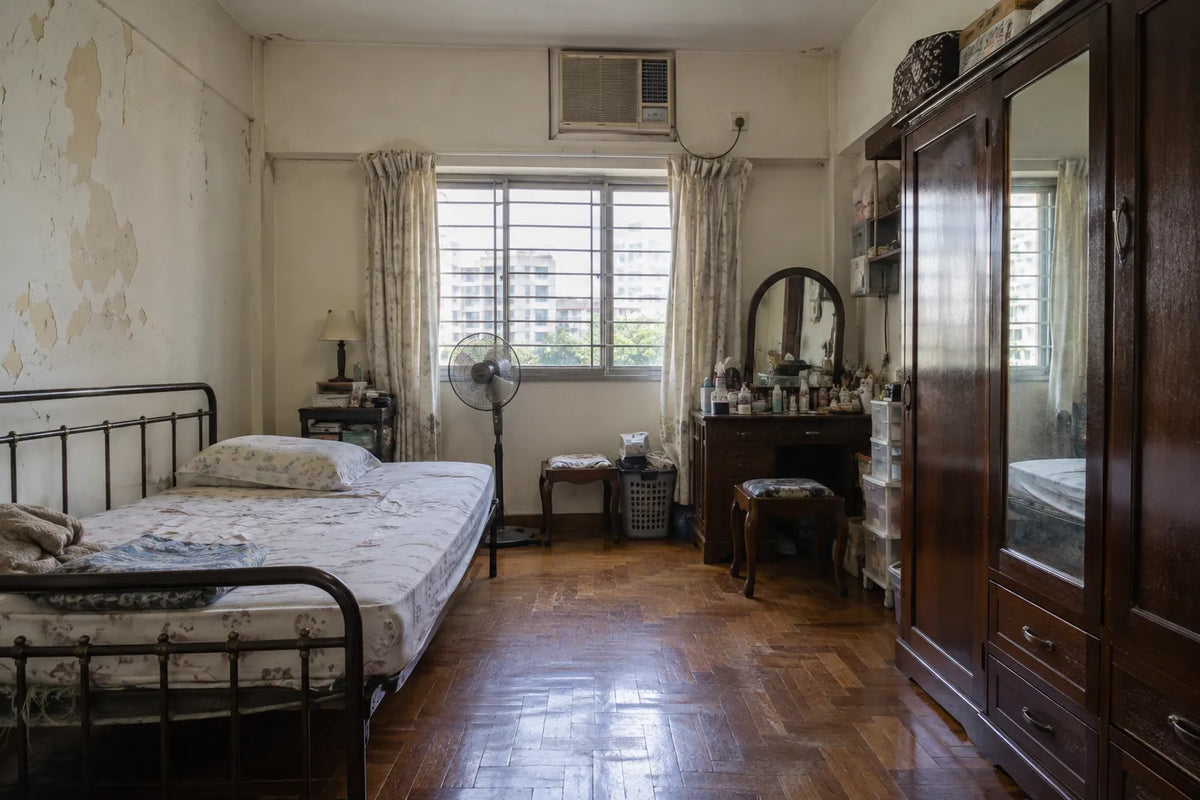
Resale flats bought by downgraders tend to be older and larger than the average BTO, and age drives renovation scope more than anything else.
An older flat carries original wiring loads that were never designed for modern appliance counts, pipework that has been patched rather than replaced, waterproofing membranes past their service life, and floor finishes laid in several layers over the decades. None of that is visible at a viewing, and all of it shows up in a quotation.
What Does a Whole-House Resale Renovation Cost?
These are published package prices for whole-house resale work, not estimates:
| Flat type | Most Popular (vinyl) | Premium (vinyl) | Most Popular (hacking) | Premium (hacking) |
|---|---|---|---|---|
| 3-room | S$28,990 | S$30,490 | S$33,990 | S$35,390 |
| 4-room | S$30,199 | S$31,880 | S$36,990 | S$38,490 |
| 5-room | S$31,290 | S$32,990 | S$39,990 | S$41,590 |
Read the table across rather than down. The jump from vinyl to hacking on the same flat is far larger than the jump between flat sizes, which tells you where your budget decision actually sits.
Vinyl or Hacking: the Real Fork
On a 4-room flat, the Most Popular tier runs S$30,199 with vinyl and S$36,990 with hacking — a difference of S$6,791. On a 5-room the same fork is S$8,700.
Vinyl overlays the existing floor. Hacking removes it down to the screed. In an older resale flat the deciding factor is the condition of what is already there: tiles that sound hollow when tapped have lost their bond, and laying over them transfers the problem rather than solving it.
This is a decision to make with a contractor standing in the flat, not from a price list.
Kitchen: Where the Largest Single Line Sits
If you are renovating room by room rather than taking a whole-house package, the kitchen is the biggest individual cost.
Resale kitchen packages run S$13,390 (Most Popular, overlay) to S$14,990 (Premium, hacking). Cabinet-only work, if your layout and tiles are sound, runs S$5,590 to S$6,190. The full breakdown sits in our kitchen renovation Singapore guide.
Toilets: the Line Downgraders Underestimate
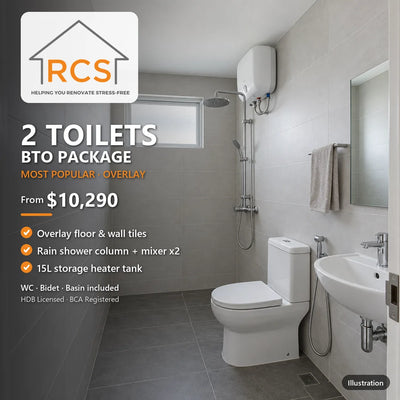
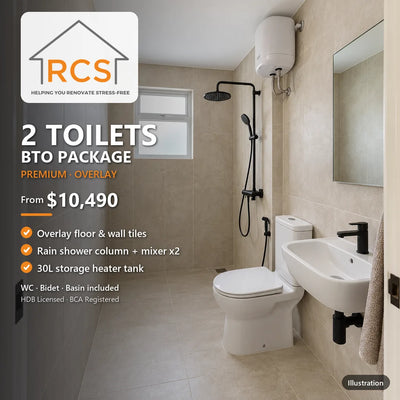
Two-toilet resale packages run S$11,690 (Most Popular, overlay) to S$12,590 (Premium, hacking).
Toilets in older flats are the most common place where an overlay turns out to be false economy. Waterproofing sits under the tiles, and if the membrane has failed, the only real fix is to hack, re-waterproof and re-lay. A leak that reaches the unit below becomes an inter-floor dispute, which is considerably more expensive than the S$900 you saved.
HDB Rules Are Not MCST Rules
This is the section written specifically for you, because you have renovated before — under a completely different regime.
In a condominium, your management corporation set the rules under its own by-laws. In an HDB flat, HDB sets them, and they are national rather than development-specific. Four differences will affect you immediately.
Who Approves Your Renovation Now?
There is no management office to submit plans to. Approval for works such as demolishing walls comes from HDB, in the form of prior written approval, and your contractor applies for it.
The practical difference is that you can no longer negotiate. A condo management office applies discretion; HDB applies a rule.
Your Working Hours Just Changed
HDB permits general renovation work between 9.00am and 6.00pm on weekdays and Saturdays, with no renovation on Sundays and Public Holidays.
Noisy works — demolishing walls, removing wall and floor finishes, cutting tiles, and heavy or excessive drilling — are restricted to 9.00am to 5.00pm on weekdays only, and are not permitted on Saturdays, Sundays, Public Holidays, or the eves of New Year's Day, Chinese New Year, Deepavali, Hari Raya Puasa and Christmas Day.
Many condominiums allow a Saturday morning window for noisy work. HDB does not allow noisy work on Saturday at all. If you are hacking, that removes a full working day per week from the schedule you may be assuming. The detail sits in our HDB renovation working hours guide.
Your Contractor Must Be on HDB's Directory
In a condo, you could engage essentially any competent contractor your management office would admit. In an HDB flat you must engage a contractor listed in HDB's Directory of Renovation Contractors.
Listing is not a quality guarantee and HDB is explicit about that. What it provides is accountability: listed contractors accumulate demerit points for infringements and can be delisted. Check the directory before you sign, not after.
The Deposit You Will Not Pay Again
One thing gets easier. There is no MCST renovation deposit on an HDB flat — no S$500 to S$3,000 held against damage to common property, and no inspection standing between you and its return.
Corridors and lifts are still shared, and your contractor is still responsible for leaving them clean, but the financial mechanism you were used to does not apply here.
Budgeting While You Still Own the Private Property
The six-month disposal window creates an overlap that catches people out. For a period, you may be servicing your existing property while paying renovation progress payments on the flat.
Singapore renovation payments are staged: a deposit on confirmation, progress payments tied to completed stages such as hacking, tiling and carpentry, and a balance on handover. Map those stages against your sale completion date before you commit to a start date. If the two do not align comfortably, the vinyl route rather than hacking buys you both time and roughly S$7,000 of headroom.
What to Check in the Flat Before You Commit
Bring a contractor to the second viewing, not the fifth. The things that move a quotation by five figures are all checkable in twenty minutes.
Tap the floor and wall tiles and listen for hollowness. Look at the ceiling in both toilets and in the room below any wet area for staining. Open the distribution board and count the circuits. Check whether windows are the original units and whether grilles are BCA-approved. Look for previous hacking that may not have been permitted, because an unauthorised alteration becomes your problem once you own the flat.
Keys to Move-In: a Realistic Timeline
A whole-house resale renovation with hacking typically runs 8 to 12 weeks from key collection. The vinyl route is shorter, commonly 6 to 8 weeks, because the noisiest and most schedule-bound phase is largely removed.
Add time for HDB approvals where walls are involved, and remember that noisy work is confined to five weekday windows. A twelve-week programme is twelve weeks of a five-day calendar, and every public holiday inside it removes a day.
What to Ask a Contractor Before You Sign
- Is the flat suitable for overlay, or does it need hacking? Ask for the reasoning, not the answer.
- What is included at this price, and what is excluded? Appliances and loose furnishings are usually out.
- Are you listed in HDB's Directory of Renovation Contractors? Verify it yourself.
- Who applies for the HDB permit, and when? It should be the contractor, before works start.
- What does the payment schedule tie to? Completed stages, not calendar dates.
- What happens if waterproofing failure is found after hacking? Get the variation rate in writing now.
Condo to HDB Resale, Defined
Moving from a condominium to an HDB resale flat means selling your private residential property and purchasing a resale flat on the open market. Since 28 July 2026, a purchase of a non-subsidised resale flat no longer requires a 15-month wait after disposing of the private property, though the buyer must still dispose of all private property interests within six months of completing the purchase and obtain an HDB Flat Eligibility letter.
Frequently Asked Questions
Can private property owners buy an HDB resale flat immediately in 2026?
For a non-subsidised resale flat, yes. The 15-month wait-out period was removed with immediate effect on 28 July 2026. A 30-month wait still applies to subsidised flats and to resale flats bought with housing grants.
Do I still have to sell my condo?
Yes. You must dispose of all interests in private residential property within six months of completing the resale flat purchase.
How much does it cost to renovate an HDB resale flat?
Whole-house resale packages run from S$28,990 for a 3-room with vinyl flooring to S$41,590 for a 5-room with hacking. Room-by-room, a resale kitchen runs S$13,390 to S$14,990 and two toilets run S$11,690 to S$12,590.
Are HDB renovation rules different from condo rules?
Yes, substantially. HDB sets national rules rather than development-specific by-laws, requires you to engage a contractor from its Directory of Renovation Contractors, and does not permit noisy work on Saturdays — which many condominiums do allow.
How long does a resale flat renovation take?
Typically 8 to 12 weeks with hacking, and 6 to 8 weeks using vinyl overlay, measured from key collection. HDB's restriction of noisy work to weekday daytime hours sets the floor on the schedule.
Get Your Resale Flat Assessed Before You Commit to a Budget
The prices on this page are published rather than estimated, so you can compare them line by line against any other quotation.
The single most useful thing you can do is bring a contractor to a viewing before you commit, so that the overlay-or-hacking question is answered by the flat rather than by a spreadsheet. Request a viewing assessment and we will tell you what the flat actually needs.
What If the Flat Has Unauthorised Alterations?
Older resale flats sometimes carry work done by a previous owner without approval — a wall removed, a service yard enclosed, a window changed for a unit that was never BCA-approved.
Once you complete the purchase, that becomes your responsibility rather than the seller's. Reinstatement can be ordered, and reinstatement is expensive because it means rebuilding something to a specification rather than simply finishing a surface.
This is the strongest argument for bringing a contractor to a viewing. An experienced eye spots a wall that was never meant to be open, or a bathroom that has been extended into a corridor, in the time it takes to walk the flat. Ask specifically about walls, windows, grilles and any enclosed balcony or yard space.
Should You Move In First and Renovate Later?
It is possible, and for cash-flow reasons it can be tempting when you are still carrying the private property. It is also almost always more expensive and slower.
Renovating an occupied flat means working around furniture, protecting finished areas, and restricting noisy work further in practice than the rules already do. Wet works in particular — toilets, kitchen tiling, waterproofing — are difficult to stage in a home someone is living in, because the room is out of use for the duration.
If the budget forces a phased approach, phase by room rather than by trade, and take the wet areas first while you can still tolerate the disruption. Doing kitchen and toilets in one mobilisation is cheaper than bringing the same trades back twice.
Five Mistakes Downgraders Make
Budgeting from BTO numbers. A resale flat is not a BTO. The whole-house resale packages above start where BTO packages finish, and that gap is the age of the flat, not a markup.
Assuming Saturday hacking. Many condominiums permit noisy work on Saturday mornings. HDB does not permit it at all. A schedule built on six working days will slip by a fifth.
Choosing overlay to save money in a flat that needs hacking. Hollow tiles and failed waterproofing do not improve under a new surface. The saving is deferred, not made.
Signing before the sale completes. Plan early, quote early, but commit payment schedules only once your own completion date is firm. The six-month disposal window leaves less room for error than it appears.
Treating the HDB permit as paperwork. Demolition without prior written approval puts the flat owner, not only the contractor, in breach. Confirm the permit is applied for and granted before anyone lifts a hammer.
Where the Whole-House Package Ends and Extras Begin
A whole-house package covers the built work: carpentry, flooring, tiling, painting, plumbing and electrical provisions across the flat. What it does not cover is the part you shop for yourself.
Appliances are the usual gap — refrigerator, washing machine, oven, hob and hood are typically homeowner-supplied unless a package explicitly includes them. Lighting fixtures, curtains, blinds and loose furniture sit outside as well. So does any carpentry beyond the standard runs, which is where feature walls and full-height wardrobes quietly add cost.
Budget an additional layer on top of the package figure for these. Owners who plan only the package number are the ones who feel ambushed in the final fortnight, when every remaining decision costs money and there is no time left to shop carefully.
Which Flat Size Actually Makes Sense?
Downgraders often assume a larger flat costs proportionally more to renovate. The published prices say otherwise.
Between a 3-room and a 5-room whole-house package on the Most Popular vinyl tier, the difference is S$28,990 against S$31,290 — S$2,300 across two flat sizes. The hacking tier spreads a little wider, S$33,990 against S$39,990, but even there the gap between sizes is smaller than the gap between methods on a single flat.
The practical reading: choose your flat size on how you want to live, not on renovation cost. The decision that moves your budget by five figures is overlay versus hacking, and that is decided by the condition of the flat you buy, not its size.
Does Renovating Now Help When You Sell Later?
Partly, and it is worth being realistic about which parts.
Kitchens and bathrooms are the areas buyers examine hardest, and sound wet works with proper waterproofing hold their value because the alternative for the next buyer is a hacking job. Neutral, well-executed finishes photograph well and shorten viewing cycles.
Highly personalised work does the opposite. Bold feature walls, bespoke carpentry built around your furniture, and unusual colour schemes narrow the pool of buyers who can picture themselves in the flat, and they are the first things a new owner pays to remove.
If you expect to hold the flat for a decade, build for how you live. If this is a shorter stay, keep the fixed elements neutral and let the removable things carry your taste.