
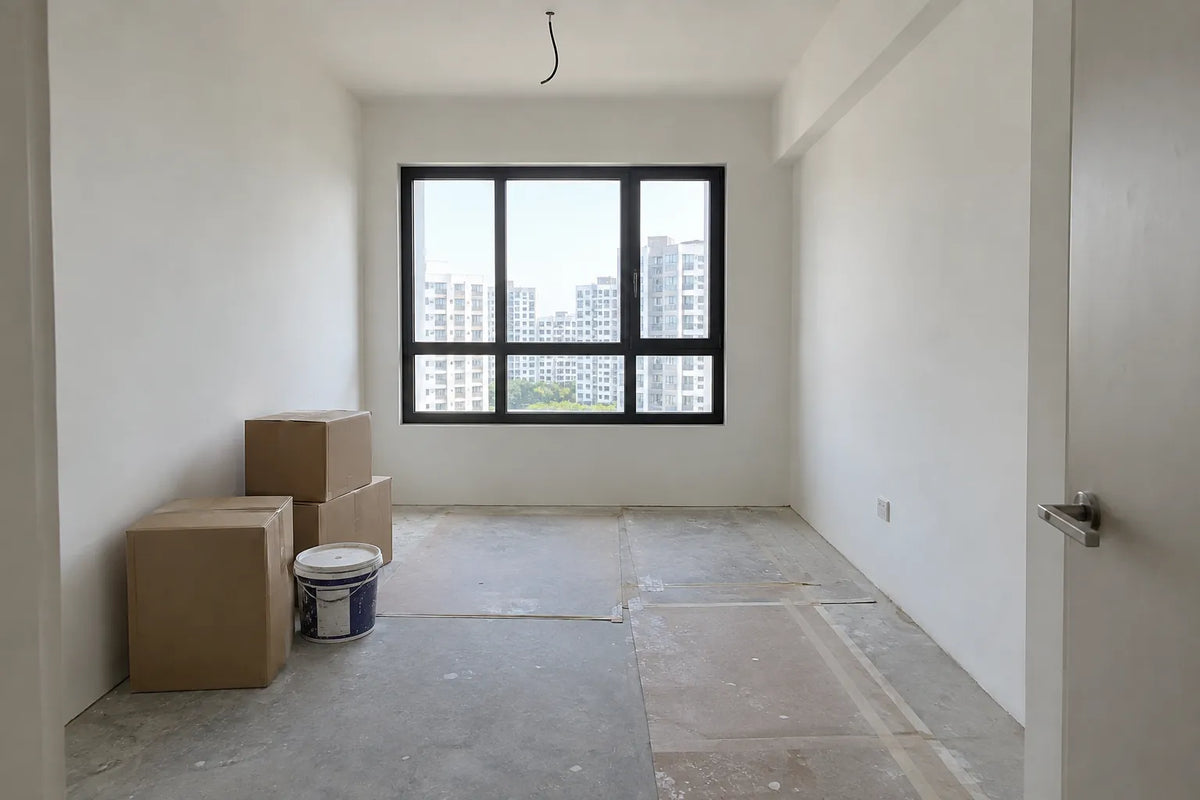


A grab bar costs a Singapore Citizen household $15.25. A hip fracture costs considerably more than that — and around 8,000 seniors are admitted to Singapore hospitals every year after a fall, a figure the Health Promotion Board expects to climb as the population ages. Roughly three quarters of those falls happen at home, and in Singapore's emergency departments, 85% of all trauma in elderly patients is fall-related.
The most dangerous room in a flat is usually the smallest one: a wet, hard-surfaced HDB toilet of about 3 to 4 square metres, with a raised kerb at the door and nothing to hold on to.
Most families discover two things too late. First, that HDB already pays up to 95% of the cost of senior-friendly fittings through the EASE programme. Second, that EASE deliberately does not cover the structural work — the tiling, the waterproofing, the kerb-free floor, the wet-and-dry separation — that decides whether those fittings are bolted into a safe bathroom or a slippery one.
This guide covers both layers, with the actual figures for each.
Key takeaways
- Under EASE 2.0, a 4-room flat owner pays $39.20 for the first set of 8 or 10 grab bars and $35.95 for slip-resistant treatment to two toilets. The Government pays the rest.
- EASE eligibility: a household member aged 65 or above, or aged 60 to 64 and needing help with at least one Activity of Daily Living.
- EASE covers fittings. It does not cover re-tiling, waterproofing, plumbing relocation, or a walk-in shower — that is renovation, and it is priced separately.
- RCS 2-toilet packages start at $10,290 (BTO, overlay) and run to $12,590 (resale, hacking), inclusive of GST.
- Sequence matters. If you are re-tiling, renovate first and apply for EASE fittings afterwards — otherwise grab bars and slip-resistant coating are destroyed by the hacking you have already paid for.
Why an HDB Toilet Is the Hardest Room to Make Safe
Ask any occupational therapist which room they worry about and the answer is the toilet. The reasons are structural, not behavioural.
It is wet by design. Singapore's tropical humidity means an HDB toilet floor rarely dries completely between uses. A tile that grips when dry can lose most of its friction under a film of water and soap residue.
It is small. A typical HDB toilet is 3 to 4 sqm. There is no room to fall safely — a stumble ends against a wall, a basin, or a toilet bowl rim rather than on open floor.
Everything demands a change of posture. Sitting down, standing up, stepping over a kerb, turning in a confined shower area. Each transfer is a moment where balance is loaded onto one leg.
There is usually nothing to grip. Towel rails are the default handhold, and they are fixed with plugs rated for a towel, not for 80 kg of falling body weight. A towel rail that tears out of the wall converts a stumble into a fall with a projectile attached.
The door often opens inward. If a senior falls against the door, an inward-swinging door can be physically blocked by the person you are trying to reach.
These are fixable problems. Some are fixed cheaply by HDB. The rest are a renovation decision.
HDB EASE 2.0: Exactly What the Government Pays For
The Enhancement for Active Seniors (EASE) programme was launched in July 2012 to improve safety and comfort for seniors living in HDB flats. In December 2018 HDB extended it to portable and customised ramps for older flats with multi-step entrances. In April 2024, HDB introduced EASE 2.0, widening the range of items to include rocker switches, Home Fire Alarm Devices, bidet sprays, wall-mounted foldable shower seats, foldable U-profile grab bars, lowering of toilet entrance kerbs and widening of toilet entrances.
The Government pays up to 95% of the cost for Singapore Citizen households, depending on flat type. You choose any combination of items and pay only for what you select.
The table below is HDB's published cost breakdown of the flat owner's share, inclusive of GST. The percentage in each column header is the owner's share of the full cost.
| EASE improvement item | 1/2/3-room (5%) |
4-room (7.5%) |
5-room (10%) |
Executive (12.5%) |
|---|---|---|---|---|
| Grab bars — first toilet (1st set, 8 or 10 bars) | $26.15 | $39.20 | $52.30 | $65.40 |
| Grab bars — second toilet (2nd set, 6 bars) | $15.25 | $22.85 | $30.50 | $38.15 |
| Slip-resistant treatment (2 toilets) | $23.95 | $35.95 | $47.95 | $59.95 |
| Lowering of toilet/bathroom entrance kerb | $47.95 | $71.90 | $95.90 | $119.90 |
| Widening of toilet/bathroom entrance | $65.40 | $98.10 | $130.80 | $163.50 |
| Widening and lowering of entrance | $77.35 | $116.05 | $154.75 | $193.45 |
| Wall-mounted foldable shower seat | $15.25 | $22.85 | $30.50 | $38.15 |
| Handrail at main entrance with step(s) | $31.60 | $47.40 | $63.20 | $79.00 |
| Ramp — 1 single-step | $14.15 | $21.25 | $28.30 | $35.40 |
| Ramp — 1 portable | $38.15 | $57.20 | $76.30 | $95.35 |
| Ramp — 1 customised, 2 to 3 steps | $87.20 | $130.80 | $174.40 | $218.00 |
| Ramp — 1 customised, more than 3 steps | $218.00 | $327.00 | $436.00 | $545.00 |
| 1 wheelchair lifter | $299.75 | $449.60 | $599.50 | $749.35 |
| Bidet spray (2 sets) | $6.50 | $9.80 | $13.05 | $16.35 |
| Rocker switch (set of 12) | $13.60 | $20.40 | $27.25 | $34.05 |
| Home Fire Alarm Device (HFAD) | $6.00 | $9.00 | $12.00 | $15.00 |
Source: HDB, Background of the EASE programme (Annex C). Figures are the flat owner's share, inclusive of GST. Verify current rates with HDB before applying.
Read that table twice, because the numbers are genuinely small. A 4-room household can fit out both toilets with grab bars, slip-resistant treatment, two bidet sprays and a foldable shower seat for $130.65 in total. That is not a typo, and it is the single highest-return safety spend available to any Singaporean family with an ageing parent.
Who Qualifies for EASE (Direct Application)
EASE is offered in conjunction with the Home Improvement Programme (HIP) so that both sets of works can be carried out at the same time. Households that need the fittings sooner, or whose blocks do not qualify for HIP, can apply directly to HDB through the e-Service on HDB InfoWEB.
The eligibility test turns on the age and functional needs of a household member:
- Aged 65 or above (based on calendar year) as at the date of application — qualifies.
- Aged 60 to 64 — qualifies if the senior requires assistance with at least one Activity of Daily Living.
Activities of Daily Living are the six basic self-care tasks used in healthcare assessment: washing/bathing, dressing, feeding, toileting, mobility and transferring. For the 60-to-64 band, HDB requires a Functional Assessment Report completed by a qualified assessor such as a doctor registered with the Singapore Medical Council.
Singapore Citizen households in sold flats and registered tenants in rental flats are both catered for. Because eligibility rules and rates are reviewed periodically, confirm the current position with HDB directly rather than relying on any third-party summary, including this one.
What EASE Does Not Cover — And Why That Matters
This is the part that catches families out, and it is worth being blunt about it.
EASE installs fittings onto your existing bathroom. It does not rebuild the bathroom. Specifically, EASE does not cover:
- Re-tiling — new floor or wall tiles, whether by overlay or hacking
- Waterproofing — new membrane systems, screed, or the mandatory water retention test
- Plumbing relocation — moving the toilet bowl, basin or shower to a safer position
- A walk-in or level-access shower — removing the shower kerb entirely and re-grading the floor to a linear drain
- Wet-and-dry separation — a glass partition that keeps the toilet and basin zone dry
- Vanity, storage, lighting and ventilation upgrades
- Door replacement — swapping an inward-swinging door for a sliding or outward-opening one
The practical consequence: slip-resistant treatment is applied to the tiles you already have. If those tiles are 20 years old, cracked, or laid with a fall towards the doorway rather than the drain, a chemical treatment improves grip but does not fix the underlying geometry. And a grab bar drilled into a wall you are about to hack is money spent twice.
That is the honest boundary between a subsidy and a renovation — and it is also why sequencing the two correctly saves real money. More on that below.
Nine Renovation Changes That Actually Prevent Falls
If EASE handles the fittings, these are the structural decisions that determine whether the room itself is safe. Not every flat needs all nine.
1. Remove or lower the entrance kerb
The raised kerb at an HDB toilet door exists to contain water. It is also the single most common trip point in the flat, particularly at night. Lowering it is an EASE item; removing it entirely and re-grading the floor towards the drain is renovation work that requires new waterproofing.
2. Separate wet from dry
A frameless glass partition or a half-height screen keeps the toilet bowl and basin zone dry. This is the highest-impact change in a small toilet because it means the senior is only ever on a wet floor while actually showering — perhaps 10 minutes a day instead of every visit.
3. Specify the tile by slip rating, not by looks
Anti-slip performance is graded R9 to R13. R9 is dry areas only. R10 is the practical minimum for an HDB bathroom floor. R11 is what we recommend inside the shower zone in a senior's home. R12 and R13 are commercial and accessibility specifications. Smaller tiles also help: more grout lines across a 300 x 300 mm format give more grip than a single large-format slab.
4. Fix grab bars into structure, never into tile alone
A correctly installed grab bar is anchored into the wall substrate with fixings rated for body weight. Position matters as much as strength: one vertical bar at the shower entry for the step-in, one horizontal bar along the shower wall, and one beside the toilet bowl for the sit-to-stand transfer. A bar in the wrong place is furniture, not safety equipment.
5. Provide a seated showering option
A wall-mounted foldable shower seat (an EASE item at $15.25 to $38.15) turns showering from a balance task into a seated one. It folds flat, so it does not consume floor space for other household members.
6. Change the tapware to levers
Arthritic hands struggle with round knobs, especially wet. Single-lever mixers can be operated with a forearm or a closed fist. A thermostatic mixer adds scald protection by holding a set temperature — worth considering where an instant heater serves the shower.
7. Light it properly, and light the route
Older eyes need substantially more light to achieve the same visual acuity, and they recover from glare more slowly. Use even, diffused ceiling light rather than a single harsh downlight, and add a motion-sensor night light on the route from bedroom to toilet. Rocker switches — larger and easier to hit than toggle switches — are an EASE item at $13.60 for a set of 12.
8. Reconsider the door
An outward-opening or sliding door means a fallen person cannot block access from outside. Widening the entrance is an EASE item; a sliding door system is renovation work.
9. Improve ventilation
A floor that dries faster is a floor that is safe more of the time. An exhaust fan rated 80 CFM or higher, ideally on a run-on timer, shortens the wet window after every shower and suppresses the mould that makes tiles slick.
For layout thinking in genuinely tight bathrooms, our guide to HDB toilet design for small spaces works through the spatial trade-offs in detail, and the small bathroom renovation guide covers fixture selection for compact footprints.
What It Costs: EASE Co-payment Versus Full Renovation
These are two different budgets and they should be planned separately.
Layer one — EASE fittings. For most families this lands between $40 and $200 depending on flat type and items chosen, as set out in the table above.
Layer two — the renovation. Below are RCS's current published 2-toilet package prices. All figures are in SGD and inclusive of GST.
| RCS 2-toilet package | Method | Price from |
|---|---|---|
| 2 Toilets BTO — Most Popular | Overlay | $10,290 |
| 2 Toilets BTO — Premium | Overlay | $10,490 |
| 2 Toilets BTO Resale — Most Popular | Overlay | $10,390 |
| 2 Toilets BTO Resale — Most Popular | Hacking | $11,290 |
| 2 Toilets BTO Resale — Premium | Hacking | $11,590 |
| 2 Toilets Resale — Most Popular | Overlay | $11,690 |
| 2 Toilets Resale — Premium | Overlay | $11,990 |
| 2 Toilets Resale — Most Popular | Hacking | $12,290 |
| 2 Toilets Resale — Premium | Hacking | $12,590 |
Two points on reading this table. Overlay lays new tiles over sound existing ones — faster, cheaper, and viable only where the current waterproofing is intact. Hacking strips back to the substrate so that a new waterproofing membrane can be laid, which is the honest answer for most flats over 10 years old and the only answer where there is any history of seepage.
Ageing-in-place items that sit outside the standard package — a level-access shower with linear drain, a sliding door system, a thermostatic mixer, or a bespoke vanity at a seated working height — are quoted on top. For a broader view of where renovation money goes across the whole flat, see our full toilet renovation cost and packages guide, and for planning the envelope, how to budget for a toilet renovation in Singapore.
Sequence Matters: Renovate First, Then Apply for EASE
This is the most valuable paragraph in this guide, so we will be direct.
If your flat needs re-tiling anyway, do the renovation first and apply for the EASE fittings afterwards. The reasoning is mechanical:
- Slip-resistant treatment is applied to existing tiles. Treat them, then hack them out three months later, and you have paid for a coating that went into a skip. Renovate first and specify R10 or R11 tiles from the outset — the slip resistance is then built into the tile body rather than applied on top.
- Grab bars are drilled into walls. Fit them before hacking and they come off with the tiles. Fit them after and they anchor into your new, sound substrate.
- Kerb heights change during renovation. Lowering a kerb that you are about to remove entirely is redundant.
The inverse also holds. If the bathroom is structurally sound and you are not re-tiling, apply for EASE now. There is no reason to wait, and no renovation is required to benefit.
One practical note: tell your renovation contractor that EASE fittings are planned. Wall reinforcement at the future grab-bar positions costs almost nothing at tiling stage and makes the later installation straightforward.
HDB Rules That Apply to Senior-Friendly Toilet Works
Accessibility work is still renovation work, and the same HDB framework applies.
A permit is required for hacking floor or wall tiles, replacing or modifying waterproofing, relocating plumbing fixtures, installing water heaters, and any structural modification to the toilet. Tile overlay, like-for-like fixture replacement and accessory installation generally do not require one. Only an HDB-registered renovation contractor can submit the application.
Waterproofing is the highest-liability item in the project. HDB requires approved materials, membrane coverage extending a minimum of 150 mm up the walls, and a 48-hour water retention test with the floor flooded to a depth of 20 to 30 mm before tiling proceeds. If your works cause a leak into the unit below, the homeowner carries the liability. Our toilet waterproofing walkthrough and the HDB wall repair and waterproofing guide explain the process and the failure modes.
Working hours are Monday to Saturday, 9.00 am to 5.00 pm. No renovation work is permitted on Sundays or public holidays, and noisy hacking or demolition is capped at three consecutive days. The full picture is set out in our guide to HDB bathroom renovation rules and restrictions.
Where a senior is living in the flat during works, these hours matter for a second reason — they define the window in which the toilet is unavailable each day.
Living Arrangements During the Works
This is the question families ask last and should ask first.
In a two-toilet flat, we stage the work so that one toilet remains in service throughout. In a single-toilet flat, the toilet is genuinely unusable for the duration, and for a senior with mobility or continence needs that is not a minor inconvenience — it needs a plan agreed before the first day.
Realistic durations: an overlay refresh of two toilets runs 5 to 6 working days. A full hacking renovation runs 2 to 4 weeks, including permit approval and the mandatory 48-hour water test, and cannot be compressed — waterproofing needs its curing time regardless of how urgent the project feels. Our 5-day HDB bathroom renovation guide sets out the day-by-day sequence for the faster route.
Dust is the other consideration. Hacking generates fine silica dust that travels, which is worth flagging where a household member has a respiratory condition. Sealed door screens and daily site cleaning are standard on our projects, but temporary relocation during the demolition days is sometimes the kinder option.
Choosing a Contractor for a Senior's Home
The general contractor-selection checklist applies, with three additions specific to this work.
Verify the licence first. Only HDB-registered renovation contractors can legally apply for permits and carry out structural works on HDB property. RCS operates under HDB Licence HB-11-5877Z, is BCA-registered, and holds bizSAFE Level 3 certification. You can and should verify any contractor against the Directory of Renovation Contractors on HDB InfoWEB before signing anything.
Ask specifically about grab-bar fixing. The question to ask is what the bar is anchored into and what load the fixing is rated for. A contractor who answers "into the tile" has told you what you need to know.
Ask how they will phase the work around the resident. A contractor who has done this before will volunteer a plan for toilet access, dust control and daily clean-down without being prompted.
On payment, the industry norm is 30% on signing, 40% at the midpoint and 30% on completion. A demand for 50% or more upfront is a reason to walk away. Our toilet renovation price list and contractor guide covers quotation red flags in more depth, and essential tips for toilet renovation in Singapore covers the basics worth getting right.
Planning around a specific estate? We have local guides for Toa Payoh, Queenstown, Woodlands and Choa Chu Kang — mature estates where flats are most likely to need the full hacking scope.
Frequently Asked Questions
Can my renovation contractor install EASE items for me?
No. EASE is administered by HDB — you apply through the e-Service on HDB InfoWEB, or the works are carried out together with HIP when your block is upgraded. A private renovation contractor handles the renovation layer: tiling, waterproofing, plumbing, layout and fittings you purchase yourself. The two are complementary, not interchangeable, and any contractor claiming to deliver EASE subsidies directly is misrepresenting the programme.
My parent is 62 and mobile. Do we qualify?
Only if they require assistance with at least one Activity of Daily Living — washing/bathing, dressing, feeding, toileting, mobility or transferring — supported by a Functional Assessment Report from a qualified assessor such as an SMC-registered doctor. At 65, the age criterion is met on its own. If your parent is 62 and fully independent today, the practical move is to build the structure now (tiles with an R10 or R11 rating, reinforced walls at grab-bar positions, wet-dry separation) and apply for the fittings later when eligibility is met.
Is slip-resistant treatment as good as anti-slip tiles?
They solve the problem at different points. Treatment is a surface application to tiles you already own, which is exactly right when you are not renovating — at $23.95 to $59.95 for two toilets it is excellent value. A tile with an inherent R11 rating carries its slip resistance in the tile body, so it does not depend on a coating remaining intact. If you are re-tiling anyway, specify the rating and you will not need the treatment.
Can we remove the toilet kerb completely?
Usually yes, but it is renovation work, not an EASE item. Removing the kerb requires re-grading the floor so that water falls towards the drain, and new waterproofing across the full floor with the 48-hour retention test. It also requires a permit. Done properly it produces a genuinely level-access bathroom; done badly it sends water out of the door, so this is not a corner to cut.
How much should we budget in total?
For a two-toilet HDB flat where the bathrooms need full renovation, a realistic total is the package price — $10,290 to $12,590 depending on flat type and method — plus roughly $40 to $200 in EASE co-payment for the fittings, plus a contingency of 10% to 15% for older resale flats where concealed pipe corrosion or subfloor damage may surface once tiles come off. Ageing-in-place extras such as a level-access shower or sliding door are quoted separately.
Will accessibility features hurt my flat's resale value?
The features that matter most — a level or low kerb, wet-dry separation, good lighting, quality slip-resistant tiles, lever taps — read as contemporary bathroom design rather than as medical equipment. Grab bars are the only visibly clinical element, and they unbolt in minutes. Foldable U-profile grab bars and foldable shower seats, both EASE items, were introduced precisely because they fold away when not in use.
Do we need a permit just to install grab bars?
Installing accessories such as grab bars does not itself require an HDB renovation permit. A permit is required once you hack tiles, alter waterproofing, relocate plumbing or install a water heater. If the grab bars are going in as part of a wider renovation, the permit covers the renovation scope.
Getting Started
If the bathroom is sound and you simply want it safer, apply to HDB for EASE — the co-payment is between $6 and $219 per item and there is no reason to delay.
If the bathroom needs work anyway, sequence it properly: renovate to a specification that anticipates ageing in place, then let EASE fit out the hardware onto sound new walls and floors.
RCS is an HDB-registered renovation contractor (Licence HB-11-5877Z), BCA-registered and bizSAFE Level 3 certified. If you would like a scoped, itemised quotation for a senior-friendly bathroom — including the elements EASE does not cover — message us on WhatsApp and we will walk through your flat's specifics.
Written by SingRank Singapore for RCS. EASE figures are taken from HDB's published cost breakdown (Annex C, Background of the EASE programme) and are inclusive of GST; package prices are RCS's current listed prices. Government programme rates, eligibility criteria and HDB regulations are reviewed periodically — confirm current details with HDB before applying. This guide is general information, not medical, legal or financial advice.