

Collecting your HDB keys is a milestone that most Singaporeans work years toward. Whether it's a brand-new BTO flat or a resale unit in an established estate, the moment those keys are in your hand, renovation planning begins almost immediately. Pinterest boards are saved, quotations are requested, and contractors are shortlisted.
But here's a reality that catches far too many homeowners off guard: before a single tile is hacked, before a wall is touched, and before any contractor sets foot in your flat to begin work, you need the correct HDB renovation permit in place. Skipping this step isn't a technicality you can work around — it is a legal requirement under Singapore law, and the penalties for non-compliance are real.
This guide covers everything you genuinely need to know: what an HDB renovation permit is, which specific works require one, what is permanently prohibited, how to apply step by step, how long approval takes, what happens if you miss the permit window, and how to choose a contractor who keeps you legally protected throughout the entire project. All regulatory information is based on official guidelines published by the Housing & Development Board on MyNiceHome.
What Is an HDB Renovation Permit?
An HDB renovation permit is a mandatory written approval issued by the Housing & Development Board before you commence specific categories of renovation work in your flat. It is not optional, and it is not something that can be obtained retrospectively after works have started.
The permit system exists because HDB flats are not independent structures — they are individual units within large multi-storey residential buildings where structural elements including load-bearing walls, reinforced concrete floor slabs, columns, and beams are shared across hundreds of units. What happens inside your flat can directly affect the structural integrity of the floors above and below you, and the safety of every resident in the building.
Under the Housing & Development (Renovation Control) Rules, homeowners are legally required to obtain the appropriate approvals before commencing works that fall within the permit-required categories. It is important to understand that the legal responsibility rests with you as the homeowner — not your contractor. Even when your contractor manages the application on your behalf (which is standard practice), you are accountable for ensuring proper permits are in place before any works begin. This distinction matters enormously: if a problem arises, HDB will be looking to you first.
Which Works Require an HDB Renovation Permit?
Understanding exactly which works trigger a permit requirement is the foundation of responsible renovation planning. Here is the complete breakdown based on HDB's official renovation guidelines.
Floor Works
Any work involving the removal of existing floor finishes and replacement with new ones requires a permit. This applies regardless of what material you are switching to — ceramic tiles, vinyl, porcelain, marble, parquet, or timber laminate. The requirement covers all areas of the flat: living room, bedrooms, kitchen, and wet areas.
A permit is also required if you intend to raise the floor level in the kitchen, balcony, bathroom, or toilet. Raising floor levels without authorisation adds unnecessary load to the floor slab and can compromise the structural performance of the flat.
Wall Works
Walls are among the most closely regulated renovation categories, and for good reason — incorrect hacking of a structural wall is one of the most serious mistakes a homeowner can make. You must obtain a permit before:
-
Hacking down or demolishing any wall — HDB must verify the wall is non-structural and that its removal will not affect the structural integrity of the building
-
Constructing arches or rounded corners within existing door or wall openings
-
Replacing internal wall finishes — to prevent unintended tampering with the wall structure itself
It is worth clarifying what does not require a permit: painting walls, applying wallpaper, or plastering surfaces can proceed without HDB approval. The permit is triggered by physical changes to the wall structure — not surface treatments.
Door Works
The main entrance door rules are specific and directly tied to fire safety regulations. If your main entrance door faces a fire escape route — that is, if it opens directly onto a staircase or lift lobby — you need a permit to replace it. The replacement door and frame must be half-hour fire-rated and fitted with a door closer. These are fire safety requirements that exist to protect every resident in your building during an emergency, and they cannot be waived or substituted.
Changing the location of any internal door within your flat also requires a permit, because relocation involves hacking works that could affect wall structure.
Bathroom and Toilet Works
Bathroom rules include a critical restriction specific to BTO flat owners: you must wait a minimum of 3 years from your date of key collection before removing any wall or floor finishes in the toilets. This rule protects the waterproofing membrane that HDB installs in the wet areas of new flats during construction. Disturbing this membrane prematurely creates a serious water leakage risk — primarily for the unit directly below yours. HDB takes this rule seriously and enforces it.
After the 3-year period, any work involving the removal and replacement of bathroom floor or wall finishes, extension of the bathroom footprint, or new waterproofing works requires an HDB renovation permit.
For resale flat owners, the 3-year restriction typically does not apply since the BTO key collection date was many years prior, but all bathroom wet works still require prior permit approval regardless.
Air-Conditioner Installation
For BTO flat owners installing a compressor at the designated air-conditioner ledge, no HDB permit is required before installation — this covers the standard configuration for new flats. However, for resale flat owners with an existing 30-amp main switch, a permit must be obtained from HDB before installing air-conditioner units that use new 15-amp power points or 20-amp isolators.
Additionally, if any part of your air-conditioner unit projects outward from the building exterior, you are required to submit an air-conditioner installation report as part of the approval process. Regardless of permit requirements, all air-conditioner installations must be carried out by a BCA-trained installer — this is a separate mandatory requirement.
Window and Grille Installation
Installing or replacing your flat's windows, or installing grilles at the service yard or balcony, requires a permit. The design and colour of any installed windows and grilles must comply with the scheme approved by HDB for your building — this maintains the visual uniformity of the building exterior.
Since 1 October 2004, only BCA-approved window contractors who are also registered with HDB can legally carry out window installations and replacements. Engaging a contractor who does not hold both credentials for window works is a direct regulatory violation, regardless of how experienced that contractor may be in other renovation trades.
Works That Do NOT Require a Permit
Equally important is knowing which renovation works can proceed without any HDB approval:
-
Painting internal walls and ceilings
-
Applying wallpaper to internal walls
-
Plastering internal wall surfaces
-
Installing freestanding furniture (sofas, beds, wardrobes)
-
Installing light fixtures (non-structural ceiling works)
-
Fitting curtains, blinds, and window treatments
-
Replacing kitchen appliances in the same positions without plumbing modifications
-
Basic carpentry that does not involve hacking or structural changes
When you are genuinely uncertain about whether a specific work falls within permit-required categories, the safest course of action is to verify directly with HDB through the MyNiceHome portal before beginning. This is not a situation where assumptions are appropriate.
Works That Are Permanently Prohibited
Beyond works that require a permit but can be approved, certain renovation types are absolutely prohibited under HDB regulations. No permit will be issued for these works because they pose unacceptable risks to structural integrity or fire safety:
-
Hacking structural reinforced concrete elements — walls, columns, beams, floor slabs, and staircases
-
Overloading floor slabs beyond the allowable 150kg per square metre
-
Partitioning using combustible, toxic, or unapproved materials such as untreated plywood, asbestos, or certain synthetic panels
-
Covering or enclosing void areas to extend usable floor area without authorisation
-
Blocking fire escape routes or altering any means of escape from the building
These prohibitions are absolute. Any contractor who suggests these works are possible "with the right connections" or "can be worked around" is misrepresenting the situation and potentially exposing you to serious legal liability.
BTO vs. Resale: How Permit Scope Differs in Practice
The permit requirements under HDB regulations are the same for both BTO and resale flats. What differs significantly is the volume and nature of works that typically triggers those permits in each scenario.
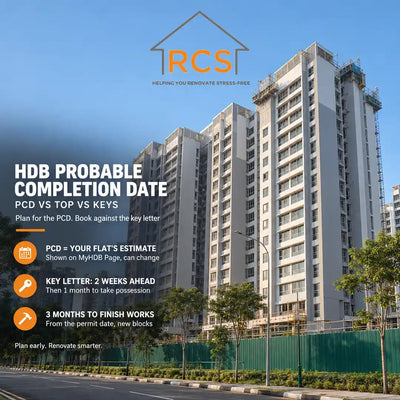
BTO flat renovations typically start from a clean slate. The flat arrives with standard HDB finishes, no pre-existing defects, and no aged infrastructure requiring replacement. Most BTO renovation scopes focus on customisation: kitchen cabinetry, bedroom storage solutions, flooring upgrades, feature walls, and lighting. Structural works are minimal, and the permit application is usually straightforward. The 3-month completion window HDB provides for BTO flats is generally sufficient for most renovation scopes.
Resale flat renovations present an entirely different picture. Depending on the flat's age — many resale units in popular estates are 20 to 30 years old — the renovation scope can be substantially more extensive. Old floor and wall finishes need to be hacked out. Outdated electrical systems require rewiring. Iron pipes must be replaced with copper pipe (this is mandated by HDB for resale flats and is non-negotiable). Waterproofing in wet areas needs to be fully redone. And structural issues sometimes only become apparent once demolition begins.
Every one of these works triggers a permit requirement. This is also why resale flat renovations consistently cost 20–30% more than equivalent BTO projects even for the same flat size — and why the shorter 1-month completion window HDB applies to resale permits demands far more careful scheduling.
Understanding this distinction before you begin helps you plan your timeline, budget, and contractor selection more accurately from the outset.
How to Apply for an HDB Renovation Permit: The Full Step-by-Step Process
Step 1: Engage an HDB-Registered Renovation Contractor
Your renovation contractor must be listed in HDB's Directory of Renovation Contractors (DRC). This directory is publicly accessible and searchable. Only contractors on this list are authorised to carry out HDB renovation works and to submit permit applications on your behalf. Verifying your contractor's DRC listing before signing any agreement or paying any deposit is not optional — it is one of the most important checks you can perform.
Step 2: Confirm Your Renovation Scope in Detail
Work with your contractor to finalise the complete scope of works before any application is submitted. For works involving structural changes — hacking walls, repositioning fittings, constructing new openings — your contractor will need to prepare detailed documentation including layout plans, elevations, sections, and construction details. These are submitted alongside the permit application and must accurately reflect the planned works.
This is also the stage where the contractor should advise you on whether any of your planned works require Professional Engineer (PE) endorsement before HDB will approve the permit. PE endorsement is typically required for works involving structural modifications or changes that require professional engineering assessment. Identifying this requirement early prevents unexpected delays once the application is submitted.
Step 3: APEX Electronic Permit Application Submission
Your contractor submits the application electronically through HDB's APEX (Automated Permit EXchange) system on your behalf. No physical visit to an HDB office is required. You formally authorise the contractor to act as your representative for this submission.
Once HDB receives the application, an SMS notification is sent directly to your registered mobile number as the homeowner. This SMS is your confirmation that the application has been received and is under review. Save this confirmation.
Step 4: Wait for Approval — No Works May Begin During This Period
Standard processing time is typically up to three weeks from the date of submission. Complex applications involving structural changes or those requiring PE endorsement may take longer. Straightforward applications for minor permit-required works may be processed within 3 to 7 working days.
This waiting period is not negotiable. Commencing renovation works before receiving your approved permit is illegal under Singapore's Housing & Development Act. The consequences — stop-work orders, mandatory reinstatement at your expense, and financial penalties — are far costlier than the delay of waiting for approval.
Step 5: View Your Approved Permit and Commence Works
Once approved, your renovation permit is accessible through My HDBPage. Your contractor is simultaneously notified of the approval. Before any physical works begin, your contractor is required to display a Notice of Renovation outside your flat — this formally informs your neighbours of the renovation timeline, the nature of works, and the expected end date.
Only after this notice is posted can works legally begin within the approved scope.
Permit Validity Windows: A Detail That Derails Many Projects
HDB renovation permits expire, and the expiry timeline is fixed:
-
New BTO flats: All approved works must be completed within 3 months of permit issuance
-
Resale HDB flats: All approved works must be completed within 1 month of permit issuance
These deadlines exist because sustained renovation works in occupied HDB buildings cause ongoing noise disruption and inconvenience to residents in neighbouring units. HDB treats these timelines seriously.
If your renovation cannot be completed within the permit validity window, you must apply for a fresh permit — adding administrative time and cost to your project. This is why experienced contractors recommend submitting the permit application only when you are genuinely ready to begin: contractor confirmed, materials selected, schedule locked. Apply too early and you waste your validity window; apply without preparation and you risk running out of time.
The 1-month window for resale flats in particular demands a tight, well-coordinated schedule from your contractor. It's one of the strongest reasons to engage a contractor who has dedicated project management resources — not just a sales team.
Renovation Working Hours Under HDB Rules
Renovation works may only be carried out during specific hours to protect the wellbeing of residents in surrounding units. The permitted hours for noisy renovation works — hacking, drilling, use of power tools — are:
Light, quiet works may be carried out at other times at the contractor's discretion, but any works involving sustained noise must strictly observe the above schedule. Your contractor is also required to post the Notice of Renovation before works begin, which gives neighbours advance notice of the renovation period and what to expect.
Legal Consequences of Non-Compliance
The penalties for violating HDB renovation rules are clearly defined and enforced. Under the Housing & Development (Renovation Control) Rules, homeowners found to have:
-
Commenced renovation works without an approved permit
-
Engaged an unlicensed contractor not listed in the DRC
-
Carried out works that deviate from the approved permit scope
-
Performed prohibited works that damage structural elements
...can face fines of up to $5,000 per offence upon conviction. Beyond fines, HDB may issue a stop-work order that halts all renovation immediately, and can require mandatory reinstatement of all completed works — entirely at your expense. In cases involving structural damage, liability may extend to affected neighbours.
The contractor accountability system adds another layer: contractors operating on HDB projects accumulate demerit points for violations. A contractor that reaches 24 demerit points within any 24-month period faces removal from the DRC — ending their ability to legally operate on HDB projects. This accountability mechanism incentivises reputable contractors to operate strictly within HDB's guidelines, which is another reason engaging a licensed, experienced contractor protects you.
Renovation Cost Context: What to Budget in 2026
While the HDB renovation permit is the central focus here, understanding how permit-required works translate into costs helps you plan realistically. These are general Singapore market estimates based on current industry data:
General Market Ranges by Flat Type
These are general market estimates. Actual costs depend on your flat's specific condition, renovation scope, material selections, and design complexity.
A frequently overlooked cost category includes the administrative expenses associated with permits themselves — HDB processing fees, PE endorsement fees where required, fire safety certificate costs, and site protection costs. These can add $300–$800 to your project before any physical works begin, and should be factored into your budget from the start.
Standard industry advice is to maintain a 10–15% contingency buffer above your quoted renovation cost. This is especially relevant for resale flats, where hidden structural issues — damaged floor screeding, deteriorated waterproofing, corroded pipe work — are often only discovered once demolition begins.
For a detailed breakdown of 2026 renovation costs by flat type and work component, the RCS HDB Renovation Cost Guide provides current market data with itemised cost ranges across all major renovation trades.
How to Choose the Right HDB Renovation Contractor
Your choice of contractor is inseparable from your permit compliance. An unlicensed contractor cannot submit a legitimate APEX permit application on your behalf. If works are carried out without a valid permit — even by an otherwise competent contractor — the legal and financial consequences fall on you as the homeowner.
When evaluating contractors, verify the following before signing any agreement:
-
HDB DRC listing — searchable at services2.hdb.gov.sg. This is non-negotiable.
-
BCA registration — for contractors carrying out structural or broader building works
-
BizSafe certification — indicates the contractor operates with formal workplace safety management standards
-
Itemised quotations — a reputable contractor provides a full breakdown by trade, not a single lump sum
-
Dedicated project manager — someone accountable for your specific project from start to completion
-
Workmanship warranty — industry standard is 12 months covering both materials and labour
-
Track record — verified reviews and completed project references
Questions worth asking any contractor before committing:
-
What is your HDB licence number and can I verify it in the DRC right now?
-
Will you handle the full APEX permit application on my behalf?
-
What is your realistic timeline from permit application to work completion, and does it fit within the permit validity window?
-
How do you handle unexpected structural discoveries during demolition?
-
Can you provide an itemised quotation separating each trade and work component?
RCS (Renovation Contractor Singapore) holds HDB licence number HB-11-5877Z, is BCA-registered, and holds BizSafe Level 3 certification. They manage the full APEX permit application process as a standard part of every project, ensuring homeowners are fully compliant before works begin. For an overview of what to look for in the best licensed contractors in Singapore, the RCS guide to top HDB renovation contractors covers verified credentials and key differentiators in detail.
Your Pre-Renovation Compliance Checklist
Before any tools are lifted and any contractor begins work in your flat, confirm every item below:
-
✅ Contractor is verified in HDB's Directory of Renovation Contractors
-
✅ All permit-required works are identified and included in the APEX application scope
-
✅ APEX application has been submitted and SMS confirmation received
-
✅ Approved permit is viewable on My HDBPage before works commence
-
✅ Notice of Renovation is posted outside the flat before works begin
-
✅ Renovation timeline is confirmed within the permit validity window (3 months BTO / 1 month resale)
-
✅ BTO flat owners have confirmed 3-year waiting period for toilet works (if applicable)
-
✅ Contingency budget of 10–15% is allocated above quoted project cost
-
✅ All renovation documents, permits, and warranties are saved securely
Post-Renovation: Your Responsibilities Don't End at Completion
A common misconception is that once renovation ends and the contractor leaves, all obligations are finished. In practice, several responsibilities remain with you as the homeowner:
Keep all documentation. Your renovation permits, approved plans, workmanship warranties, and contractor certificates should be stored securely. These documents may be requested during future HDB inspections, or when you sell or transfer ownership of the flat. Buyers and their lawyers increasingly request renovation permit documentation during resale due diligence.
Ensure no unauthorised changes were made. If your contractor made any changes during the project that deviated from the approved permit scope — even minor ones — these are technically unauthorised works. If you discover any deviation, address it with your contractor immediately.
Maintain waterproofing in wet areas. Proper maintenance of bathroom and kitchen waterproofing protects your investment and avoids liability for water damage to the unit below. If you notice any signs of leakage — damp patches, discolouration on ceilings or walls — act promptly.
The Bottom Line
The HDB renovation permit is not an obstacle in your renovation journey — it is the legal and structural foundation that protects your home, your neighbours, and your investment. The homeowners who encounter serious problems are almost always those who either did not know the requirement existed, underestimated which works required approval, or chose to proceed without permits hoping the issue would not surface. It consistently does, and the costs of non-compliance — stop-work orders, mandatory reinstatement, fines — far exceed the time and effort of getting permits right from the start.
Managed correctly, the process is straightforward. Work with an HDB-licensed contractor who handles the APEX application as a standard service, plan your timeline to comfortably fit within the permit validity window, and approach the project with accurate expectations on both scope and budget.
For official and up-to-date guidance on which works require permits and how to apply, the authoritative reference is the HDB MyNiceHome portal — a government resource maintained directly by HDB. Pair this with an experienced, licensed contractor who treats permit compliance as a core part of the service they deliver, and your renovation will be built on a foundation that is both legally sound and structurally safe.
All renovation cost ranges in this article are general Singapore market estimates based on industry data as of 2026. Actual costs vary depending on flat type, condition, renovation scope, material selections, and design complexity. Always obtain itemised quotations from multiple HDB-licensed contractors before committing to any renovation project. All regulatory information is based on official HDB guidelines published at MyNiceHome.gov.sg. As HDB guidelines may be updated from time to time, always verify current requirements directly with HDB or through their official channels before commencing works.
If a neighbour complains: a permit does not stop a complaint. Our guide to HDB renovation noise complaints explains how they are handled.