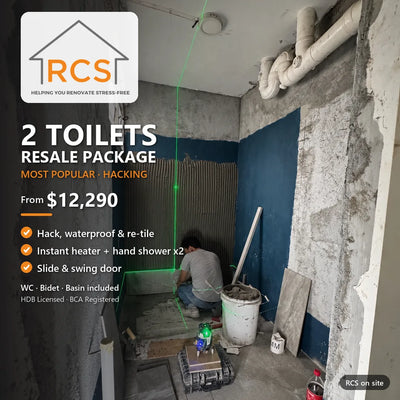

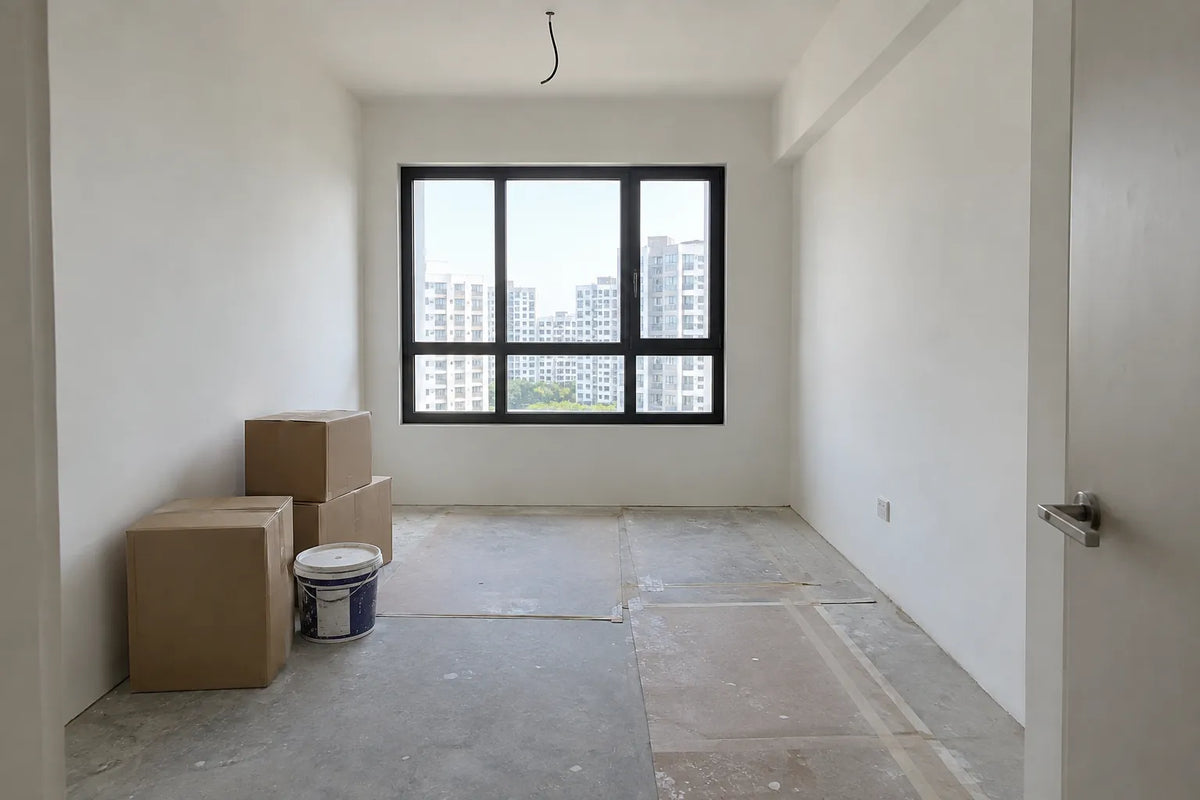

There is a moment in almost every Singapore renovation conversation where a homeowner says, "We just want to knock down this one wall to make the kitchen feel bigger." Sometimes the wall comes down without a problem. Sometimes it does not. The difference between those two outcomes is not luck. It is a permit, a properly identified wall, and — for certain works — a Professional Engineer who has done the calculations.
This guide is the conversation we have with our own clients before any sledgehammer touches concrete. Wall hacking in HDB flats is one of the few areas of renovation where getting it wrong is not just expensive. It can be unsafe to the structure of the entire block, and it can attract enforcement action under the Building Control Act and HDB's renovation rules.
We are RCS Renovation Specialists — HDB Licence HB-11-5877Z (verifiable via HDB's Directory of Renovation Contractors), BCA-registered, and bizSAFE Level 3 certified. Every regulatory statement below has been cross-checked against the relevant Singapore authority, with the source linked inline. Where we quote a price, it is our own published rate.
What "Wall Hacking" Actually Means in HDB Terms
In day-to-day talk, "hacking" covers everything from chiselling off bathroom tiles to demolishing a full partition wall. In the HDB renovation framework, it is more specific. Hacking refers to the removal or demolition of a wall, floor finish, or reinforced concrete (RC) feature such as a lintol, hanger, or stiffener.
Three categories matter for permit purposes, summarised from HDB's official Important Information on Renovations page:
-
Demolition of a non-load-bearing partition wall. Permitted with a written renovation permit, subject to specific conditions and a 3-consecutive-day execution window.
-
Removal of floor or wall finishes (e.g. tiles, screed). Permitted with a permit. For BTO flats, additional restrictions apply during the first three years (see below).
-
Hacking of structural reinforced concrete elements — load-bearing walls, columns, beams, floor slabs, staircases, refuge shelter (household shelter) walls. Prohibited. No permit, no exception, no engineer endorsement can override this.
If a contractor tells you they can "hack just a bit" of a load-bearing wall to widen a doorway, the conversation should end there. There is no legal pathway for that work in an HDB flat.
The Single Most Important Rule: Identify the Wall Before You Plan Around It
Every HDB renovation that involves wall removal starts with one question: is the wall structural or non-structural? Get this wrong, and the rest of the project either does not happen or has to be redesigned around the wall you cannot touch.
How Load-Bearing Walls Are Identified
On your HDB-issued floor plan, load-bearing walls are typically marked with thick, solid black lines, while non-structural partition walls are usually shown as thinner or hatched lines. Wall thickness is also a strong signal — load-bearing walls in modern HDB flats are commonly 150 mm or thicker reinforced concrete, while partition walls are often 100 mm or thinner and made of lightweight materials.
If you cannot tell from the floor plan alone — and many homeowners genuinely cannot — engage a Professional Engineer (PE) registered in the Civil & Structural (C&S) branch to verify. PE involvement for residential wall verification typically falls in the range of S$800 to S$2,000 in our experience, depending on scope. The fee varies by PE firm and the complexity of the work, so always request a written quote.
Why Hacking Load-Bearing Walls Is Off-Limits
The prohibition is grounded in the Building Control Act and its subsidiary Housing & Development (Renovation Control) Rules 2006. Load-bearing walls carry the load of every floor above yours. Hacking even a section of one can compromise the structural integrity of the block — not just your unit, but every flat above and adjacent.
For the underlying engineering and compliance principles, the regulator is the Building and Construction Authority (BCA). HDB layers its own renovation rules on top through the Important Information on Renovations page and the Renovation Guidelines for Building Works.
The HDB Renovation Permit — What Triggers It
Not every kitchen refresh needs a permit. But anything involving wall hacking, demolition, structural alteration, plumbing relocation, or major electrical work crosses into permit territory.
Works That Require a Written Permit
Based on HDB's Application for a Renovation Permit page and the Renovation Guidelines for Building Works, works that need a permit include:
-
Hacking down or demolishing any wall — HDB must verify the wall is non-structural and that its removal will not affect the structural integrity of the building.
-
Removal of existing floor finishes and replacement with new ones.
-
Floor hacking or raising greater than 50 mm.
-
Bathroom and toilet wet works, including tile removal (with the BTO 3-year rule below).
-
Relocation of any internal door where hacking the existing frame and creating a new opening is involved.
Works That Are Prohibited
Drawn from HDB's published building works guidelines, the following are not allowed:
-
Hacking structural reinforced concrete elements — walls, columns, beams, floor slabs, staircases.
-
Tampering with refuge shelter (household shelter) walls or doors. The shelter is part of Singapore's civil defence framework.
-
Works that affect the external facade beyond what is permitted.
-
Works that compromise fire safety routes or provisions.
The BTO 3-Year Rule
For BTO flat owners, HDB advises that you wait three years from the date of key collection before removing any wall or floor finishes in toilets and bathrooms. The rule protects the integrity of the original waterproofing membrane installed by HDB's appointed contractor, as explained on HDB's MyNiceHome homeowner education portal and the building works guidelines.
For resale flats, the 3-year window has typically lapsed by the time of purchase. All bathroom wet works still require permit approval regardless.
When a Professional Engineer Is Required — And When They Are Not
This is the area where homeowners get the most contradictory advice. Here is the precise position based on HDB's own published forms.
HDB's Published Position on PE Renovation-Plan Endorsement
HDB Form SED-054N is the acknowledgement form for PE supervision of demolition works on non-load-bearing reinforced concrete (RC) partition walls, hangers, stiffeners, or lintols. The form contains an explicit note (verbatim):
"There is no requirement for the Professional Engineer to endorse on renovation plan for HDB's approval."
In other words, for the routine demolition of a non-load-bearing RC partition wall that follows the SED-054N pathway, HDB does not require the PE's signature on the renovation plan submitted with the permit application. The role of the PE is to verify and supervise.
This is not a loophole. It is a workflow decision: HDB requires the PE to take responsibility for the wall identification and the demolition supervision rather than the paperwork on the plan itself. Other forms in the SED series may apply when the scope is different — for example where stiffener removal or more complex RC works are involved — and in those cases PE endorsement obligations may be different.
What the PE Actually Does (And Why You Engage One)
Per the SED-054N form, the engaged PE is responsible for:
-
Pre-demolition verification — confirming the wall, hanger, stiffener, or lintol is non-load-bearing and that its removal will not affect the structural integrity of the unit or the block.
-
Supervision of the demolition — ensuring the work is carried out without damaging adjacent structural elements.
Once HDB issues the renovation permit, the homeowner and contractor must furnish the approved plan and the permit conditions to the PE before work commences. The PE remains responsible for the supervision throughout.
When PE Engagement Is Effectively Required
While HDB's SED-054N pathway does not require PE endorsement on the plan, PE engagement is the practical standard whenever:
-
A wall, hanger, stiffener, or lintol containing reinforced concrete is being demolished.
-
The structural status of the wall is unclear from the floor plan alone.
-
The unit is older and the original drawings are not readily available.
-
The demolition is in proximity to a structural element.
Where to Verify a PE
The Professional Engineers Board (PEB) maintains the public Directory of Professional Engineers licensed to practise in Singapore. For renovation work, you want a PE registered in the Civil & Structural branch.
The Permit Application Process, Step by Step
Step 1 — Engage an HDB-Registered Contractor
Under the Housing & Development (Renovation Control) Rules 2006, only contractors listed in HDB's Directory of Renovation Contractors (DRC) can carry out renovation works in HDB flats and apply for permits on the homeowner's behalf. The DRC is publicly searchable. Verify any contractor's licence number on the directory before signing an agreement.
RCS is HDB-registered under licence HB-11-5877Z. Homeowners are encouraged to verify the licence directly on the HDB DRC search.
Step 2 — Prepare the Documentation
The contractor prepares the renovation drawings showing the proposed scope of work. For wall demolition, this includes the floor plan with the wall to be removed clearly marked, dimensions, and the demolition method. Where a PE is engaged, the PE provides written confirmation of the wall's non-structural status.
Step 3 — Electronic Submission
Renovation permit applications are submitted electronically through HDB's e-Service, accessible to HDB-registered contractors through the HDB Renovation Portal. Homeowners do not submit applications directly.
Step 4 — HDB Review and Approval
Processing time depends on the scope. Per HDB's renovation permit information, simpler applications can be processed within a few working days, while applications involving structural verification or PE-supervised demolition typically take longer. Always confirm the current processing timeline with your contractor at the time of application.
Step 5 — Permit Issued, Works Commence
Once issued, the renovation permit specifies the approved scope, the permit conditions, and the validity period. Works can only commence after the permit is in hand. Starting work without a permit, or deviating from the approved scope, exposes the homeowner to enforcement action.
What the Permit Actually Costs
This is where homeowners often get confused, because the answer has two parts.
HDB Direct Permit Fee
There is no separate, government-imposed application fee for the renovation permit on the homeowner side. The application is processed through HDB's e-Service at no charge. If a contractor presents you with a separate "HDB permit fee" line item, ask exactly what that figure represents. It is typically a contractor administration charge, not a government fee.
Contractor Service Fees and Ancillary Costs
Real costs sit in the contractor's quote and supporting professional fees. From RCS's published guidance:
-
Contractor permit-related administration — HDB e-Service processing time, drawing preparation, fire safety documentation where applicable, and site protection. Typical bundled cost: S$300 to S$800, depending on project complexity.
-
Professional Engineer consultation and supervision — typical residential range S$800 to S$2,000, depending on scope. Always request a written PE quote before commitment.
These ranges reflect RCS's market observations as of 2026 and are subject to change. Quotes should always be confirmed in writing before work begins.
The 3-Day Hacking Rule and Working Hours
Once the permit is issued, the actual hacking work has its own timing rules. These are the most-commonly-broken rules in Singapore renovation, and getting them wrong can lead to neighbour complaints and HDB enforcement action.
Hacking Must Be Completed Within 3 Consecutive Days
Per HDB's Important Information on Renovations page:
"Renovation contractors cannot take more than 3 consecutive days to demolish walls and/or remove wall/floor finishes."
And from the same HDB resource on the use of tools:
"Your renovation contractor can only use 2 handheld power tools approved by HDB or their equivalent at a given time. Such work must be completed within 3 consecutive days."
The rule exists to limit disturbance to neighbours, who experience the highest noise and dust intensity during demolition. A demolition that drags into a fourth or fifth day is a permit-condition breach.
Working Hours — Verbatim from HDB
This is the section of the original guidance most often misquoted on the internet. The correct rules, drawn directly from HDB's published Renovation Portal Terms and Conditions and the Important Information on Renovations page, are:
The point that catches many homeowners: hacking is "noisy renovation" and is therefore not allowed on Saturdays. It is a weekday-only activity, between 9:00 am and 5:00 pm, with general (non-noisy) finishing works permissible until 6:00 pm on weekdays and Saturdays.
For DIY drilling and hammering by homeowners (not contractors), HDB advises that such works be confined to between 7:00 am and 10:30 pm on any day, while still respecting neighbour concerns.
Site Protection and Common Areas
Your contractor is responsible for protecting common corridors, lift lobbies, and landings during demolition. Debris must not be left in common areas. Lift padding is the standard practice when transporting material. Town councils (for HDB precincts) or the MCST (for executive condominium and condo cases) may impose additional rules on top of HDB's framework.
Common Wall-Hacking Scenarios — A Realistic Walk-Through
Scenario 1: Open-Plan Kitchen by Removing the Kitchen-Living Partition Wall
In many HDB layouts, the wall between the kitchen and the living area is a non-load-bearing partition wall. Removing it creates the popular "open kitchen" or "dry-wet kitchen with island" layout. Generally permittable with the standard process — DRC contractor, permit application, PE confirmation if the wall is reinforced concrete, 3-day hacking window.
The catch: in some flat types and in older blocks, what looks like a partition wall is actually structural. Verification is non-negotiable.
Scenario 2: Master Bedroom En-Suite — Adding a Door or Wall
Creating a new en-suite bathroom typically involves removing or relocating an internal door and constructing a new partition wall. Internal door relocation requires a permit because it involves hacking the existing frame. Constructing the new partition wall in lightweight materials is generally permittable under the same renovation permit.
Scenario 3: Knocking Down a Wardrobe Wall to Enlarge the Bedroom
If the "wall" is a built-in wardrobe back panel rather than a structural wall, this is carpentry removal, not hacking. No permit required, no PE involved. If the wardrobe is integrated into a structural wall, the wall itself stays — only the carpentry comes out.
Scenario 4: Hacking Bathroom Tiles in a 2-Year-Old BTO
Generally not permitted under the BTO 3-year guidance. The waterproofing membrane installed by HDB must remain undisturbed during the first three years from key collection. Tile refresh in this window is typically done by overlay, not hacking.
Scenario 5: Hacking a Wall to Move the Front Door
The wall containing the main entrance is almost always structural, and the door frame itself is set into a structural opening. Relocation of the front door is generally not permittable.
Where Things Go Wrong — Five Patterns We See
After many projects, these are the patterns that turn a routine wall removal into an enforcement matter.
-
Hacking before the permit is issued. "We have applied, the permit will come" is not the same as having the permit. Works started before issuance are unauthorised.
-
Treating a "small" cut to a load-bearing wall as harmless. Even a horizontal channel cut into a reinforced concrete wall to run a pipe can compromise it. Any cut to a load-bearing element is prohibited.
-
Ignoring the 3-day hacking window and the weekday-only rule. Once demolition spills past day three, or onto a Saturday, the permit conditions are breached.
-
Skipping the PE for a "borderline" wall. When the floor plan is ambiguous, the cost of a PE consultation is far cheaper than rectifying an unauthorised demolition.
-
Using a non-DRC contractor for "just the hacking". Every renovation work in an HDB flat must be carried out by a DRC contractor. A subcontractor brought in directly by the homeowner is not compliant.
What Happens If You Hack Without a Permit
This is the section homeowners hope they will never need to read.
HDB Enforcement Action
HDB has the authority to issue a rectification order requiring the homeowner to restore the unit to its original state. The cost of restoration falls on the homeowner. For a demolished partition wall, restoration may be possible. For a hacked load-bearing wall, restoration may require structural reinforcement designed by a PE — a cost that can run into tens of thousands of dollars.
Building Control Act Penalties
Under the Building Control Act, building works carried out without prior approval of plans can attract serious penalties. As reported by The Straits Times in October 2024, citing BCA:
"Anyone who carries out building works without prior approval of plans may, on conviction, face a maximum fine of $200,000 or imprisonment for a term not exceeding two years, or both."
The Act is administered by BCA with HDB cooperation for HDB flats. The current text of the Building Control Act is published on Singapore Statutes Online.
Implications on Resale
An unauthorised structural alteration discovered during a future resale conveyancing check can derail the sale. The buyer's bank may decline mortgage financing on a unit with unrectified illegal works. Even if the sale proceeds, the buyer can require the seller to bear the cost of rectification.
Implications on Insurance
Most fire insurance and home contents policies exclude losses arising from unauthorised structural alterations. A claim made on a unit with illegal hacking can be repudiated. Always check your policy wording with your insurer.
RCS Hacking & Renovation Package Pricing (Published 2026)
Most homeowners do not buy "hacking" as a standalone service. It is bundled inside a renovation package that includes the demolition, the rebuild, the finishes, and the supporting trades. Here is RCS's own published pricing for the packages most relevant to wall-hacking projects:
Add-ons:
-
Professional Engineer consultation (where required): typical range S$800 – S$2,000 based on scope.
-
Permit-related administration: typical bundled cost S$300 – S$800 depending on complexity.
GST at 9% applies to goods and services in Singapore from 1 January 2024, per IRAS. A reputable contractor includes GST clearly in the quote rather than presenting it at signing.
Pricing reflects RCS's published rates as of May 2026 and is subject to change with material costs and project scope. All quotes are confirmed in writing before work begins.
Six Questions to Ask Before Signing a Hacking Quote
-
Is the wall I want removed structural or non-structural — and how do you know?
-
Will you engage a Professional Engineer for verification, and is the cost included in the quote?
-
What is your HDB licence number, and can I see it on the Directory of Renovation Contractors?
-
What is your plan to complete the hacking within the 3 consecutive days, weekdays only, between 9am and 5pm?
-
What does the permit-related administration cost cover specifically — HDB e-Service processing, PE fees, fire safety, site protection?
-
What is your defects liability period for hacking-related works such as tile reinstatement, waterproofing, and wall finishes?
A contractor confident in their compliance posture will answer all six without hesitation. A contractor who deflects is asking you to carry the regulatory risk.
Your Rights If Something Goes Wrong
Consumer Protection Framework
Renovation services in Singapore are covered by the Consumer Protection (Fair Trading) Act (CPFTA), administered by CCCS. Industry-specific guidance is published in the Fair Trading Practices for the Renovation Industry document. For renovation workmanship — which includes hacking, rebuilding, and reinstatement — your primary recourse is the contractor's defects liability period and the contract itself.
CASE Mediation and Small Claims
The Consumers Association of Singapore (CASE) provides mediation for renovation disputes. For monetary claims, the Small Claims Tribunals can hear cases up to S$20,000 (or up to S$30,000 with mutual consent), with a filing window of two years from the date the cause of action arose.
The Permit as Evidence
The permit itself is your strongest evidence in any dispute. It shows what was approved, what conditions applied, and what the contractor agreed to deliver. Keep a copy of the permit, the approved plan, and the PE's written verification (where applicable) in your renovation file.
Closing — A Small Honest Note from Us
Wall hacking is one of the few renovation decisions where the regulatory boundary is hard, not soft. There is no negotiating with a load-bearing wall, no creative interpretation of the BTO 3-year guidance, no shortcut around the Directory of Renovation Contractors. The process is designed to protect every household in your block — including yours.
The good news is that the process is also workable. A homeowner who engages a DRC contractor, applies for the permit through HDB's e-Service, engages a PE where appropriate, and respects the 3-consecutive-day hacking window during weekday hours can transform their flat with full regulatory clarity and no enforcement risk. We have done it many times.
If you are considering wall hacking and your contractor's quote does not address permit, PE, the 3-day window, and weekday working hours in writing, that is the moment to ask harder questions. The cost of a clean process is small. The cost of an enforcement order is not.
Frequently Asked Questions
Can I demolish a wall in my HDB flat without a permit?
No. Any wall demolition in an HDB flat requires a written renovation permit from HDB before works commence. This is true even for non-structural partition walls. The permit confirms the wall is non-structural and authorises the specific scope of work. See HDB's Application for a Renovation Permit page.
Does HDB require a Professional Engineer to endorse my renovation plan?
For routine demolition of non-load-bearing RC partition walls under the SED-054N pathway, HDB form SED-054N states: "There is no requirement for the Professional Engineer to endorse on renovation plan for HDB's approval." However, the PE is still engaged to verify the wall's non-structural status and supervise the demolition. For more complex structural changes, different SED forms may apply with different endorsement obligations. Confirm the applicable form with your DRC contractor.
How much does a Professional Engineer cost for residential wall verification?
Based on RCS's market observations, residential PE consultation typically falls in the range of S$800 to S$2,000, depending on scope. Always request a written quote.
How long does it take to get an HDB renovation permit?
Processing time depends on scope. Simpler applications can be processed within a few working days, while complex applications involving structural verification or PE-supervised demolition take longer. Confirm current timelines with your DRC contractor at the time of application.
Can I do hacking work on a Saturday?
No. Per HDB's Important Information on Renovations page, noisy renovation work — which includes wall hacking, demolition, removal of floor or wall finishes, tile cutting, and excessive drilling — is permitted only Monday to Friday, 9:00 am to 5:00 pm. Noisy work is not allowed on Saturdays, Sundays, or public holidays. General (non-noisy) renovation can continue on Saturdays between 9:00 am and 6:00 pm.
What happens if my hacking work goes past the 3-day window?
The 3-consecutive-day rule is a permit condition stated in HDB's renovation guidelines. Exceeding it is a breach and may result in enforcement action. The contractor's project plan should mobilise sufficient labour and equipment to complete hacking within 3 consecutive days during permitted weekday hours.
Can I hack the wall between my unit and the corridor to make a new entrance?
Generally not. The corridor-facing wall is part of the building envelope and is structural. Front door relocation is typically not permittable.
Can I remove a refuge shelter (household shelter) wall?
No. Household shelters are part of Singapore's civil defence framework and must remain intact in their original specification.
Related Reading from RCS
-
HDB Renovation Permit Singapore: Rules & Application Guide
-
Singapore Renovation Laws 2026: HDB & Condo Compliance
-
Toilet Waterproofing Singapore 2026: HDB 3-Year Rule and BCA Standards
-
Kitchen Carpentry Cost Per Foot Run Singapore 2026
-
Overlay vs Hacking HDB Bathroom Renovation 2026
Internal links to be inserted by the RCS publisher matching live URLs on the RCS blog.
Sources and Further Reading
Singapore Government and Statutory Bodies
Consumer Protection
Independent News Coverage
Disclaimer. This article is for general informational purposes only and does not constitute legal, engineering, or financial advice. All RCS pricing reflects published RCS Renovation Specialists package and consultation rates as of May 2026; rates are subject to change with material costs and project scope. Where regulations are summarised, readers should refer to the relevant authority — HDB, BCA, the Professional Engineers Board, NEA, IRAS, CCCS, or CASE — for the official, current wording. The Building Control Act and Housing & Development (Renovation Control) Rules 2006 govern the matters described in this guide; statutory references should be verified against the current text published on Singapore Statutes Online. RCS Renovation Specialists has no commercial relationship with any of the third-party entities named in this guide. Content is reviewed and updated periodically; please check the publication date and refer to the underlying sources for the most current information.
RCS Renovation Specialists | HDB Licence HB-11-5877Z (verifiable on the HDB DRC) | BCA Registered | bizSAFE Level 3
If a neighbour complains: wall hacking is the noisiest stage of any renovation. Read our guide to renovation noise complaints and who to contact before works begin.