

Toilet waterproofing in Singapore is governed by four specifications you can verify yourself: membrane dry-film thickness, substrate preparation, junction detailing, and a 24-hour ponding test. BCA publishes all four in its Good Industry Practices — Waterproofing for Internal Wet Areas guide, and SS 637:2018 extended the ponding test requirement from 12 hours to 24.
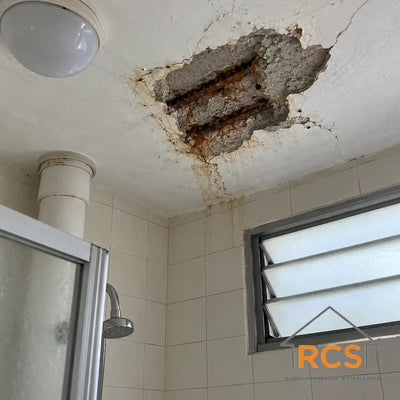
Most renovation defects announce themselves. A chipped tile is visible on day one. Waterproofing failure stays invisible until it appears on your neighbour's ceiling, and by then the problem is no longer only yours. Therefore this is the one specification worth reading properly before you sign.
Key Takeaways
- HDB imposes a 3-year restriction on removing wall and floor finishes in bathrooms and toilets of newly built flats (HDB).
- Overlay stays permitted inside that window. Hacking is the prohibited action.
- Cementitious membranes need 2–3 mm dry film. Polyurethane needs 1–1.5 mm. Acrylic needs a minimum of 1.2 mm with fibreglass reinforcement (BCA Academy).
- Flood-test timing differs by system. Cementitious is tested within 24 hours. Most polyurethane and rubber-based systems need 72 hours first.
- A 25 × 25 mm angle fillet belongs at every wall-to-floor junction, or fibreglass reinforcement fabric 150 mm wide.
- Cementitious systems want a damp substrate. Polyurethane, acrylic and rubber systems want a dry one, confirmed by moisture meter.
- Singapore Standards are voluntary unless a regulator makes them mandatory. They are still the benchmark a professional quote should reference.
The Three Regulators You Are Working Inside
Every HDB toilet renovation answers to three separate authorities, and each owns a different part of the job. Knowing which agency owns which rule tells you who to ask when a contractor's answer sounds thin.
HDB owns when you may touch the finishes. Newly built flats carry a 3-year restriction on removing wall and floor finishes in bathrooms and toilets. HDB also owns the permit: all demolition and hacking needs prior written approval, and your contractor submits the flat's floor plan with the electronic application (HDB).
BCA owns how the waterproofing is done. Its Good Industry Practices — Waterproofing for Internal Wet Areas, now in a second edition, sits within the CONQUAS Enhancement Series (BCA). Alongside it, SS 637:2018 replaced CP 82:1999 as the code of practice for waterproofing reinforced concrete buildings.
PUB owns the drainage and sanitary plumbing layer. Floor traps, waste-pipe falls and sewer connections fall under its regime rather than HDB's. Confirm the licensing requirement for your specific sanitary works before work starts — HDB's own water and sanitary plumbing guidance is the starting point.
One honest caveat on all three. Singapore Standards are voluntary in nature except where a regulatory authority makes them mandatory. Consequently a contractor who ignores SS 637 is not automatically breaking the law — but they are working below the published benchmark, and you should price that risk accordingly.
What the BCA Guide Actually Specifies
BCA publishes minimum dry-film thickness by material type, and the numbers are not interchangeable. A contractor who says "we apply waterproofing" without naming the system has given you an unverifiable scope. Ask which system, then check it against this table.
| Membrane system | Dry film thickness | Main characteristic |
|---|---|---|
| Cementitious | Between 2 and 3 mm | Easy application, excellent compatibility with concrete, good vapour permeability |
| Polyurethane | Between 1 and 1.5 mm | Good flexibility, excellent adhesion to concrete, good tearing strength |
| Acrylic | Minimum 1.2 mm (due to fibreglass reinforcement) | Good UV resistance, flexible, needs 4–5 coats minimum |
| Rubber-based | Generally 0.8 to 1.5 mm recommended | Highly flexible, excellent resilience to cyclic movement |
Source: BCA Academy — Good Industry Practices, Waterproofing for Internal Wet Areas.
Cementitious systems dominate HDB toilet work for a specific technical reason. They bond excellently to concrete on both slabs and vertical walls, and their adhesion is not affected by surface dampness. Notably, that last property matters in a Singapore wet area.
BCA also asks that test certificates for the chosen product be submitted to confirm compliance with the stated specification. Ask for them. A specialist has them on file.
Substrate Preparation: The Half of the Job You Cannot See
Membrane failure usually traces back to what happened before the first coat. BCA treats surface preparation as the single most important factor in performance, and its requirements are specific enough to audit on site.
The concrete must be free of scale, laitance, dust, mould, form oils, wax and curing agents. Non-structural cracks get cut out to a minimum depth of 25 mm in a V or U profile, then plastered back with non-shrink grout. Sharp protrusions get ground off. Sharp external corners get ground to a smooth radius. Honeycombing gets hacked back to sound concrete first.
Three field tests confirm the surface is ready, and you can watch all three. Wipe the surface with a dark cloth — excessive white powder means it is too dusty. Sprinkle water — standing droplets mean it is oily. Scrape with a knife — loose powdery material means laitance is still present.
Then comes the counter-intuitive part. Cementitious systems require a damp surface to improve adhesion, so the applicator removes lying water and pre-saturates the substrate before the first coat. Polyurethane, acrylic and rubber systems require the opposite, confirmed by a correctly calibrated moisture meter.
Junction Detailing: Where Failures Actually Start
Most Singapore waterproofing failures are junction failures, not membrane failures. The material rarely fails. The interface between the material and a floor trap, a pipe penetration or a wall base fails, and water bypasses a perfectly good membrane entirely.
BCA specifies a continuous angle fillet of 25 × 25 mm at the wall-to-floor junction, mixed 1:3 cement to sand with a 1:4 bonding agent and water. Its purpose is mechanical: it makes the joint gradual enough for the membrane to sit on without bridging a sharp corner. As an alternative, reinforcement fabric such as fibreglass mat 150 mm wide may be used.
At pipe penetrations, three conditions apply. The portion of pipe inside the slab must have no joints. A slight upward-sloping fillet must surround the protrusion to carry the membrane upturn. And water outlets must be cast flush with floor level so the membrane can be dressed down cleanly.
Wall upturn height follows the designer's specification and the manufacturer's requirement. BCA's own illustrations show walls rendered to 300 mm with fillets installed at corners, and require rendering at shower areas, long baths, wall-hung basins and cisterns to the specified heights. Ask for the number in writing rather than accepting "we go up a bit".
One further detail worth checking: the finished floor level of the wet area should sit lower than the slab of adjacent dry areas. That single level difference stops water migrating into your bedroom floor.
The Ponding Test: The Only Proof That Matters
The ponding test is the only way to confirm the membrane is intact before tiles go down, and SS 637:2018 extended the requirement from 12 hours to 24 hours. The applicator plugs the floor trap and drain points, floods the wet area, and holds the water for the full period. Any unexplained drop, or any seepage visible below, fails the test.
Timing depends on the system, and this is where schedules slip. Cementitious membranes are flood-tested within 24 hours, because the water assists curing. Acrylic systems need 48 hours before the flood test. Most polyurethane systems and rubber-based systems need 72 hours. Coal-tar-based polyurethane needs 7 to 10 days.
BCA also expects two separate watertightness checks, not one. The first happens during surface preparation, before the membrane goes on — a structural watertightness test. The second happens after membrane application, before screed or floor finishes.
Insist on being present at the start and the end of the ponding test. Photograph both, with time stamps. A contractor who declines homeowner observation has told you something.
The HDB 3-Year Restriction, Decoded
Newly built HDB flats carry a 3-year restriction period on the removal of wall and floor finishes in bathrooms and toilets. HDB states this in its renovation guidelines for building works, and the purpose is to protect the original waterproofing membrane installed during construction.
Confirm the exact start reference for your own block with HDB. Published guidance describes the restriction period without a single universal trigger date, and homeowners commonly hear both key collection and TOP quoted. Therefore treat the start date as a question for your HDB branch, not an assumption.
What the restriction prohibits: removing or hacking bathroom wall tiles, removing or hacking bathroom floor tiles, removing any wall or floor finish in the wet area, and disturbing the membrane beneath.
What the restriction still allows: overlaying existing tiles with new tiles, replacing the WC, basin, taps, mirrors and accessories, replacing the shower system and screen, replacing the water heater, repainting dry areas, and re-grouting existing joints.
Breaching it carries two consequences. HDB may require reinstatement to original condition at your cost. More expensively, disturbing the original membrane shifts liability for any subsequent leak — to your own floor or to the unit below — onto you.
Resale flats past the restriction period are not affected. Full hacking, re-waterproofing and re-tiling become available, subject to the permit your registered contractor submits.
Overlay: The Compliant Route, and Its One Constraint
Overlay is what most BTO owners actually do, and it works because it never touches the membrane. New tiles go directly over the existing finish, which keeps you inside the restriction while still changing the room completely.
The constraint is thickness. HDB's renovation guidelines cap floor tile thickness inclusive of adhesive, and the figure in the guidelines document reviewed for this article is 13 mm. Confirm the current limit for your flat type before selecting tiles, because slim porcelain and thick natural stone behave very differently against that ceiling.
Two practical consequences follow. Your finished floor rises, so the bathroom door may need trimming to clear it. And the wet-area-lower-than-dry-area principle still has to hold after the overlay, not before it.
Full method comparison sits in Overlay vs Hacking HDB Bathroom Singapore 2026. The regulatory side is covered in HDB Bathroom Renovation Rules & Restrictions.
Six Questions That Sort Specialists From Tilers
Ask these six in writing. The answers separate a contractor who understands waterproofing as a system from one who treats it as a coating.
- Which membrane system, and which brand? A specialist names both. "We apply waterproofing" is not an answer.
- What dry-film thickness, across how many coats? Cementitious should reach 2–3 mm. A single thin coat does not.
- What upturn height at the walls, and where? Expect a specified number, and rendering carried to that height at shower and basin zones.
- How long before the ponding test, and how is it documented? The answer should match the system: 24 hours for cementitious, 72 for most polyurethane.
- How are floor traps and pipe penetrations detailed? Listen for angle fillets, jointless pipe within the slab, and outlets cast flush.
- What workmanship warranty applies to the waterproofing layer specifically? Get the duration and the exclusions, separately from the general renovation warranty.
Five Failure Modes, and What Causes Each
Insufficient thickness. A single coat of cementitious membrane delivers roughly half the specified dry film. It passes visual inspection. Pinhole defects then multiply during curing, and damp patches appear below within the first 18 months.
Truncated or missing wall upturn. When the membrane stops at the floor line, splash water travels behind the wall tiles. The damage surfaces on the far side — typically as a damp patch on the bedroom wall adjoining the toilet.
Poorly detailed traps and penetrations. Without a fillet and a clean dress-down at the floor trap, water enters at the junction and bypasses the membrane completely. This failure is mechanical, not chemical.
Damage during follow-on works. Screeding, heavy hammering or incompatible adhesives can puncture or degrade a cured membrane. BCA is explicit that remedial work after membrane application should be avoided, that the specialist must be consulted where it is unavoidable, and that the area should be cordoned off until protection or screed is laid.
Wet-to-dry boundary breach. Open shower zones blur the boundary. If the membrane does not cover the full wet zone as designed, and if the wet-area floor level is not lower than the adjacent slab, water tracks into the dry area and under adjoining flooring.
What to Do If You Suspect a Failure
Symptoms arrive in a predictable sequence, and the cost of fixing them rises at every stage.
Stage 1 — cosmetic (months 6–18). White efflorescence on grout, persistent damp at the wall-floor junction, mould returning within days of cleaning.
Stage 2 — seepage (months 12–24). Water marks on the bedroom wall adjoining the toilet, peeling paint at the wall base outside the toilet, dampness on the ceiling below.
Stage 3 — active leak. Visible dripping in the unit below, swollen door frames, concrete staining.
The escalation path
- Notify the contractor in writing, inside the warranty period, with dated photographs.
- Request an inspection and a written rectification proposal within a defined period.
- If liability is disputed, approach CASE. The Consumers Association of Singapore handles consumer disputes and publishes the available legal options.
- For a claim against the contractor, consider the Small Claims Tribunals. The claim limit is $20,000, rising to $30,000 where both parties sign a Memorandum of Consent, and every claim must be filed within 2 years of the cause of action (Singapore Courts).
- Note the exclusion for neighbour disputes. The Small Claims Tribunals do not hear disputes between neighbours. Those fall to the Community Disputes Resolution Tribunals under the Community Disputes Resolution Act 2015. For inter-unit water damage, HDB and the Town Council may also issue inspection notices.
What RCS Toilet Packages Cost in 2026
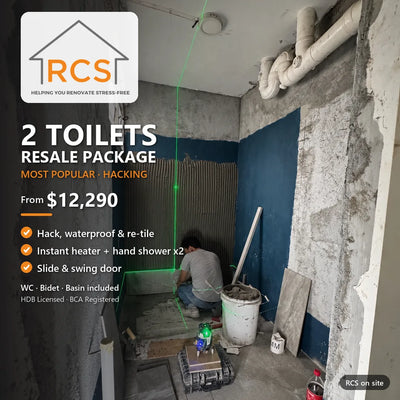
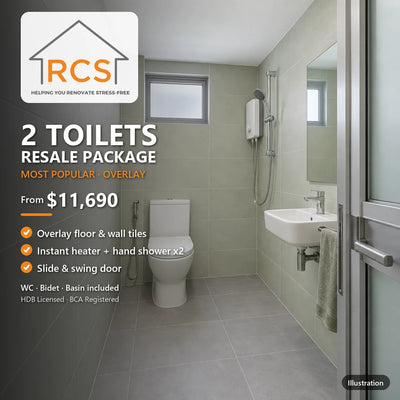
RCS publishes all ten two-toilet packages with fixed prices, which means you can benchmark any quote against a live figure. Prices below are current product-page listings as at 27 July 2026.
| Package | Method | Price |
|---|---|---|
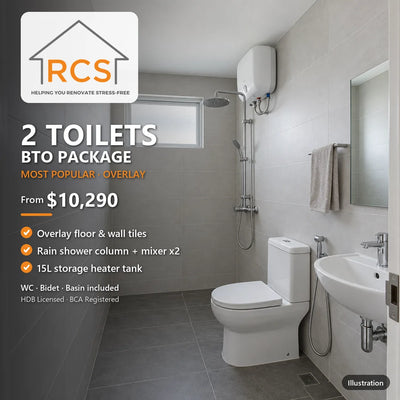
| 2 Toilets BTO — Most Popular | Overlay | S$10,290 |
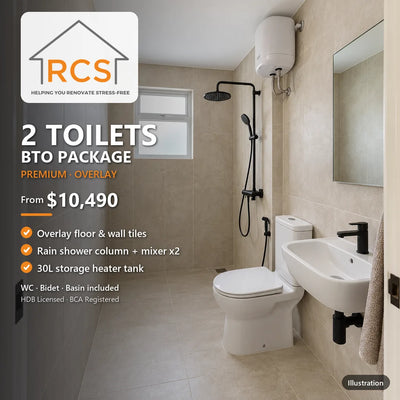
| 2 Toilets BTO — Premium | Overlay | S$10,490 |
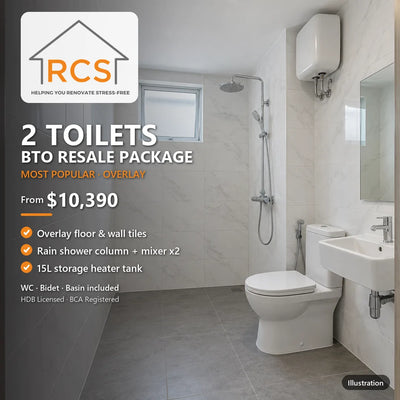
| 2 Toilets BTO Resale — Most Popular | Overlay | S$10,390 |
| 2 Toilets BTO Resale — Premium | Overlay | S$10,590 |
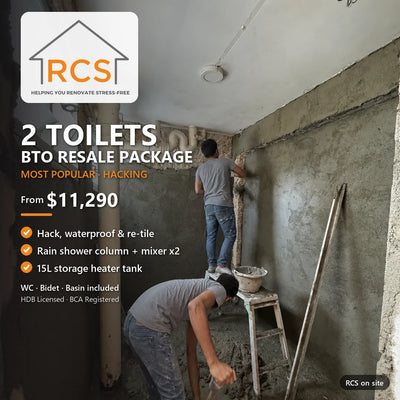
| 2 Toilets BTO Resale — Most Popular | Hacking | S$11,290 |
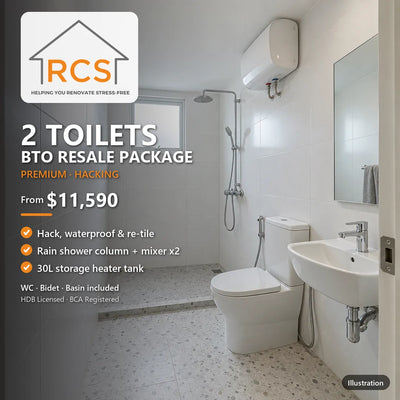
| 2 Toilets BTO Resale — Premium | Hacking | S$11,590 |
| 2 Toilets Resale — Most Popular | Overlay | S$11,690 |
| 2 Toilets Resale — Premium | Overlay | S$11,990 |
| 2 Toilets Resale — Most Popular | Hacking | S$12,290 |
| 2 Toilets Resale — Premium | Hacking | S$12,590 |
Read the table by condition, not by budget. BTO owners inside the restriction period take an overlay package, because hacking is not available to them. Resale owners with sound substrate take overlay. Resale owners with failing tiles take hacking, and the hacking tier is where new waterproofing is actually installed.
Browse the full scope on each product page: toilet renovation packages. Deeper package analysis sits in 2 Toilet Renovation Package Singapore 2026.
Frequently Asked Questions
Is HDB toilet waterproofing covered by a warranty?
HDB installs the original membrane in new flats, and the 3-year restriction on removing wall and floor finishes exists to protect it. Once you install new waterproofing after that period, the cover comes from your renovation contractor's own workmanship warranty. Confirm its duration and exclusions in writing.
Can I choose a different membrane from the one my contractor proposes?
Yes. BCA's guide covers cementitious, polyurethane, acrylic and rubber-based systems, each with its own minimum dry-film thickness. Cementitious dominates HDB work because it bonds excellently to concrete and tolerates surface dampness. Polyurethane suits substrates prone to micro-movement.
How long should a ponding test run?
SS 637:2018 extended the ponding test requirement from 12 hours to 24 hours. The wait before testing differs by system: cementitious is tested within 24 hours of application, acrylic after 48 hours, and most polyurethane and rubber-based systems after 72 hours.
Do I need a licensed plumber for toilet waterproofing?
Membrane application itself is not sanitary plumbing work. However, relocating a floor trap, altering waste-pipe falls or creating new drainage connections falls under PUB's sanitary plumbing regime. Confirm the licensing requirement for your specific scope before those works begin.
Is there a separate waterproofing permit?
No. The HDB renovation permit covers the bathroom works as a whole, and your contractor submits the application electronically with the flat's floor plan. The contractor must be listed in HDB's Directory of Renovation Contractors before any work starts.
What minimum thickness will HDB accept?
HDB does not publish a unit-by-unit membrane acceptance figure. The working reference is BCA's guide: 2–3 mm for cementitious, 1–1.5 mm for polyurethane, and a minimum of 1.2 mm for acrylic with fibreglass reinforcement.
Can I waterproof the floor only and skip the walls?
Technically possible, but it is the wrong specification for a wet area. Splash and capillary action carry water up the wall behind the tiles. BCA requires rendering to the specified upturn height at shower areas, long baths, wall-hung basins and cisterns for exactly this reason.
Is condo toilet waterproofing different from HDB?
The technical benchmark is identical — BCA's guide and SS 637:2018. The approval route differs. Condo works answer to the MCST rather than HDB, and walk-in shower designs more often require full-height membrane on wet-zone walls.
How do I check on site that the standard is being followed?
Ask for four things: the product specification sheet showing dry-film thickness, photographs of the upturn at each wall, time-stamped photographs of the ponding test start and end, and the system brand. BCA also expects an Inspection and Test Plan from the contractor and Material Safety Data Sheets on site.
Get the Waterproofing Specified Before You Sign
The cost gap between correct and incorrect waterproofing at renovation stage is small. The gap eighteen months later — re-hack, re-waterproof, re-tile, plus the neighbour's ceiling — is not. Treat the membrane as the most important line in the quote, and hold it against BCA's guide and SS 637:2018 before you commit.
RCS delivers waterproofing as part of every toilet renovation package, applying cementitious systems to BCA good-practice specifications with documented ponding tests. RCS holds HDB Renovation Contractor Licence HB-11-5877Z, is BCA-registered, holds bizSAFE Level 3 and maintains PMI membership — all verifiable on the respective registries.
Speak to the RCS team on WhatsApp →
Comparing contractors: use the six questions above on every quote, then compare firms in our guide to HDB bathroom contractors in Singapore.