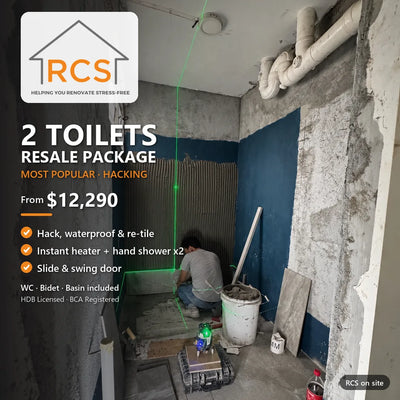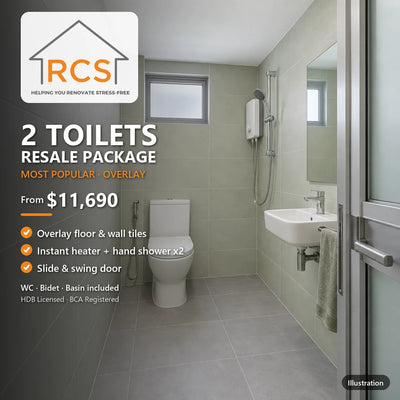

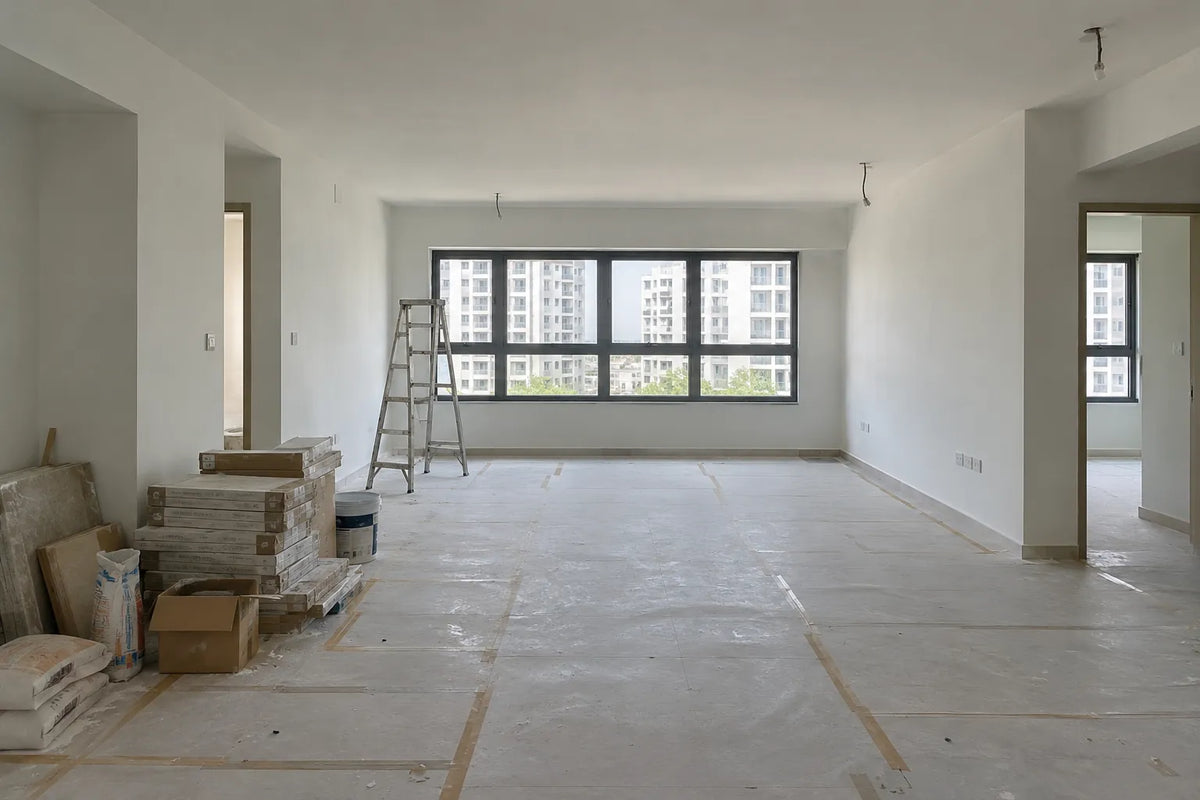

You have the quote in front of you. Two lines, same flat, same rooms: one says S$31,290, the other says S$39,990. The only difference is the word "hacking".
On a 5-room HDB flat, choosing hacking over vinyl overlay costs S$8,700 more — and in most flats it changes nothing you will ever see. Hacking is a remedial method, not a quality upgrade. It is the right answer in four specific situations. Outside those four, it is the most expensive decision available to you, and it is the one homeowners most often get backwards.
This article is about how to tell which flat you have.
The 5-room hacking premium, in numbers
Package prices verified against the live store on 28 July 2026, in SGD:
| 5-room package | Vinyl overlay | With hacking | Difference |
|---|---|---|---|
| Whole House Resale — Most Popular | 31,290 | 39,990 | 8,700 |
| Whole House Resale — Premium | 32,990 | 41,590 | 8,600 |
| Whole House BTO Resale — Most Popular | 24,990 | 33,990 | 9,000 |
| Whole House BTO Resale — Premium | 25,990 | 34,990 | 9,000 |
Between S$8,600 and S$9,000, every line. That is the single largest optional number in a 5-room renovation.
Why 5-room flats carry the biggest penalty
The hacking premium scales with floor area, not with room count. A 3-room resale flat carries a S$5,000 gap. A 5-room resale flat carries S$8,700. That S$3,700 spread is more square metres of screed to remove, more debris to cart away, and more labour days on site.
Disposal is charged by volume. It is a real line item, not padding — which is exactly why the number grows with the flat.
Compare it against the upgrade you probably want more
Here is the comparison almost nobody runs. On a 5-room resale flat, moving from Most Popular to Premium costs S$1,700 and changes material specification throughout the entire flat. Hacking costs S$8,700 and changes the layer underneath your floor.
Five times the money, for the thing you cannot see. If your floors are sound, the ranking is not close.
When does hacking actually earn the S$8,700?
Four situations, and they are checkable before you commit:
- The existing floor is uneven — a dipped or humped screed telegraphs straight through an overlay.
- Waterproofing has failed — overlaying a failed wet area traps the fault and makes the eventual repair far more expensive.
- Floor height cannot absorb the overlay — where door clearance or thresholds are already tight, added height causes binding doors and trip edges.
- You are moving walls — layout changes expose the slab anyway.
If none of those four describes your flat, you are being asked to pay S$8,700 to recreate a condition you already have.
How to check your own floor before anyone quotes you
You do not need a contractor to run the first check, and you should not wait for one. Put a long spirit level or a straight edge across the floor in each room and look for daylight underneath. Open and close every door and look at the clearance at the threshold. In the bathrooms, look at the ceiling of the unit below if you can, and at your own skirting for staining.
That is a twenty-minute inspection that decides an S$8,700 line item. Take photographs while you do it — they are the single most useful thing you can bring to a site assessment.
The advice we would push back on
The most persistent belief in Singapore renovation is that hacking equals quality and overlay equals cutting corners. It is wrong, and it is expensive.
Hacking is remedial. It exists to fix a substrate that has failed. Where the substrate is already sound and level, hacking spends thousands of dollars to arrive at the condition you started with — then adds demolition days, dust, debris disposal and screed curing time to your programme.
We are not saying this because overlay is easier for us. We are saying it because a contractor who quotes hacking without inspecting your floors is guessing with your money, and the guess costs you between S$8,600 and S$9,000.
Is vinyl overlay bad for resale value?
No, and there is an argument it is better. Overlay is reversible in a way hacking is not. A future owner can lift vinyl and start again without touching the slab, which keeps their options open and their cost down.
Hacking is a one-way door. It resets the datum to the slab permanently, and the next owner inherits whatever screed you laid.
What overlay removes from your schedule
Vinyl overlay skips demolition and skips screed curing. Both sit at the front of the programme, so removing them compresses the timeline meaningfully — and noise-generating works are constrained by HDB permitted hours anyway, which caps how much demolition can happen per day.
Our guide to HDB drilling and renovation hours covers what those limits are.
Where the waterproofing exception bites hardest
Of the four hacking conditions, failed waterproofing is the one to take most seriously, because the consequence is not your flat. Water reaching the unit below becomes a dispute with a neighbour and a liability that escalates.
Read how inter-floor leak responsibility is decided and what a waterproofing quote should contain. If there is any sign of failure, this is the flat where hacking earns its money.
The uneven-floor test, in practice
Tile popping and lifting is a symptom worth recognising, because it points at the substrate rather than the tile. Our write-up on why tiles pop in HDB flats explains what is happening underneath and when it forces a hack.
Bathroom floors are a separate decision from bedroom floors
The hacking question is usually discussed as though it applies to the whole flat at once. It does not have to.
Wet areas and dry areas fail differently. A bathroom can need a full strip because its membrane has gone, while the bedrooms three metres away sit on a perfectly sound screed that would accept an overlay tomorrow. Treating those as one decision is how homeowners end up paying the full S$8,700 to fix a problem confined to two rooms.
Ask for the assessment room by room. A contractor who cannot tell you which rooms need what has not looked properly.
The debris question nobody asks
Hacking a 5-room flat produces a genuinely large volume of broken screed and tile, and disposal is charged by volume rather than by the hour. That is most of why the premium scales with floor area instead of room count.
It also has a practical dimension people forget until it starts. Debris has to leave through the same lift and corridor your neighbours use, on the same permitted-hours schedule as every other noisy trade. Removal is not a background activity; it occupies days at the front of the programme, and those days are visible to everyone on your floor.
What hacking does to your neighbours
Demolition is the loudest phase of any renovation, and it lands in the first weeks rather than being spread across the job. In a block of flats that concentration matters more than the total noise.
Working strictly inside permitted hours is the whole defence, and giving your immediate neighbours notice before demolition week costs nothing. Our guide on how renovation noise complaints are handled sets out what happens when it goes wrong, and who gets contacted.
What a proper floor assessment looks like
A real assessment is physical. Someone puts a straight edge across the floor in each room, checks door clearances at the thresholds, looks at the skirting for moisture staining, and inspects the bathrooms specifically for signs the membrane has failed.
What it is not: a glance from the doorway followed by "we recommend hacking to be safe". That sentence costs S$8,700 and contains no information. If you hear it, ask which of the four conditions the flat actually meets, and where.
If your quote does not mention the substrate
Here is a simple filter you can apply to every quote you receive. Look for the word "screed", or "substrate", or "levelling". If a quotation proposes hacking without describing the condition of what is being removed, it has not been priced from an inspection.
That is not necessarily dishonesty. Quoting hacking by default is easier and carries no risk for the contractor — if the floor turns out to be fine, nobody complains that it was over-specified. The cost of that convenience is simply transferred to you, and it is between S$8,600 and S$9,000.
So ask the question that makes the assumption visible: what did you find under the existing floor, and what would change your recommendation?
How this fits your whole-house package
The hacking decision sits inside the whole-house package rather than beside it. Every RCS whole house package covers all rooms in the flat under one contract: hacking or overlay, tiling, carpentry, plumbing, electrical works, painting and cleaning.
For the complete ladder across every flat size and tier, see our whole house renovation package costs guide, and for the kitchen-specific version of the same decision, kitchen overlay versus hacking.
Resale package or BTO resale package?
The two families answer flat condition, not flat age on paper. Resale packages cover older flats needing full stripping. BTO resale packages cover newer flats in sound condition where less demolition is required, and run roughly S$6,000 lower for the same flat size and tier.
A 5-room BTO resale flat with vinyl starts at S$24,990. The same 5-room on a resale package with hacking reaches S$39,990. Same flat type, S$15,000 apart, entirely on condition and method.
What changes if you are a BTO owner collecting keys
If you are taking keys on a new 5-room flat, the answer is almost always overlay, and the numbers reflect it. A 5-room BTO resale package with vinyl starts at S$24,990 against S$33,990 with hacking — a S$9,000 gap on a flat whose floors were laid months ago and have never been loaded.
The four hacking conditions describe failure modes that take years to develop. A flat that has not been lived in yet has had no opportunity to develop them. Unless you are moving walls, the case for hacking a new BTO flat is very hard to make.
What the package does not cover
Three costs sit outside almost every renovation quotation in Singapore, and they arrive at the worst moment:
- Temporary accommodation — a whole house renovation takes the kitchen and bathrooms offline at once.
- Appliances and loose furniture — packages cover built-in works only.
- Permit and administrative items — your contractor applies, but responsibility sits with you as the flat owner.
How long will a 5-room whole-house renovation take?
Duration depends on scope and on whether hacking is involved. Hacking adds demolition and disposal days at the front, then requires screed curing before tiling starts. Overlay skips both. Our stage-by-stage HDB renovation timeline sets out the sequence.
The order to make your decisions in
Most 5-room budgets go wrong because the decisions are made in the wrong sequence. This is the order that keeps the money where it does the most visible good:
- Establish the substrate condition first, room by room, with photographs.
- Decide hacking or overlay per area based on that evidence, not on a blanket recommendation.
- Choose the package family — resale or BTO resale — from flat condition.
- Choose the tier last, because it is the smallest number of the four at S$1,700.
Run it in that order and the tier upgrade you actually want is usually affordable, because it is being funded by a hacking premium you did not need to pay.
Does my estate change the answer?
Package prices stay consistent across Singapore because quotes are based on flat type and scope, not postcode. What estate changes is which package family fits, because build era changes condition. Older estates skew towards resale packages; newer blocks skew towards BTO resale.
Estate-level detail is available for Toa Payoh, Clementi and Bukit Batok, plus a flat-level guide for 5-room flats in Bedok.
How big is a 5-room flat, exactly?
Floor area is what drives the hacking premium, so it is worth knowing your actual number rather than the nominal flat type. Our HDB flat size guide compares 3, 4 and 5-room dimensions.
If you are renovating to sell
The arithmetic inverts when you are preparing a flat for sale after MOP, because you have to recover the spend in the sale price. An S$8,700 hacking premium is very hard to recover on a resale listing. Read our MOP renovation guide before committing budget you may not get back.
Verify the contractor before the deposit
Three things in writing before money moves: the HDB Registered Renovation Contractor licence number, a payment schedule tied to completed and inspectable stages, and a written room-by-room scope. We operate under HDB Licence HB-11-5877Z and hold BizSafe Level 3 — cross-check it independently rather than accepting a screenshot, using our guide to HDB licensed contractors.
Working to a tighter budget
If the 5-room numbers are above where you need to be, the entry point across the whole range sits lower on smaller flats and BTO resale packages. Our cheapest whole house package guide lays out where the floor actually is.
Bring four things and we will settle it in one visit
Photographs of your existing floors and bathrooms, your flat type and floor area, your target move-in date, and a written list of the rooms you want changed. The floor photographs matter most, because they are what determine whether you pay the hacking premium or keep it.
We will tell you which of the four hacking conditions your flat meets, if any — before a figure is committed, not after. Guessing wrong in either direction costs between S$8,600 and S$9,000.
WhatsApp or call +65 8784 8742, or email rcs@renovationcontractorsingapore.com. You can also compare the full 5-room resale renovation packages directly.
Frequently asked questions
How much more does hacking cost on a 5-room HDB flat?
Between S$8,600 and S$9,000 across all four 5-room whole house package lines. On the Whole House Resale Most Popular tier, vinyl overlay is S$31,290 against S$39,990 with hacking — a difference of S$8,700. Prices verified against the live store on 28 July 2026.
Do I need to hack my HDB floor?
Only in four situations: the existing floor is uneven, waterproofing has failed, floor height cannot absorb an overlay, or you are moving walls. Where the substrate is sound and level, vinyl overlay delivers the same visual result for thousands less.
Is vinyl overlay bad for resale value?
No. Overlay is reversible — a future owner can lift the vinyl without touching the slab. Hacking permanently resets the floor datum. Neither method is inherently better for resale; the condition of the finished floor matters more than the method used.
Why do 5-room flats have a larger hacking premium than 3-room?
The premium scales with floor area rather than room count. A 3-room resale flat carries a S$5,000 gap against S$8,700 for a 5-room. The difference is more screed removal, more debris disposal charged by volume, and more labour days on site.
What is the cheapest 5-room whole house package?
The Whole House BTO Resale package on the Most Popular tier with vinyl overlay, at S$24,990. That suits flats in sound condition needing minimal demolition. Older 5-room flats requiring full stripping take a resale package instead, from S$31,290.
Does the Premium tier change which rooms are covered?
No. Both tiers cover the same scope across the whole flat. Premium changes material specification and finish quality only. On a 5-room vinyl package the tier difference is S$1,700, against S$8,700 for the hacking decision.
Disclaimer
All package prices stated were verified against the Renovation Contractor Singapore online store on 28 July 2026 and are subject to change. Final pricing depends on site conditions, measured scope and material selection confirmed after a site assessment; this article is not a quotation or a contract. HDB renovation rules, permit categories and permitted working hours are set by the relevant Singapore authorities and may be revised — verify current requirements with HDB and BCA directly. Guidance on when hacking is required reflects general construction practice and does not replace an on-site assessment of your flat. Renovation Contractor Singapore — HDB Licence HB-11-5877Z, BizSafe Level 3.