SingRank Singapore
The moving truck is booked. The EC has a buyer. And somewhere between the sale agreement and the new keys, most households discover that a downgrade from EC to HDB is not just a smaller mortgage — it is a smaller floor plan, a different permit system, and a renovation brief that has to be rewritten from scratch. Every EC owner planning this move asks the same practical question first: will my furniture even fit?
This guide is written for households selling an EC to buy an HDB flat, whether that flat is a resale unit or a fresh BTO. We focus on the part nobody else covers well — the renovation-planning and execution side of the move: layout, permits, storage, timeline, and budget. If you are also asking should I downgrade from EC to HDB, the honest answer depends less on price and more on whether your household can adapt its layout habits to a smaller, more tightly regulated home.
An EC to HDB flat transition means swapping MCST-approved renovation with a refundable deposit for HDB's DRC-contractor system and fixed permit validity windows — 3 months for BTO, 1 month for resale, per HDB.
By the end of this guide, you will know what actually changes in your renovation process, how to plan storage for a smaller footprint, and where your budget needs to shift when moving from condo to HDB renovation. We cover eligibility briefly, permits in depth, layout and storage tactics, timeline planning, and budgeting — the full practical path from EC keys handed back to HDB keys collected.
Why Households Downgrade From an EC to an HDB Flat
Most EC owners only gain full flexibility to sell once the 5-year Minimum Occupation Period (MOP) ends, measured from the date the Temporary Occupation Permit was issued. During that period, HDB does not allow the owner, spouse, or essential occupiers to acquire private residential property, and the unit cannot be sold or rented out in full. Once MOP completes, the household can sell, retain, or rent the unit — and the EC only becomes a fully privatised property, open to foreign buyers, at the 10-year mark, according to HDB's conditions for Executive Condominiums.
Downgrading is rarely about affordability alone. Retirees right-sizing, families reducing a mortgage after a job change, or couples consolidating two households into one all land on the same practical question — is a smaller HDB flat livable without losing what the EC gave them? The answer is almost always yes, but only with a renovation plan built around the actual size difference, not around habits formed in a larger unit.
Should You Downgrade From an EC to an HDB Flat? What Changes First
The honest starting point is your floor area, not your finishes. A typical EC unit runs from roughly 90 to 140 square metres depending on layout, while a 4-room HDB flat is commonly in the 90 to 100 square metre range and a 3-room flat considerably less. The renovation brief that worked in your EC — freestanding furniture, a walk-in wardrobe, a separate study — usually needs to compress into built-in, multi-use carpentry the moment you move.
This matters because most downgrade regrets trace back to skipping this step. A household that ships EC-sized furniture into an HDB flat without a layout rethink ends up with blocked walkways and wasted floor. Planning the layout before the move, not after the truck arrives, is the single biggest lever for a smooth transition.
HDB Flat After EC: Eligibility and Second-Timer Status
If you bought your EC directly from a developer, HDB generally treats you as a second-timer applicant for future subsidised housing transactions. This mainly affects which CPF Housing Grants you can access and whether a resale levy applies to your next subsidised purchase — it does not, on its own, stop you from buying a standard HDB resale flat, which currently carries no income ceiling on the purchase itself.
A resale levy may still apply once you buy your next flat directly from HDB or a new EC, and the amount depends on the flat type you sold previously. We are not detailing those figures here — check HDB's official resale levy schedule for the current amount that applies to your household, since it is tied to specific flat-type conditions that change your total figure. For a full read on eligibility conditions after selling an EC, HDB's page on conditions after buying an Executive Condominium is the primary reference, and requesting an HDB Flat Eligibility (HFE) letter gives you a household-specific answer before you commit to a purchase.
Moving From Condo to HDB Renovation: What Actually Changes for Permits
This is where most first-time downgraders get caught out. Your EC renovation ran through the Management Corporation Strata Title (MCST) — a private, per-development approval process. Your HDB renovation runs through a completely different, statutory system, and the two do not overlap in any way.
MCST Rules vs HDB Renovation Permit Rules
Under the Building Maintenance and Strata Management Act, your EC's management corporation had the legal authority to approve or reject renovation works affecting common property, building structure, or your neighbours. In practice, that usually meant submitting a renovation application, contractor details, floor plans, and a refundable security deposit set by your specific development — the amount and approval timeline varied by MCST, since each development's house rules are registered separately and can differ meaningfully even between two condos in the same district.
HDB renovation works under a different legal instrument entirely. There is no refundable deposit system and no per-development by-laws to check — instead, every flat in Singapore follows one statutory set of rules. Which means the process is more standardised, but also less flexible: HDB either permits a category of work outright, permits it with a permit application, or prohibits it entirely, regardless of which estate or block you live in.
The trade-off works both ways. MCST approval can be slower because it depends on your specific management council's schedule and requirements. HDB's process is faster to understand since the rules are published and identical everywhere, but the categories of prohibited work — hacking structural reinforced concrete elements, for instance — are non-negotiable regardless of your renovation budget or design ambitions.
Why You Need a DRC-Listed Contractor for HDB Renovation
Your condo renovation likely used any BCA-registered contractor your MCST approved. HDB renovation is stricter: the Directory of Renovation Contractors (DRC) is a mandatory list, and under the Housing & Development (Renovation Control) Rules, homeowners are legally required to engage only DRC-listed contractors for renovation work in an HDB flat.
This is not a formality you can skip because a contractor "does good work." A contractor outside the DRC cannot legally submit your renovation permit application through HDB's electronic APEX system, which means any work carried out without a valid permit exposes you — the homeowner, not the contractor — to fines, stop-work orders, and mandatory reinstatement at your own cost, according to HDB's official renovation guidelines. Verifying DRC status before signing anything is one of the few checks that genuinely protects you.
Our own HDB renovation permit rules and application guide walks through the full APEX process step by step, including which specific works trigger a permit and which do not — useful reading before you finalise your EC to HDB flat transition renovation scope.
Space and Layout Differences Between an EC and an HDB Flat
Square footage aside, the layout logic of an EC and an HDB flat differs in ways that catch downgraders off guard. ECs are built to condo specifications, which usually means taller ceilings in some developments, wider living-dining zones, and separate utility or yard areas. Standard HDB BTO ceiling height runs at approximately 2.6 metres — workable, but it changes how vertical storage needs to be planned compared with a condo unit with more headroom.
Typical Size Difference and What It Means for Your Layout
Most households moving from condo to HDB renovation are compressing from a 3 or 4-bedroom EC layout into a 3-room or 4-room HDB flat. That is not a minor trim — it is often a 20 to 40 percent reduction in usable floor area, depending on the specific units involved. The practical implication: a walk-in wardrobe becomes a built-in wardrobe, a home office becomes a desk nook inside a bedroom, and a separate dining room usually merges into an open living-dining zone.
Bring your EC floor plan and your prospective HDB floor plan to your renovation consultation together. A contractor can then map which furniture genuinely survives the move, which needs re-sizing, and which should be sold before moving day rather than after — moving oversized furniture twice costs more than replacing it once.
Storage Adjustment Tips When Selling EC to Buy HDB Flat
The single highest-value move for a smaller flat is building storage to the ceiling rather than relying on freestanding EC-sized furniture. Full-height wardrobes and kitchen cabinets reclaim the 500 to 600 mm most standard furniture leaves wasted above it — a straightforward way to recover capacity without adding floor footprint.
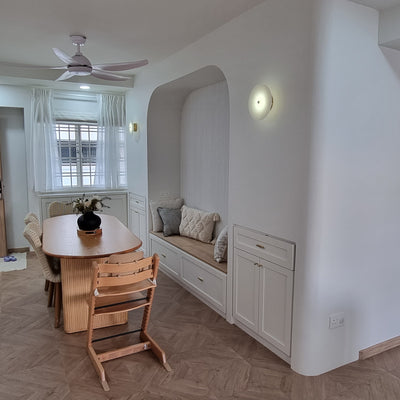
Multi-use carpentry compounds the gain. A platform bed with integrated drawers replaces a bed plus a separate storage chest. A wardrobe with a built-in study nook removes the need for a standalone desk. These combinations matter more in an HDB flat than they did in your EC, simply because there is less floor to spare for single-purpose furniture. For a deeper walkthrough of exactly which carpentry ideas add the most usable space — and which of them need an HDB permit before you start — our guide to space-saving renovation ideas for small HDB flats covers the full ranked list.
Renovation Timeline Planning for Your EC to HDB Flat Transition
Timeline planning for an EC to HDB flat transition needs to work backwards from two dates: your EC completion date and your HDB flat's key collection or handover date. Overlap between the two, even by a few weeks, is what lets you renovate the new flat without paying for temporary accommodation.
Permit Validity Windows and Scheduling
HDB renovation permits carry fixed validity windows that your MCST renovation never had to work around: new BTO flats get 3 months to complete approved works, while resale HDB flats get just 1 month, according to HDB's renovation guidelines. Missing that window means reapplying for a fresh permit, which adds cost and delay right when you are trying to move.
This is the opposite of how most MCST renovation timelines work, where the deposit-and-inspection cycle is the main constraint rather than a hard permit expiry. Because the HDB window is fixed and short — especially for resale flats — the practical advice is to only submit your permit application once your contractor, materials, and full scope are locked, not while you are still deciding on finishes.
Working Hours and Noise Rules in HDB Estates
Noisy renovation works in HDB estates — hacking, drilling, and similar power-tool work — are restricted to specific hours, generally weekdays and Saturdays, with no noisy work permitted on Sundays and public holidays. This is broadly similar in spirit to most condo house rules, but the enforcement sits with HDB directly rather than with a managing agent, and a Notice of Renovation must be posted outside your flat before works legally begin. Build this into your schedule from day one — a renovation that assumes weekend flexibility for a small crew will consistently run long in an HDB estate.
Budgeting Your Renovation When Downsizing From EC to HDB
Budgeting a downgrade from EC to HDB is not simply "spend less because the flat is smaller." Several cost categories shift direction, and getting this wrong is the most common way households overspend on a move meant to reduce costs.
What to Prioritise When Your Furniture Won't All Fit
Carpentry usually needs a larger share of the renovation budget in a smaller flat than it did in the EC, precisely because built-in, multi-use pieces are doing the work that several freestanding furniture items did before. Flooring and painting, by contrast, typically cost less simply because there is less area to cover. The households that budget well treat carpentry as the priority line item and treat cosmetic finishes as the flexible one.
Resist the instinct to bring every EC furniture piece "to save money." A wardrobe that does not fit an HDB bedroom footprint, once you factor in removal, storage, and eventual disposal, frequently costs more than commissioning a correctly sized built-in from the outset.
General Cost Ranges by Flat Size
Renovation cost still tracks flat type more than any other single variable. As a general Singapore market reference for 2026, whole-house resale renovation packages commonly range from roughly S$29,890 for a 3-room flat up to S$52,990 for a premium 5-room package, while BTO whole-house ranges typically run lower given the absence of hacking works. Actual figures depend heavily on scope, material selection, and whether hacking or overlay methods are used — treat any number here as a planning reference, not a quote, and confirm current pricing with an itemised proposal. Our HDB resale renovation cost guide breaks these ranges down by flat size and package tier in more detail.
Set aside a 10 to 15 percent contingency above your quoted cost, the same standard applied to any HDB renovation. Resale flats in particular often reveal aged wiring, deteriorated waterproofing, or corroded piping only once demolition starts — a risk equally relevant whether you are moving from a BTO or an EC.
A Practical Downgrade Checklist: EC to HDB Renovation Planning
Before signing any renovation contract for your new flat, work through this sequence. It compresses the lessons above into a single pre-renovation pass.
Confirm your EC's MOP and sale timeline against your new flat's handover date, so renovation and moving windows overlap rather than force a rental gap. Bring both floor plans — EC and HDB — to your first renovation consultation, and decide which furniture survives the move before quotations are drawn up. Verify your chosen contractor is DRC-listed before any deposit changes hands, since this single check determines whether your permit application is even valid. Map your storage plan around full-height, multi-use carpentry rather than replicating your EC's freestanding furniture layout. Confirm your permit validity window with your contractor — 3 months for BTO, 1 month for resale — and only submit the APEX application once your full scope is locked. Check HDB's resale levy schedule directly if your household previously received a housing subsidy, so it is accounted for in your overall moving budget, not just your renovation budget.
Renovation Packages for Your New HDB Flat
Whether you're moving into a resale flat or a fresh BTO, RCS packages are scoped by flat size so you can compare against the post-move budget covered above:
| 3-Room | BTO | Resale | BTO Resale (5+yr) |
| 4-Room | BTO | Resale | BTO Resale (5+yr) |
| 5-Room | BTO | Resale | BTO Resale (5+yr) |
| Kitchen / Toilet only | BTO | Resale | BTO Resale |
All packages carry transparent, all-inclusive pricing — BTO move-in packages start from S$7,290, whole-house resale packages start from S$28,990. Get an exact quote for your flat →
Frequently Asked Questions
Should I downgrade from EC to HDB if my EC hasn't reached MOP yet?
You generally cannot sell your EC in full before the 5-year Minimum Occupation Period ends, and owners cannot acquire private residential property during that window either, according to HDB. If your MOP is still running, the practical step is to plan your renovation timeline around your actual MOP completion date rather than an assumed one, since selling early is not an option under current HDB rules.
What is the biggest renovation mistake people make when moving from condo to HDB?
The most common mistake is shipping EC-sized, freestanding furniture into a smaller HDB flat without a layout rethink. This routinely blocks walkways and wastes floor that built-in, multi-use carpentry would have reclaimed. Planning your new layout, and deciding what to sell before the move, avoids paying to move furniture that will not fit anyway.
Does selling an EC to buy an HDB flat trigger a resale levy?
A resale levy generally applies to your next subsidised purchase from HDB or a new EC if your household previously enjoyed a housing subsidy, but the exact figure depends on the flat type involved. Check HDB's official resale levy schedule for your specific case, since this is a policy detail that changes household to household and is confirmed directly through HDB, not estimated.
Can I use my EC's renovation contractor for my new HDB flat?
Only if that contractor is also listed in HDB's Directory of Renovation Contractors (DRC). HDB legally requires homeowners to engage DRC-listed contractors for any renovation works in an HDB flat, which is a separate requirement from whatever your EC's MCST approved. Verify the DRC listing directly before signing any new agreement.
How long does renovation take for an HDB flat after an EC?
Timeline depends on scope and flat condition, but HDB fixes the permit validity window at 3 months for BTO flats and 1 month for resale flats. Whole-house resale renovations commonly take 5 to 8 weeks depending on hacking scope and material lead times. Plan your moving date with this fixed permit window in mind, since it is stricter than most MCST renovation timelines.
Is an HDB flat renovation cheaper than an EC renovation?
Generally yes, mainly because there is less floor area to finish and no MCST-imposed refundable deposit to budget for. However, carpentry often takes a larger share of the total spend in a smaller flat, since multi-use, built-in storage has to replace several freestanding furniture pieces that fit comfortably in a larger EC layout.
Plan Your EC to HDB Renovation With a Licensed Contractor
A downgrade from EC to HDB works best when the renovation plan is built around your actual new floor plan, not habits carried over from a bigger unit. If you are still finalising your layout, storage plan, or renovation timeline around your move, a short consultation turns those open questions into a scoped, budgeted plan before any deposit changes hands. Book a renovation consultation with RCS and bring both your EC and HDB floor plans — we will map what survives the move and what your new flat's permit and layout rules actually allow.
Disclaimer: HDB eligibility rules, resale levy amounts, and renovation permit requirements are set by HDB and subject to revision. This article summarises general guidance current as of July 2026 and is not a substitute for verifying your specific circumstances directly with HDB, including through an HDB Flat Eligibility (HFE) letter. MCST renovation rules vary by development — always confirm your specific by-laws with your management corporation or managing agent.Strategic Content by SingRank.