

Here's something most first-time homeowners don't realise until it's too late: your renovation quote is not your total move-in budget. Not even close.
That S$18,000 quotation you received? It covers the renovation work — the tiling, the carpentry, the plumbing, the painting. And it covers those well. But a move-in-ready home needs more than construction. It needs air-conditioning. Furniture. Appliances. Curtains. Lighting. Cleaning. Moving. And a dozen smaller items that add up faster than most people expect.
None of this is anyone's fault. It's simply how home renovation works — the contractor builds your home, and you furnish it. Two different scopes, two different budgets. The problem isn't the system. The problem is that nobody explains this clearly enough before you sign.
This guide fixes that.
We've renovated enough HDB flats to know exactly where homeowners get caught off guard. Every category below is something we've seen surprise real clients — and every tip comes from years of watching these patterns repeat. Our goal is simple: after reading this, you'll know exactly what to budget for, and nothing will catch you off guard on move-in day.
📌 A note before we begin: The term "hidden costs" doesn't mean anyone is hiding anything from you. It simply refers to expenses that fall outside the standard renovation package scope. These costs exist because every home has unique variables — your lifestyle, your preferences, your flat's condition — that no standardised quote can predict in advance. Understanding them early is the best financial planning tool you have.
Your Renovation Quote: What It Covers (and What It Doesn't)
Let's start with something fundamental. A renovation package — whether it's a BTO bare unit or a resale whole-house — covers construction work. That includes things like:
-
Floor and wall finishes (tiles or vinyl)
-
Bathroom renovation (waterproofing, sanitary fittings, vanity)
-
Kitchen renovation (cabinets, countertop, sink, backsplash)
-
Painting for the entire flat
-
Carpentry (shoe cabinet, storage)
-
Plumbing works
-
Basic electrical works (standard allocation of power points)
What it does not cover falls into 14 distinct categories. Some are small. Some are significant. Together, they make up the gap between your renovation quote and your actual move-in cost.
Let's walk through each one.
1. HDB Permit and Compliance Costs
Before your contractor picks up a single tool, your renovation needs written approval from HDB through the APEX system. This isn't optional — it's the law.
As the flat owner, you are legally responsible for ensuring all required permits are obtained and that all work complies with HDB's renovation rules. It doesn't matter if your contractor handles the submission on your behalf. In the eyes of HDB, the responsibility sits with you.
And the consequences of non-compliance are real:
"Any flat owner who has not engaged a DRC-listed contractor and/or breached any of the renovation rules/guidelines shall be guilty of an offence and shall be liable on conviction to a fine not exceeding $5,000."
What you need to know about timelines
HDB gives you a fixed window to complete all approved renovation works:
-
BTO flats: All works must be completed within 3 months from permit approval
-
Resale flats: You only get 1 month
Miss these deadlines and you'll need to apply for a new permit.
When you might need a Professional Engineer
Most straightforward BTO renovations don't require one. But if your scope involves any of the following, HDB requires a PE (Professional Engineer) for Civil or Structural works:
-
Demolition of non-load bearing reinforced concrete elements — partition walls, party walls, stiffeners, lintols, or hangers
-
Replacement of staircase balustrades in executive maisonettes where the vertical drop exceeds 1m
-
Installation of awnings exceeding 1.4m horizontal projection at open-to-sky balconies
The PE must supervise the demolition and ensure proper repair of affected structural elements.
Source: HDB — Building Works Guidelines
How RCS handles this
Every RCS renovation package includes full permit handling at no extra charge — APEX submission, HDB liaison, and approval tracking. You don't pay separately for this, and you don't need to navigate the system yourself.
2. Debris Haulage and Disposal
Renovation produces waste. Hacked tiles, demolished cabinets, old fixtures, packaging materials — it all needs to go somewhere, and that somewhere must be an NEA-approved disposal site.
HDB is explicit about this:
"You are to pay for the haulage and debris removal services provided by the Town Council, where applicable."
The Ministry of National Development has also confirmed in Parliament that contractors must remove and dispose of renovation debris at NEA-approved sites by the end of each workday. Contractors who improperly dispose of debris in common areas face a financial penalty of S$500 and six demerit points.
Placing a skip tank in an HDB car park without a valid permit? That's an offence carrying fines of up to S$2,000 per offence upon conviction.
Source: MND Parliamentary Answer
What this means for your budget
The cost of debris disposal varies significantly depending on how much hacking your renovation involves. A simple overlay project generates far less waste than a full hacking scope. Some contractors include basic haulage in their packages. Others charge it separately. The key is to ask upfront before signing: "Is haulage included, or charged separately?"
At RCS, debris haulage is included in all whole-house packages.
3. Extra Electrical Points
This is the one that surprises almost everyone.
Your renovation package comes with a standard allocation of electrical power points. It's a reasonable number for a basic setup. But the moment you start planning where your TV goes, where you'll charge your phone at the sofa, where the router sits, where the rice cooker and air fryer live on the kitchen countertop — you realise you need more. A lot more.
Think about your living room alone. The TV console area needs power points for the TV, set-top box, soundbar, and maybe a gaming console. That's four points in one spot. Your sofa area needs at least one for charging. The dining area needs one or two if you use a laptop there or plug in a hot pot occasionally.
One room. Easily six to eight points. Now multiply that across bedrooms, a study area, and the kitchen — and most 4-Room BTO homeowners end up adding 10 to 15 points beyond the standard allocation.
This isn't a flaw in the package. It's simply the reality that electrical needs are deeply personal. A couple who works from home needs different point placement than a family with young children. No standard package can predict your exact setup.
The HDB safety rule you should know
"Drill-in fasteners or connectors used must not exceed 6mm in diameter and 40mm in penetration depth."
Our advice
Before your first meeting with any contractor, walk through your flat (or your floor plan) room by room and mark every spot where you'll need a power point, data point, or light switch. Be specific. Think about furniture placement. Think about where you charge devices. Think five years ahead.
The more precise your electrical plan is before signing the contract, the fewer surprise add-ons during construction.
4. Waterproofing — It's Not Optional
If your renovation involves any bathroom floor or wall work, waterproofing isn't a nice-to-have. It's an HDB regulatory requirement.
"Pre-packed waterproofing screed and waterproofing membrane must be used in bathrooms/toilets before laying new floor finishes. Membrane should be upturned (minimum 150mm) against the walls, kerbs, and pipes."
The rules extend beyond bathrooms:
-
Kitchen and open balcony: Waterproofing screed required. Membrane (minimum 150mm upturn) around sanitary stacks within a 400mm radius
-
Floor traps: UPVC floor trap grating with long collar must be used when replacing floor finishes
-
Water test: Must be conducted after completing floor finish replacement
The 3-year rule most BTO owners don't know about
Here's one that catches many new homeowners:
Toilet floor and wall finishes provided by HDB or the developer cannot be replaced for 3 years from the completion date of the block. During this period, you can only lay new finishes over the existing ones using adhesives — no hacking.
This means if you collect keys for a BTO flat and want completely new bathroom tiles, you have two options: overlay now (adhesive over existing tiles), or wait three years and then hack.
Source: HDB — Building Works | MyNiceHome.gov.sg — HDB Renovation Permits 101
How RCS handles this
All RCS bathroom renovation packages include waterproofing as part of the standard scope — because it's mandatory, and we believe mandatory items shouldn't be an add-on. If you're comparing quotes from different contractors, check whether waterproofing is listed as a line item. If it's not mentioned, ask.
5. Air-Conditioning
Let's be clear: no renovation company in Singapore includes air-conditioning in their renovation package. It is always a separate purchase and installation from an aircon specialist. This is industry standard across the board.
Yet for most homeowners, it represents one of the largest single expenses after the renovation itself.
What HDB says about aircon installation
Source: HDB — Important Information
Our advice
Get your aircon quote before your renovation starts — not after. Your contractor needs to coordinate trunking routes and power point placement with the aircon installer. If you decide on concealed piping (hidden in the ceiling for a cleaner look), this must be done during the renovation, not after.
The most common setup for a 4-Room BTO is a System 3 (three indoor units + one outdoor unit), covering the master bedroom, second bedroom, and living room. But your needs may differ. Budget for this separately and get at least three quotes from aircon companies.
6. Furniture and Household Appliances
This one seems obvious — of course you need to buy furniture. But the number catches people off guard because they've been so focused on the renovation quote that they forget about everything that goes inside the renovated flat.
You'll need, at minimum:
-
Bed frames and mattresses
-
A sofa
-
A dining table and chairs
-
A study desk (especially if you work from home)
-
A refrigerator
-
A washing machine (or washer-dryer)
-
A built-in oven or standalone oven
-
A cooker hood
The total varies wildly based on your preferences. Some couples spend modestly and focus on essentials. Others furnish from premium retailers. Both approaches are valid — but budget for it early so the number doesn't land on you after renovation is already paid for.
Our advice
Start a furniture and appliance spreadsheet the moment you ballot for your BTO. List everything you'll need, research price ranges, and set a firm cap. Many homeowners find that splitting purchases — essentials first, nice-to-haves over the next 6 months — makes the financial burden more manageable.
7. Curtains and Window Blinds
Every room with a window needs some form of covering — for privacy, light control, and comfort. This is a separate purchase that no renovation package covers.
Options range from simple roller blinds (the most affordable) to day-and-night curtain combinations (moderate) to motorised smart blinds (premium). The choice depends on your budget and lifestyle.
Our advice
Measure your windows during renovation and get curtain quotes before your flat is completed. Installation is quick — usually one day — and can be scheduled immediately after post-renovation cleaning.
8. Lighting Fixtures
Your renovation includes the installation of light points (the wiring and ceiling connection). But the actual light fixtures — ceiling lights, pendant lights, LED downlights, cove lighting strips — are your own purchase.
This is another area where costs can range widely. Basic LED ceiling lights are very affordable. Designer pendant lights or extensive cove lighting setups cost significantly more.
Our advice
Plan your lighting layout during the renovation design phase, not after. The number and position of light points is fixed during electrical works. If you decide later that you want a pendant light over the dining table but there's no ceiling point there, adding one post-renovation is expensive and disruptive.
Think about how each room will be used. Living rooms benefit from layered lighting (a combination of ambient ceiling light, task lighting, and accent lighting). Bedrooms need warm, dimmable options. Study areas need focused, bright light. Plan around function, not just aesthetics.
9. Variation Orders (VOs) — The Silent Budget Killer
A Variation Order is any change to the agreed renovation scope after the contract is signed. It is the single most common reason homeowners exceed their renovation budget.
And here's the thing — most VOs aren't caused by contractor issues. They're caused by homeowner decisions made during construction:
-
"Actually, can you add one more power point behind the sofa?"
-
"I changed my mind on the tile colour — can we switch?"
-
"Can we move the shower point 30cm to the left?"
-
"I want to add a feature wall in the master bedroom — it wasn't in the original scope"
-
"The wall looks uneven after hacking — can you plaster it smooth?"
Each individual change seems small. But five or six VOs across a 4-Room renovation can add thousands to your final bill — and because each VO is priced individually (outside the package), the per-unit cost is typically higher than if the item had been included from the start.
How to minimise VOs
-
Finalise every single decision before signing the contract. Tile colours. Paint shades. Cabinet hardware. Electrical point positions. Power point heights. Everything. Take your time at this stage — rushing it costs money later
-
Visit your flat with your contractor before signing. Walk room by room. Discuss everything on-site. Things that seem abstract on a floor plan become concrete when you're standing in the space
-
Request a fully itemised quotation. Every line item should be listed separately — material, quantity, unit cost. This makes it easy to understand exactly what's included and what's not
-
Set a written VO approval process. Agree upfront that any addition or change beyond the signed scope requires your written approval before work proceeds. This prevents surprises on the final invoice
-
Keep a dedicated contingency fund. More on this in Category 14
If disputes arise
HDB provides an official resolution pathway:
"If you are dissatisfied with the work delivered, and both parties cannot resolve it satisfactorily, you may seek the assistance of CASE or the Small Claims Tribunals. Alternatively, you may seek remedy through court proceedings."
10. Post-Renovation Deep Cleaning
After weeks of construction, your flat will look beautiful — but it won't be clean. Renovation generates a fine layer of dust that settles everywhere: inside new cabinets, along window tracks, in electrical socket gaps, on top of door frames.
A regular household cleaning won't cut it. You'll need a post-renovation deep clean by a specialist team equipped to handle construction dust and debris residue.
Our advice
Book your cleaning company at least two weeks before your renovation completes — post-reno cleaning services are in high demand, especially during peak BTO key collection periods. A thorough clean typically takes a full day for a 4-Room flat.
11. Moving Costs
Getting your belongings from your current address to your new flat. If you're moving from a family home, you may have less to transport. If you're coming from an existing flat with a full household of furniture, you'll need professional movers.
What affects the cost
-
Volume: More items = larger truck = higher cost
-
Bulky items: Pianos, large safes, gym equipment carry surcharges
-
Access: Walk-up flats without lift access increase labour costs
-
Timing: Weekend and public holiday moves often carry surcharges
-
Distance: Most movers price based on location-to-location distance
Our advice
Get at least three moving quotes. Book early — especially if your move-in coincides with a BTO key collection wave, as movers get fully booked quickly.
12. Temporary Accommodation (Resale Flat Owners)
This category applies mainly to resale flat owners whose renovation flat is their only home. If your resale flat is undergoing a major renovation (whole-house scope with hacking), the flat will be uninhabitable for 8 to 12 weeks.
BTO owners usually don't face this issue — they're moving from an existing residence (parents' home or rental) into the newly renovated BTO, so there's no overlap period.
For resale owners, options include staying with family, renting a room short-term, or renting a temporary apartment. The cost range is significant depending on which route you choose.
Our advice
If you have family nearby who can host you for 2 to 3 months, that's the most financially efficient option. If not, factor temporary accommodation into your budget from the very beginning — it's a cost that's easy to forget until it's too late.
13. Renovation Loan Interest
If you're financing your renovation through a bank loan, the interest paid over the loan tenure is a real cost on top of your renovation price.
Most banks in Singapore offer dedicated renovation loans up to S$30,000 with tenures up to 5 years. These are unsecured loans (no collateral required), which means interest rates are higher than home loan rates.
Our advice
-
Compare at least three banks before committing. Interest rates and processing fees vary significantly
-
Check the EIR (Effective Interest Rate), not just the advertised flat rate. The EIR reflects the true cost of borrowing and is always higher than the flat rate
-
Borrow only what you need. It's tempting to max out a S$30,000 loan "just in case," but every extra dollar borrowed accrues interest for years
-
Consider a shorter tenure. Higher monthly payments, but significantly less total interest paid
-
Check for early repayment penalties. Some loans charge fees if you pay off the balance ahead of schedule
Disclaimer: Loan rates, terms, and conditions change frequently. The information above is general guidance only and does not constitute financial advice. Always verify current rates and terms directly with your bank before making any financial decisions.
14. Contingency Fund
This isn't a specific expense — it's a buffer for everything you cannot predict. And in renovation, unpredictable things happen more often than you'd think:
-
Walls turn out to be uneven after hacking — requiring extra plastering
-
A BTO unit's room dimensions are slightly different from the floor plan — carpentry needs minor adjustments
-
You discover you need one more power point in a location you hadn't considered
-
A material you selected is out of stock — the replacement option costs slightly more
-
An unforeseen plumbing issue behind a wall requires additional work
None of these are catastrophic. But each one costs money. Without a contingency fund, each one erodes your remaining budget or forces a difficult trade-off somewhere else.
How much to set aside
The industry standard recommendation is 10–15% of your renovation package cost. On a renovation package of S$18,490, that's roughly S$1,850 to S$2,775. On a S$30,000 resale package, it's S$3,000 to S$4,500.
Set this money aside from day one. Treat it as untouchable unless a genuine unforeseen issue arises. If you finish your renovation without using it — congratulations, you now have furniture money.
Putting It All Together
So what does your total move-in budget actually look like?
The renovation package — whether BTO or resale — forms the foundation. It's the largest single line item and covers the physical transformation of your flat. But surrounding it are 13 additional categories that collectively represent a substantial portion of your total spending.
As a general guide: your renovation package typically represents about 40–60% of your total move-in cost. The rest is everything above — aircon, furniture, appliances, curtains, lighting, cleaning, moving, contingency, and more.
The exact split depends on your lifestyle and preferences. A minimalist couple moving into a 3-Room BTO with basic furniture will have a smaller gap. A family furnishing a 5-Room resale with premium appliances and designer furniture will have a much larger one.
The point isn't the exact number. The point is to budget for all 14 categories from the start — not just the renovation.
How RCS Helps You Plan for the Full Picture
We designed our packages knowing that the renovation quote is only part of the story:
-
✅ Permit handling included at no extra charge — APEX submission, HDB liaison, approval tracking. You never pay separately for this
-
✅ Debris haulage included in all whole-house packages — no surprise haulage invoice at the end
-
✅ Waterproofing included in all bathroom scopes — it's HDB-mandatory, so we include it as standard
-
✅ Fully itemised quotation — every line item is listed and priced individually. You see exactly what's covered
-
✅ No hidden admin fees — the quoted price is the contract price. Period
-
✅ Workmanship warranty — if something isn't right after handover, we fix it at no cost
-
✅ Dedicated project manager — one person manages your entire project from start to finish
Browse All RCS Renovation Packages
BTO Packages (New Flat):
-
3-Room BTO — Bare Unit from S$14,290 | Move-In from S$7,590
-
4-Room BTO — Bare Unit from S$18,490 | Move-In from S$7,690
-
5-Room BTO — Bare Unit from S$19,790 | Move-In from S$7,790
-
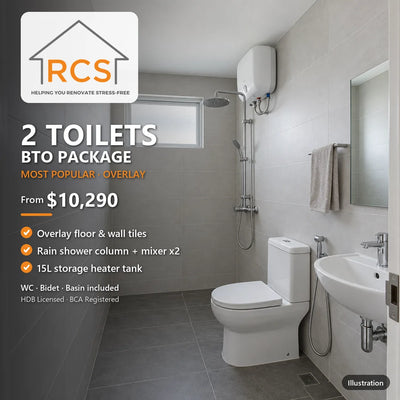
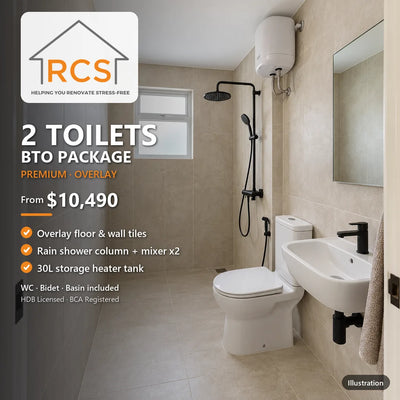
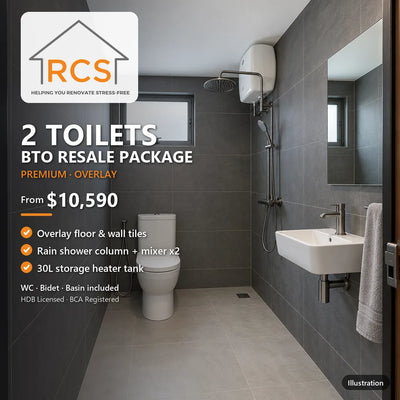
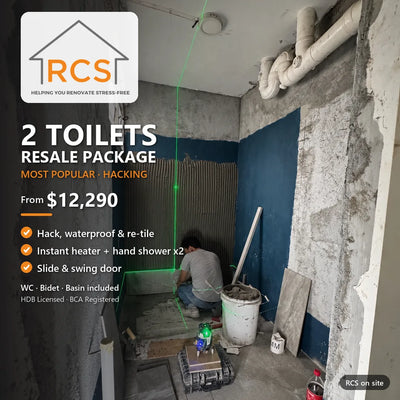
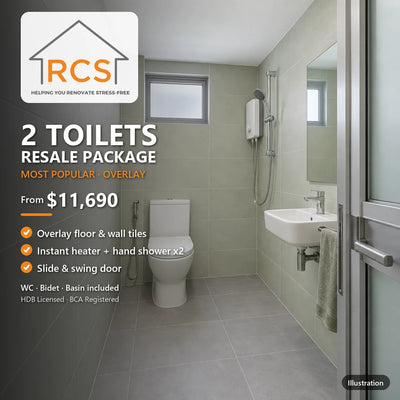
Adhoc BTO — Kitchen Cabinet from S$5,590 | 2 Toilets from S$9,990
Resale Packages (Existing Flat):
-
3-Room Resale — Whole House from S$29,890
-
4-Room Resale — Whole House from S$30,199
-
5-Room Resale — Whole House from S$31,290
-
Adhoc Resale — Kitchen from S$13,990 | 2 Toilets from S$11,990
BTO Resale Packages (5+ Year Old BTO):
Get a Free Budget Consultation
Not sure what your total move-in cost will be? We offer free renovation consultations with a complete budget breakdown — covering all 14 categories, not just the renovation package.
-
📱 WhatsApp: +65 8784 8742
-
✉️ Email: rcs@renovationcontractorsingapore.com
-
🌐 Website: renovationcontractorsingapore.com
Disclaimer: This article is published as an educational resource for Singapore homeowners planning HDB renovation. All HDB rules, penalties, and regulatory requirements cited in this article are sourced directly from official government websites — HDB.gov.sg, HDB Building Works Guidelines, MyNiceHome.gov.sg, and MND.gov.sg. All RCS package prices reflect published rates as of April 2026. This article does not constitute financial, legal, or professional advice. Homeowners should verify all regulations, pricing, and loan terms directly with the relevant authorities and institutions before making decisions. RCS is not responsible for changes in government regulations, bank lending terms, or third-party pricing that may occur after publication.