
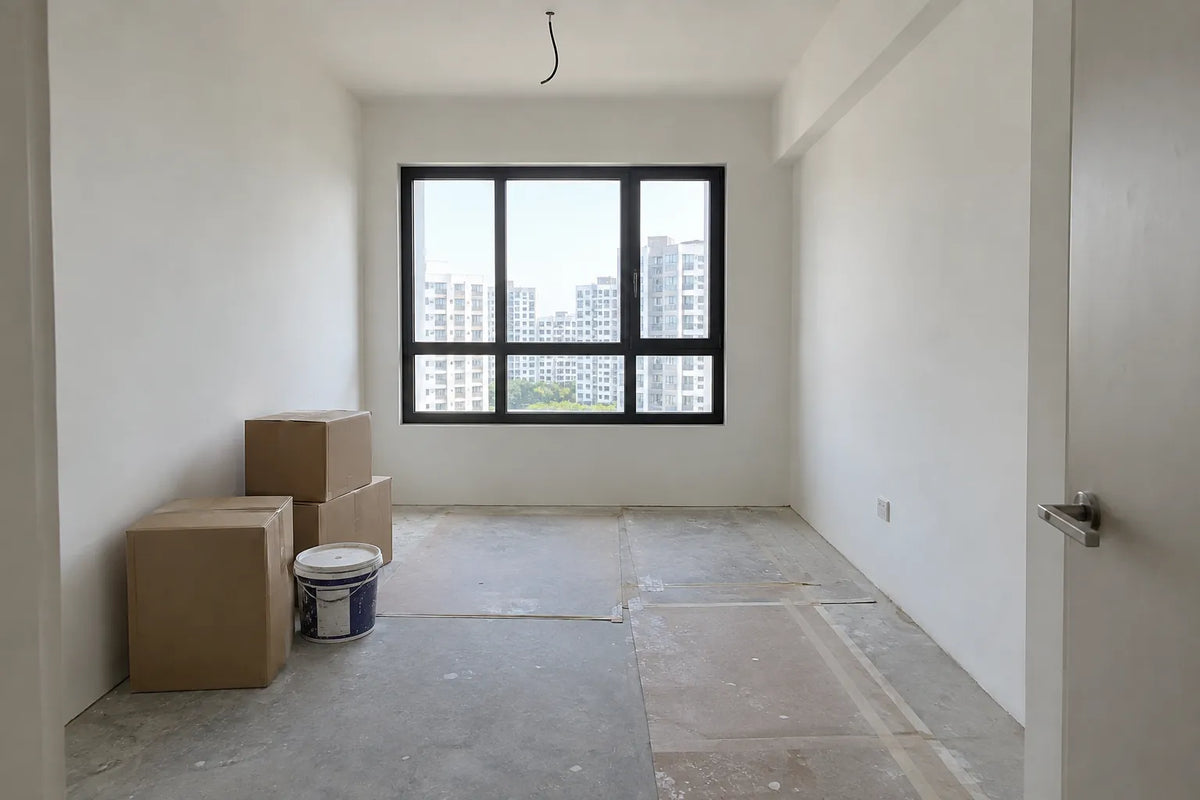


Stand in any HDB showflat and the floor decides the mood before the furniture arrives. Vinyl, tiles, and laminate all promise a beautiful finish — yet they behave very differently once your family moves in. Pick wrong, and you face buckled planks after a kitchen flood, hollow tiles after two years, or a swollen laminate edge near the bathroom door.
Worse, the HDB 3-year rule can quietly block the wet-area flooring you wanted. This 2026 cost guide compares vinyl, tiles, and laminate for HDB flats on price, durability, water resistance, and the rules that actually govern your choice — room by room.
Key Takeaway: For most HDB flats in Singapore, vinyl gives the best balance of cost, water resistance, and quiet installation across dry rooms. Tiles last longest and are the only safe choice for wet areas, while laminate offers warmth but fails near water. The HDB 3-year rule restricts removing original bathroom and toilet floor finishes for three years, which shapes every wet-area flooring decision. RCS holds HDB Licence HB-11-5877Z and BizSafe Level 3, with whole-house vinyl resale packages from SGD 28,990.
What Are Vinyl, Tiles, and Laminate Flooring?
The three materials differ fundamentally in how they meet water, traffic weight, and time. Vinyl is a resilient plastic plank laid over your existing screed. Tiles are fired ceramic or porcelain set into adhesive. Laminate is a printed wood-fibre board that clicks together. Each suits different rooms, budgets, and risk tolerances — and understanding the basic construction explains every strength and weakness that follows.
What Vinyl Flooring Actually Is — SPC vs LVT Explained
Vinyl flooring is a multi-layer plastic plank, available in two main types for Singapore HDB flats: SPC (Stone Plastic Composite) and LVT (Luxury Vinyl Tile). Both are fully waterproof overlay floors — they click together over your existing screed without wet trades, making installation fast and quiet. The key difference is in the core. SPC uses a rigid stone-limestone composite core containing approximately 50% ground limestone, making it denser, more impact-resistant, and more forgiving over uneven subfloors. LVT uses a more flexible vinyl core with plasticizers, making it softer and more comfortable underfoot, but it telegraphs subfloor imperfections more than SPC. SPC is the better choice for high-traffic areas, households with children or pets, and any floor over a slightly imperfect screed. LVT suits bedrooms where softness underfoot is prioritised over maximum rigidity. Vinyl in Singapore typically costs SGD 5.50–6.50 per square foot for supply and installation at entry level, rising to SGD 15 per square foot or more for premium wear-layer grades. A 4-room whole-house resale vinyl package costs SGD 30,199 at RCS, covering supply, laying, and the wider renovation scope. Our vinyl flooring packages guide for Singapore 2026 breaks down SPC versus LVT grade choices in detail.
What Tile Flooring Actually Is
Tile flooring is fired ceramic or porcelain set into adhesive over a prepared screed bed. Porcelain tiles have near-zero water absorption, which makes them the correct choice for HDB kitchens and bathrooms under HDB and PUB guidance — no other residential flooring material matches their wet-area performance. Tiles handle heat, heavy furniture, years of footfall, and constant mopping without wearing through. They are the only one of the three materials genuinely rated for constant wet-area use throughout the flat's lifetime. The trade-off is installation: tiling is a skilled wet trade requiring adhesive, levelling systems, grouting, and curing time — making it slower, noisier, and more labour-intensive than vinyl or laminate. Hollow tiles and lippage are common defects when workmanship is poor, so a proper levelling system and a skilled tiler matter as much as the tile brand. Our guide on professional tiling and tile levelling systems in Singapore explains what good tiling workmanship looks like and how to inspect it.
What Laminate Flooring Actually Is — And Why It Differs
Laminate flooring is a printed decorative layer bonded to a high-density fibreboard (HDF) core that clicks together as a floating overlay. The HDF core is wood-based, and this single fact defines laminate's fundamental limitation: standing water or persistent moisture seeping into the click-lock seams causes the core to swell, buckle, and delaminate permanently. The surface layer is tough against scratches and provides a warm, timber-like finish at a price range of SGD 6–10 per square foot in Singapore. Installation is a quiet, dry click-lock process similar to vinyl and suits occupied homes and tight schedules. The crucial difference from vinyl is water behaviour — vinyl shrugs off spills and high humidity; laminate does not. This rules laminate out of HDB kitchens, bathrooms, and any room adjacent to water sources. Reserve it for bedrooms and dry living areas where spills are rare, quickly wiped, and a single washing-machine flood will never reach the floor.
Vinyl vs Tiles vs Laminate: Side-by-Side Comparison for HDB Singapore
The table below compares all three flooring types on the factors Singapore HDB owners ask about most. Use it as a shortlist before reading the detailed verdicts by room.
For the bigger budget picture, read our HDB renovation cost guide for Singapore 2026 before setting a flooring budget in isolation.
How Much Does Each Flooring Cost in an HDB Flat in Singapore?
Flooring cost depends on the material, the area being covered, and whether you overlay the existing floor or hack and re-lay. Overlay floors like vinyl and laminate skip demolition, which significantly lowers labour. Tiles cost more because laying is a skilled wet trade — but hacking adds cost on top for resale renovation jobs.
Vinyl Flooring Cost for HDB Flats
Vinyl is typically the most budget-friendly whole-flat flooring option because it overlays the existing screed without any wet trade. Entry-level SPC vinyl in Singapore costs approximately SGD 5.50–6.50 per square foot for supply and installation, with premium grades reaching SGD 12–15 per square foot depending on wear-layer thickness and plank specifications. A 4-room whole-house resale vinyl package at SGD 30,199 and a 3-room version from SGD 28,990 at RCS both cover supply, laying, and the wider coordinated renovation scope — not just the flooring line item in isolation. The cost drivers are wear-layer grade, plank thickness, and whether the quote includes subfloor levelling and skirting boards. Always confirm both levelling and skirting are inside the quoted price before comparing figures across contractors.
Tile Flooring Cost for HDB Flats
Tiles cost more per square metre than vinyl or laminate because laying is a labour-intensive skilled trade. The tile material itself can be affordable — but adhesive, levelling systems, grouting, and the tiler's time add significantly to the installed cost. Kitchens and bathrooms in HDB flats almost always use tiles, so the spend concentrates in wet areas where there is no substitute. A kitchen BTO resale overlay package at SGD 11,290 at RCS includes overlay tiling — laying new tiles over existing ones to preserve the original waterproofing membrane during the 3-year restriction period. Hidden charges in tiling quotes frequently hide in tile wastage from pattern cuts, levelling compound, and grout colour matching. Our guide on hidden HDB renovation costs in Singapore 2026 explains where tiling quotes expand beyond the headline figure.
Laminate Flooring Cost for HDB Flats
Laminate flooring sits in the low-to-mid price range at approximately SGD 6–10 per square foot in Singapore for supply and installation — similar to entry-level vinyl. Installation is a quick dry click-lock overlay, so labour stays modest. The catch is scope limitation: laminate cannot go into kitchens or bathrooms in any HDB flat, so it never covers the whole flat by itself. You will still pay for tiles in all wet areas regardless of your laminate choice, meaning the apparent saving over whole-flat vinyl can disappear quickly when you add the tile cost alongside it. Price laminate as a partial-flat solution against a full vinyl quote that covers all dry rooms before deciding, since whole-flat vinyl often delivers more area for a similar or lower total outlay. For a room-by-room budget view, our 4-room resale renovation cost guide for Singapore 2026 shows where flooring sits in the wider renovation spend.
The HDB 3-Year Rule: How It Governs Every Wet-Area Flooring Choice
The HDB 3-year rule is the single constraint most Singapore flooring guides skip — yet it governs every wet-area decision in a new BTO flat. It restricts removing original bathroom and toilet wall and floor finishes for the first three years after flat collection, per HDB renovation guidelines (2026). This rule interacts differently with vinyl, tiles, and laminate.
Why the 3-Year Rule Exists for Bathrooms and Toilets
For newly built HDB flats, owners must not remove the original waterproofing membrane and floor or wall finishes in bathrooms and toilets for three years, per HDB (2026). The original waterproofing membrane sits beneath the bathroom screed and original tiles — hacking it out during this period risks leaks into the unit below before the membrane has been adequately tested over time. HDB's restriction exists specifically to protect both the owner and the neighbour below. This is why overlay renovation packages exist as a product category — they preserve the original waterproofing layer while updating the visible surface. An important nuance: kitchen and service yard floor tiles can be hacked with the relevant HDB approval even during this period, as they fall outside the bathroom and toilet restriction. Confirm this distinction clearly with your contractor before planning any wet-area hacking. Our guide on toilet waterproofing and the HDB 3-year rule in Singapore 2026 covers the membrane requirements in full.
How the Rule Interacts With Vinyl, Tiles, and Laminate
The 3-year restriction pushes all bathroom and toilet renovations toward overlay rather than hacking during the first three years. Vinyl suits this perfectly in dry rooms — it overlays the screed across living areas, bedrooms, and corridors without touching any bathroom waterproofing. Bathroom and toilet floors get overlay tiling: new tiles laid over the original HDB tiles to preserve the waterproofing membrane intact underneath. Laminate is irrelevant in bathrooms and toilets regardless of the rule, because its HDF core fails under damp conditions and should never be used in these rooms. Kitchen and service yard tiles occupy a different position — they can be hacked with the proper HDB permit, outside the bathroom and toilet restriction. In practice this means: bathrooms and toilets get overlay tiling during the first three years, kitchens may be hacked with approval, and dry rooms take vinyl or laminate as overlay floors. For the overlay-versus-hacking decision in detail, see our guide on overlay vs hacking for HDB bathroom renovation in Singapore.
What Changes After Three Years
After the 3-year restriction period passes, owners may hack and re-lay bathroom and toilet finishes subject to obtaining a renovation permit and applying a compliant new waterproofing layer. Full wet-area hacking opens up as an option — replacing overlaid tiles with a freshly hacked, re-waterproofed, and re-tiled bathroom. New waterproofing must be applied and tested before any re-tiling begins. This is the point when many resale owners who bought a young resale flat do a full wet-area refresh. Vinyl and laminate remain confined to dry rooms throughout the flat's lifetime — the 3-year rule changes nothing for those two materials. Any hacking still requires HDB approval and the relevant permit. Our guide on HDB renovation permits and APEX fees for Singapore 2026 covers exactly which works need approval and what the process involves.
Durability and Water Resistance: How Each Flooring Ages in Singapore
Durability and water resistance determine how your floor performs in Singapore's humid tropical climate over years of daily use. Tiles lead on both measures, vinyl follows closely, and laminate trails significantly on water resistance.
Which Flooring Lasts Longest Under Daily Use
Tiles last longest — often exceeding 20 years without the surface wearing through — because fired porcelain is one of the hardest materials used in residential construction. Good-quality vinyl with a thick wear layer typically serves 10–20 years, depending on the grade selected. Laminate generally lasts 10–15 years before edges, joints, and high-traffic areas show visible wear. The enemies of all three are the same: heavy furniture dragged across the surface, grit tracked in from outdoors, and repeated impact. Tiles resist all three most effectively. Quality SPC vinyl resists dents and scratches better than laminate at the joints. For high-traffic living rooms and corridors, both tiles and quality SPC vinyl with a thick wear layer perform reliably over a decade, as noted in our family living room renovation cost guide for Singapore 2026. Select the thickest wear layer your budget allows — it is the single most important specification in any vinyl quote.
Which Flooring Handles Singapore's Humidity and Spills Best
Tiles and quality vinyl handle Singapore's humidity and water exposure well; laminate is the clear weak link. Porcelain tiles absorb near-zero water, making them suitable for constantly wet bathrooms and kitchens. SPC and LVT vinyl are both fully waterproof plastic composites — they handle spills, regular mopping, and Singapore's tropical humidity well in dry rooms. Laminate has a wood-fibre core that swells when water sits on a seam or penetrates a joint — a single washing-machine leak or persistent bathroom splash can permanently ruin a run of laminate. Never install laminate in rooms adjacent to plumbing or water sources without a completely dry, sealed barrier between them. Grout lines in tiled floors need periodic resealing to remain waterproof over years of use. Quality vinyl needs only regular mopping, with no sealing required — making it the most low-maintenance overlay floor for busy Singapore households. Confirm any vinyl product is explicitly rated for tropical climate conditions before specifying it.
Which Flooring Should You Choose? Room-by-Room Decision Guide
The right floor depends on the specific room and its primary risk — water, traffic, or warmth. Mixing materials across the flat is not a compromise; it is the technically correct and practically sensible approach for most HDB renovations.
Best Flooring for Living Rooms and Bedrooms
For living rooms and bedrooms, SPC vinyl is the all-round recommended choice, with laminate a valid warmer alternative for bedrooms where spill risk is very low. These dry rooms see daily foot traffic but rarely standing water, so both overlay types work technically. SPC vinyl wins on spill resistance, impact tolerance, subfloor forgiveness, and consistency across the whole flat. Laminate offers a slightly warmer underfoot feel and a more natural timber visual at a similar price — but the water risk must genuinely be minimal for the room to suit laminate safely. Quiet, fast installation for both materials suits occupied homes and tight renovation schedules. For a hotel-style master bedroom, SPC vinyl planks pair particularly well with built-in carpentry, as explored in our master bedroom renovation guide for Singapore 2026.
Best Flooring for Kitchens and Bathrooms
For HDB kitchens and bathrooms, porcelain tiles are the only safe choice — and the HDB 3-year rule defines how you install them in a new flat. Porcelain tiles handle constant moisture, cooking grease, cleaning chemicals, and repeated wet mopping in a way that no vinyl or laminate product can match long-term. In a new BTO flat during the first three years, overlay tiling over the original HDB tiles preserves the waterproofing membrane intact. For kitchens and service yards, hacking is permitted with HDB approval even during this period — but requires the proper permit and new waterproofing if you do. Choose a matt, anti-slip finish rated for wet areas in bathrooms — a polished or glazed tile can become dangerously slippery when wet. Never install laminate in these rooms under any circumstances. RCS offers dedicated toilet renovation packages with overlay tiling that preserve the waterproofing layer while updating the full bathroom finish.
Mixing Flooring Across One HDB Flat
Mixing materials is the technically correct answer for most HDB flat renovations — not a design compromise. The standard practical layout combines porcelain tiles in kitchens, bathrooms, and toilets with SPC vinyl across living rooms, corridors, and bedrooms. Transition strips at doorways manage the height change cleanly and safely. This approach respects each room's water and traffic demands simultaneously, while letting you spend where the material difference actually matters — tiles only where water demands them. Whole-house resale 4-room resale renovation packages from RCS already combine tiled wet areas with vinyl dry rooms in a coordinated single scope. Plan the finished floor heights at the design stage so levels align cleanly across door thresholds — a difference of more than a few millimetres at a doorway needs a threshold trim or levelling to avoid a trip hazard. Discuss skirting board and transition strip finishes upfront, since they tie mixed floors together visually at every junction.
FAQ: Vinyl vs Tiles vs Laminate Flooring for HDB Singapore 2026
Is vinyl or tile better for an HDB flat in Singapore?
It depends on the room. Tiles are the correct choice for kitchens and bathrooms because they handle constant moisture and last beyond 20 years. Vinyl — specifically SPC — is better for living rooms, corridors, and bedrooms, offering a fast, quiet overlay that is fully waterproof and durable. Most Singapore HDB owners use both across the same flat, with tiles in wet areas and vinyl in dry rooms.
What is the difference between SPC and LVT vinyl flooring for HDB Singapore?
SPC has a rigid limestone composite core — it is denser, more impact-resistant, and forgiving over slightly uneven subfloors. LVT has a flexible vinyl core with plasticizers, making it softer and more comfortable underfoot, but it requires a flatter subfloor and is less impact-resistant. SPC is the better choice for high-traffic areas, households with children or pets, and most Singapore HDB living rooms and corridors. LVT suits bedrooms where underfoot softness is prioritised. Both are fully waterproof.
Can I lay vinyl or laminate over my existing HDB tiles?
Yes. Both vinyl and laminate are overlay floors designed to click-lock over a sound, clean, level existing surface. This avoids hacking, which the HDB 3-year rule restricts in new flat bathrooms and toilets. The subfloor must be dry and level before laying — confirm whether subfloor levelling is inside your contractor's quoted scope. SPC vinyl is more tolerant of slight subfloor imperfections than LVT or laminate.
Why can't I use laminate in my HDB kitchen or bathroom?
Laminate has a wood-fibre HDF core that permanently swells and buckles when water penetrates the click-lock seams. Kitchens and bathrooms expose floors to constant moisture, cooking splashes, and cleaning water. A single plumbing leak or persistent water exposure can ruin an entire run of laminate planks irreversibly. Porcelain tiles, with near-zero water absorption, are the correct material for these wet areas.
How does the HDB 3-year rule affect my flooring choices?
For new BTO flats, HDB prohibits removing original wall and floor finishes in bathrooms and toilets for three years, per HDB renovation guidelines (2026). This restricts bathroom and toilet hacking — pushing those rooms toward overlay tiling during the restriction period. Kitchen and service yard floors fall outside this restriction and can be hacked with HDB approval. Dry rooms — living areas, bedrooms, corridors — take vinyl or laminate overlay and are unaffected by the rule.
How much does whole-house vinyl flooring cost for an HDB resale flat in Singapore?
At RCS, a 3-room whole-house resale vinyl package costs SGD 28,990 and a 4-room version costs SGD 30,199, both covering supply, laying, and the wider renovation scope. Material-only pricing for SPC vinyl starts from approximately SGD 5.50 per square foot in Singapore, with premium grades reaching SGD 12–15 per square foot. Always confirm whether subfloor levelling and skirting boards are included in any quoted price before comparing figures.
Which flooring is quietest and fastest to install in an HDB flat?
SPC vinyl and laminate are both quiet, dry, click-lock overlays that install significantly faster than tiles and without the noise of adhesive or levelling works. They suit occupied homes and tight renovation schedules well. Tiles require adhesive, a levelling system, grouting, and curing time — making tile installation slower, noisier, and a wet trade. For fast, quiet dry-room installation, SPC vinyl is the dependable choice across most HDB flat renovation scopes.
Plan Your HDB Flooring With a Licensed Contractor in Singapore
Your flooring choice is three smaller decisions made by room type. Porcelain tiles belong in kitchens, bathrooms, and toilets — where water and traffic are relentless and no substitute exists. SPC vinyl suits living rooms, corridors, and bedrooms, with laminate a valid warmer alternative in genuinely dry bedrooms. The HDB 3-year rule keeps bathroom and toilet floors on overlay tiling until the restriction period passes — while kitchens can be hacked with proper HDB approval even earlier.
RCS works as a direct HDB-licensed renovation contractor under Licence HB-11-5877Z, BizSafe Level 3, with whole-house vinyl resale packages from SGD 28,990 and overlay tiling scopes for wet areas. Book a renovation consultation at SGD 150 to map the right floor to every room with a dated scope and verified licence.
Sources: HDB Renovation Guidelines — Building Works · PUB Singapore · BCA Singapore
Prices and HDB rules accurate as of June 2026. Verify current package prices and HDB permit requirements before signing. Published by RCS Renovation Specialists — HDB-licensed renovation contractor in Singapore.