
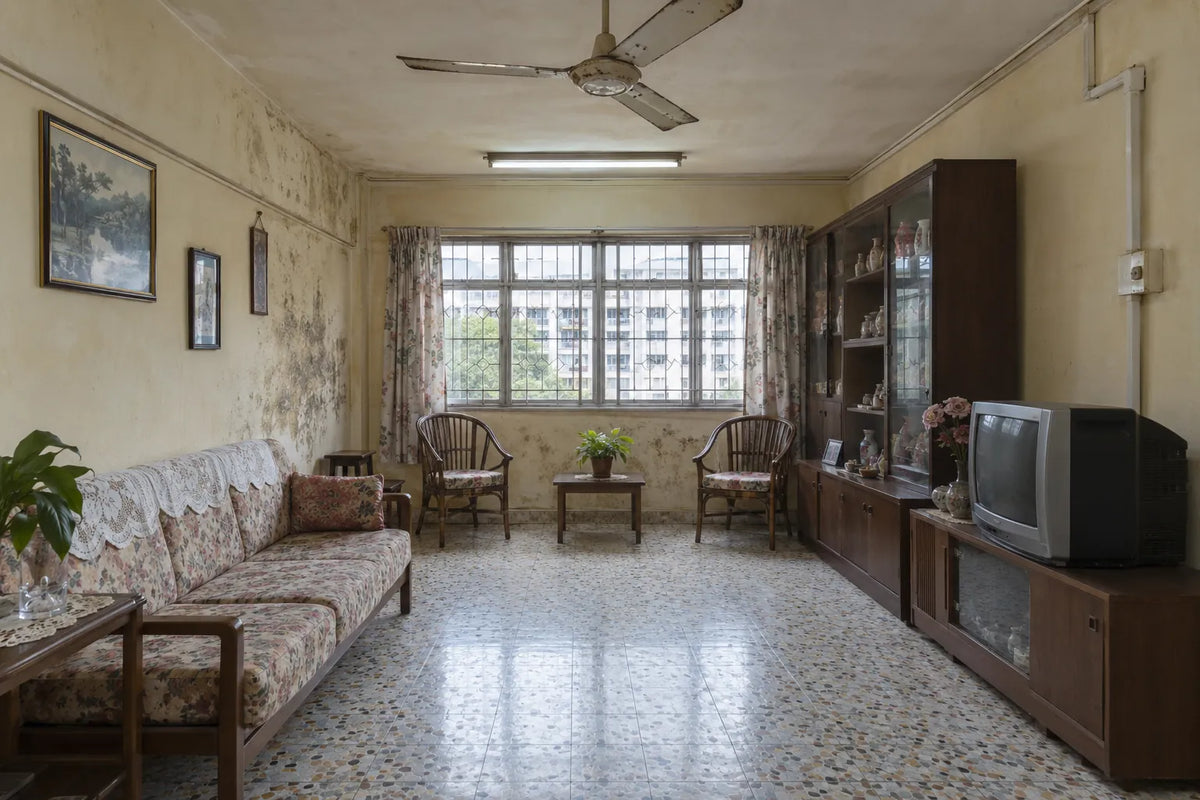

The nicest thing about a Bishan 3-room resale is the location. The most expensive thing about it is what you cannot see. Bishan's housing stock largely dates from the 1980s onwards, so in the older blocks the condition of three hidden systems will decide your budget long before your tile choice does.
Ask HDB for your block's completion year before you budget anything — it is the single most useful number in the whole exercise. We work across the central and north-east mature estates, and the survey findings are remarkably consistent. Here is what turns up.
The three things a mature-estate survey always finds
In order of cost impact:
- Electrical capacity that no longer matches how people live. The original distribution board and circuit count were sized for a household with a fraction of today's appliance load.
- Waterproofing at or past its service life. The bathroom membrane is the original one, buried under the original tiles, and it has been working for decades.
- Concealed pipework of the same vintage. Particularly the sections serving the kitchen and bathroom.
None of these appear on a viewing. All three become dramatically more expensive to reach once new finishes are in. That is why we survey before quoting rather than pricing from photographs.
Electrical: why rewiring is not optional at this age
This is the item owners most often try to defer, and the one we most often argue for.
An older 3-room flat typically has few circuits, limited socket provision, and a distribution board without the protective devices expected today. Add an induction hob, a storage water heater, air-conditioning and a washer-dryer to that installation and you are loading a system designed for a different era.
Rewiring means opening walls. If you are hacking anyway, the marginal cost is modest. If you decide to rewire after new finishes are installed, you are paying to break and repair surfaces you just paid for. That sequencing argument is the whole reason it belongs at the start.
Practical note: additional electrical points and a distribution board change are usually the difference between a flat that works and one where you live with extension leads. Decide the appliance list first, then the circuit plan.
Plumbing and the neighbour-below problem
Concealed pipework in a mature block is generally at the end of its intended life. The failure mode that matters is not a burst pipe in your flat — it is a slow seep that appears as a stain on the ceiling of the flat below.
At that point the problem stops being technical and becomes a shared one. Under HDB's framework for inter-floor leakage, responsibility and rectification cost can be shared between the upper and lower flat owners, and the process to establish the cause takes time. It is a genuinely unpleasant way to start life in a new home.
If you are opening the walls for rewiring, replacing the concealed sections serving the wet areas at the same time is the cheapest insurance available. Our guide to HDB ceiling leaks between floors sets out how liability is determined.
Waterproofing that has already failed once
In a bathroom of this age, assume the membrane is spent. Common signs: hollow-sounding floor tiles, a bathroom floor that was raised in a previous renovation, efflorescence on the wall below, or a stain in the neighbour's ceiling.
A previously raised floor is worth flagging. It usually means an earlier owner overlaid rather than fixed, which buys time but leaves the original problem in place and steals headroom. Removing those layers is part of the job.
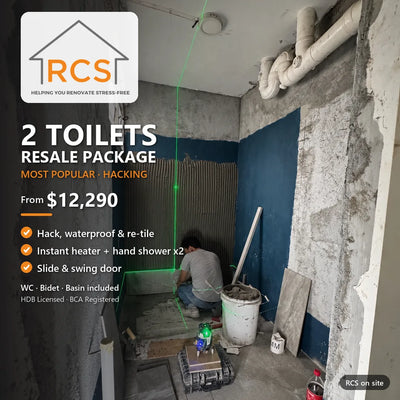
The replacement sequence is not negotiable: hack out, apply new membrane, allow it to cure, then flood the bathroom for a 48-hour water ponding test before a single tile is laid. If the membrane leaks, you learn it while the fix is cheap. The specification detail is in toilet waterproofing standards.
What HDB will and will not let you hack
For a resale flat, the three-year restriction that applies to new flats does not — but the structural rules do, absolutely.
- Structural walls cannot be hacked. Not with a permit, not with an engineer. They are load-bearing.
- Non-structural walls may be removed with an HDB permit, and depending on the works, a Professional Engineer's endorsement.
- Hacking, floor finishing, plumbing relocation and water heater installation all require a permit, filed by a contractor listed in HDB's Directory of Renovation Contractors. Approval can take up to three weeks.
Noisy works — which a resale strip-out largely is — are confined to 9am to 5pm on weekdays and must be completed within three consecutive days. No noisy work on Sundays or public holidays. For a full 3-room hack, that cap needs planning. Our wall hacking permit and PE endorsement guide covers the process.
Where a resale budget goes that a BTO budget does not
- A new flat spends on finishes and carpentry. The infrastructure is new.
- A mature resale spends a substantial share on work you will never see — demolition and disposal, rewiring, pipework, new waterproofing, floor levelling — before any finish is chosen.
This is why comparing a resale quote against a BTO package figure is misleading. They are not the same scope. Our 3-room resale renovation cost guide breaks the resale scope down by item, and the 3-room flat renovation cost guide gives the wider picture.
Sequencing so you do not pay twice
- Survey and agree scope on what is actually there
- File permits — up to three weeks for approval
- Hack and remove, within the three-day noisy-works window
- Rewire and re-pipe while walls are open
- Waterproof, cure, and pass the 48-hour water test
- Tile and finish
- Measure and install carpentry against finished floor level
Every reversal in that list means undoing completed work. That is the entire mechanism behind resale budgets running over.
Is it worth renovating a 3-room resale in a mature estate?
For location, often yes — but budget for the infrastructure honestly rather than treating it as a contingency. The flats that disappoint owners are the ones where visible finishes were prioritised and the hidden systems were deferred.
Can I keep the existing bathroom if it looks fine?
Only if there is no evidence of a past leak and the floor has not been previously raised. Appearance alone is not a test at this block age. If in doubt, the membrane is the thing to replace while the floor is open.
How long does a full 3-room resale renovation take?
Typically eight to twelve weeks, governed by permit approval, the three-day noisy-works cap, waterproofing cure and test time, and carpentry fabrication. A partial scope finishes sooner.
Before you commit
RCS is an HDB-licensed renovation contractor (Licence HB-11-5877Z), BCA-registered, PMI and BizSafe Level 3 certified. Our content strategy partner is SingRank. Related: Bishan HDB renovation, Clementi 3-room resale renovation, and the Bishan, Ang Mo Kio and Bukit Merah BTO cost guide.
Scope, permits and costs vary by unit condition, flat type and HDB or BCA approval. Rules described here are indicative and current at the time of writing; confirm the position for your own flat with HDB and through a site consultation before committing to works.