
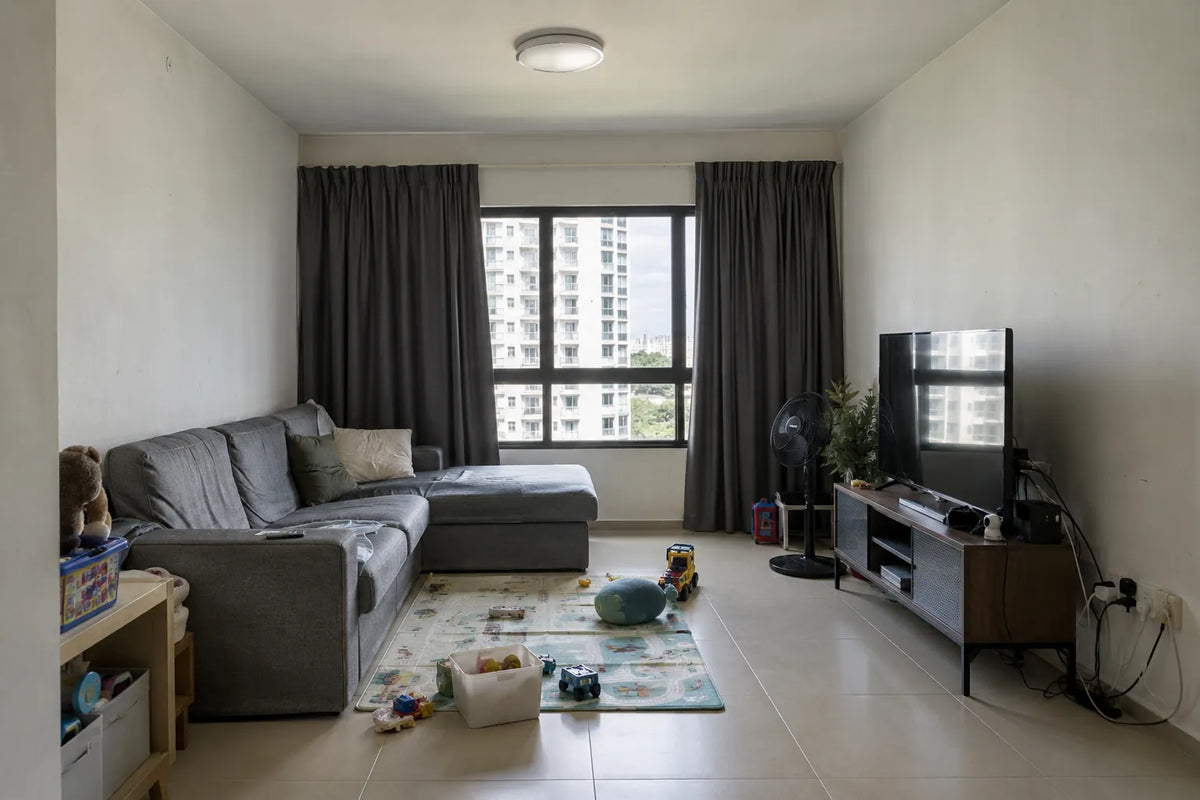

Whole home renovation in Singapore starts from S$22,990 through RCS whole house packages, and runs to S$41,590 for the largest flat on the highest tier. Cost depends on three things: flat size, finish tier, and whether you hack the existing floors or overlay them. Flooring method moves the total more than anything else.
Key Takeaways
- RCS whole house packages span 24 published prices, from S$22,990 to S$41,590, all-inclusive in SGD.
- Choosing vinyl overlay instead of hacking saves between S$4,900 and S$9,000 on the same flat.
- BTO resale packages cost roughly S$6,000 less than resale packages at the same flat size.
- Hacking is a remedial method, not a quality upgrade. Four specific conditions justify it.
- Appliances, loose furniture and temporary accommodation sit outside every package.
- RCS holds HDB Licence HB-11-5877Z and BizSafe Level 3 certification.
What a Whole Home Renovation Covers
A whole home renovation transforms every room under one contract: kitchen, all bathrooms, bedrooms, living and dining areas. It bundles hacking or overlay, tiling, carpentry, plumbing, electrical works, painting and final cleaning. Unlike room-by-room work, one contractor carries one schedule and one warranty.
The fragmented alternative creates gaps. You engage a tiler, then a carpenter, then an electrician. Each waits for the previous trade. Meanwhile nobody owns the overall programme, and defects fall between contractors.
Which Property Types Need What
Three property situations drive most whole home renovations in Singapore. Each carries a different scope, and therefore a different package family.
BTO flats arrive with sound base finishes. Demolition stays minimal, so these units usually qualify for the lower-priced BTO resale package family.
Resale HDB flats need comprehensive updates. Ageing infrastructure, dated layouts and worn finishes mean full stripping, and that pushes them into the resale package family.
Condominiums and landed properties follow similar renewal cycles but answer to different rules. Condo works require management corporation approval; landed works may need planning permission. Speak to RCS directly for a scoped quotation on either.
Whole Home Renovation Cost Singapore: The Verified Package Ladder
RCS publishes 24 whole house package prices across two families and three flat sizes. Every figure below comes from the live RCS store, verified on 28 July 2026. These are the actual transactable prices, not market estimates.
Whole House Resale Package Prices
Resale packages target older flats needing full stripping. They cost more than BTO resale packages because existing condition demands more removal, more making good, and more remedial plumbing work.
| Flat type | Tier | Vinyl overlay | With hacking | Difference |
|---|---|---|---|---|
| 3-room | Most Popular | 28,990 | 33,990 | 5,000 |
| 3-room | Premium | 30,490 | 35,390 | 4,900 |
| 4-room | Most Popular | 30,199 | 36,990 | 6,791 |
| 4-room | Premium | 31,880 | 38,490 | 6,610 |
| 5-room | Most Popular | 31,290 | 39,990 | 8,700 |
| 5-room | Premium | 32,990 | 41,590 | 8,600 |
Whole House BTO Resale Package Prices
BTO resale packages suit flats in newer condition. Because base finishes are sound, less demolition happens, and the entry price drops by roughly S$6,000 against the equivalent resale package.
| Flat type | Tier | Vinyl overlay | With hacking | Difference |
|---|---|---|---|---|
| 3-room | Most Popular | 22,990 | 28,990 | 6,000 |
| 3-room | Premium | 23,990 | 29,900 | 5,910 |
| 4-room | Most Popular | 23,990 | 31,990 | 8,000 |
| 4-room | Premium | 24,990 | 32,990 | 8,000 |
| 5-room | Most Popular | 24,990 | 33,990 | 9,000 |
| 5-room | Premium | 25,990 | 34,990 | 9,000 |
The cheapest entry point sits at S$22,990 for a 3-room BTO resale flat, Most Popular tier, vinyl. Budget-focused homeowners should compare that against Cheapest Whole House Renovation Package Singapore 2026.
Why Does the Hacking Premium Grow With Flat Size?
The hacking premium scales with floor area, not room count. A 3-room resale flat carries a S$5,000 gap. A 5-room resale flat carries S$8,700. That S$3,700 spread reflects more screed to remove, more debris to cart away, and more labour days on site.
The same pattern holds in the BTO resale family, where the gap widens from S$6,000 on a 3-room to S$9,000 on a 5-room. Larger flat, larger penalty for hacking you did not need.
What Separates the Two Tiers
Both tiers cover identical scope across the whole flat. Most Popular and Premium differ in material specification and finish quality, not in which rooms get touched.
The gap is narrower than most homeowners expect. On a 4-room resale vinyl package, Premium costs S$31,880 against S$30,199 for Most Popular. That is S$1,681, roughly 5.6% more, for upgraded specification throughout.
Compare that to hacking on the same flat at S$6,791. Flooring method matters four times more to your total than the tier you pick. Homeowners routinely get this backwards.
When Does Hacking Justify the Extra Cost?
Hacking earns its premium in four situations: uneven existing floors, failed waterproofing, floor height that cannot absorb overlay, and layout changes that move walls. Outside those four, vinyl overlay delivers the same visual result for thousands less.
The Existing Floor Is Uneven
Vinyl overlay follows the surface beneath it. Consequently a dipped or humped screed telegraphs straight through the new finish. Hacking back to the slab lets the contractor lay fresh, level screed.
Waterproofing Has Failed
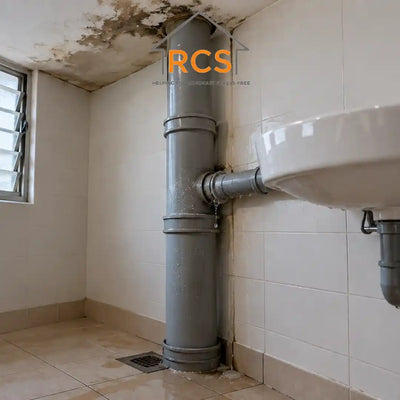
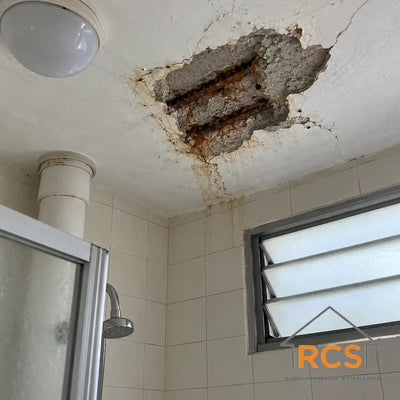
Water seeping into the unit below is not cosmetic. It escalates fast, and it involves your neighbour. Overlaying a failed bathroom floor traps the fault and makes the eventual repair far more expensive.
Floor Height Cannot Absorb the Overlay
Overlay adds height. Where door clearance or existing thresholds are already tight, that height causes binding doors and trip edges. Hacking resets the datum to the slab.
You Are Moving Walls
Layout changes expose the slab anyway. Once walls come down, overlaying around the scar makes little sense. For the structural side, see Kitchen Overlay vs Hacking Singapore 2026.
When Is Vinyl Overlay the Smarter Choice?
Vinyl overlay wins when the existing floor is sound, level and dry. It saves S$4,900 to S$9,000, cuts noise and dust dramatically, and removes debris disposal from the schedule entirely. For many BTO resale flats, overlay is the correct engineering answer rather than a compromise.
Homeowners often assume hacking equals quality. It does not. Where the substrate is already good, hacking spends thousands recreating a condition you already have.
Worked Example: Budgeting a 4-Room Resale Flat
A 4-room resale flat on the Most Popular tier with vinyl costs S$30,199. The table below shows how the realistic all-in figure assembles, so you can pressure-test your own budget before signing.
| Item | Inside the package? | Figure |
|---|---|---|
| Whole house package (vinyl) | Yes | 30,199 |
| Upgrade to Premium tier | Optional | +1,681 |
| Upgrade to hacking | Optional | +6,791 |
| Appliances and loose furniture | No | Budget separately |
| Temporary accommodation | No | Budget separately |
Selecting both upgrades takes the same flat from S$30,199 to S$38,490. That is S$8,291 more, an increase of roughly 27% on the base package.
Now weigh the two against each other. Premium adds S$1,681 and changes materials throughout. Hacking adds S$6,791 and changes nothing visible once the floor is laid. If your existing floor is sound, the ranking is obvious.
Which Package Fits Your Flat?
Match the package family to flat condition, then match the tier to budget. Newer flats with sound floors take a BTO resale package with vinyl, from S$22,990 to S$25,990. Older flats with failed floors take a resale package with hacking, from S$33,990 to S$41,590.
Most homeowners sit between those poles. A resale flat with sound floors still takes a resale package because of the stripping scope, but it takes the vinyl line at S$28,990 to S$32,990 rather than the hacking line.
Three Costs Homeowners Consistently Miss
Package prices cover works inside the package scope. Three costs sit outside almost every renovation quotation in Singapore, and they surprise homeowners at the worst moment.
Temporary Accommodation
A whole home renovation makes the flat uninhabitable. Kitchen and bathrooms go offline simultaneously. Homeowners either stay with family or rent, and neither appears on the contractor's quotation.
Appliances and Loose Furniture
Packages cover built-in works. They exclude your fridge, washing machine, hob, hood, sofa and bed. Budget these separately from the outset.
Contingency Buffer
Resale flats hide their faults until demolition starts. Set aside a contingency before works begin rather than scrambling mid-project. RCS will flag likely risk areas during the site assessment.
Planning Your Renovation: Vision and Budget
Begin by defining renovation goals, lifestyle requirements and aesthetic preferences clearly. Mood boards showing desired colour schemes, materials and design elements keep every later decision anchored.
Set the budget before you shop, not after. Review renovation cost guides to understand market pricing and identify budget traps before committing to any contractor.
Contractor Selection and Permits
Select contractors with verifiable credentials: HDB renovation contractor registration, BCA registration, and current insurance cover. Verification protects your investment far better than reviews do.
RCS operates under HDB Licence HB-11-5877Z and holds BizSafe Level 3. Any licensed contractor can supply its number on request. Cross-check it independently rather than accepting a screenshot.
Learn the full procedure in HDB Approved Contractor Singapore Guide.
What HDB Requires Before Works Begin
HDB regulates renovation works through a permit system, a registered contractor scheme, and fixed permitted working hours. Your contractor normally applies on your behalf, but responsibility sits with you as the flat owner.
Permit categories, processing times and validity periods change. Confirm current requirements directly with the Housing and Development Board before works start. For the process walkthrough, see HDB Renovation Permit Complete Guide.
Structural and building-control matters fall to the Building and Construction Authority. Plumbing on the water service installation must be carried out by a licensed plumber registered with PUB, Singapore's National Water Agency. That is a separate licence from the HDB contractor licence, and homeowners frequently conflate the two.
Comparing Quotations Properly
Obtain detailed quotations including material specifications, brand names and quality grades. Compare timelines, warranty terms, included services and payment schedules, not headline price alone.
Request itemised breakdowns separating labour, materials and permit fees. A quotation that cannot be itemised cannot be compared. Learn what to look for in How to Read a Renovation Quotation Singapore 2026.
Red Flags Before You Pay
Three signals should stop a deposit: a contractor who front-loads payment, one who works without a written scope, and one whose quotation sits far below every other bid you received.
Payment milestones belong against completed, inspectable stages. Ask for the schedule in writing and check that each milestone names a stage you can inspect before releasing payment.
An unusually low quotation usually signals incomplete scope rather than efficiency. The gaps surface later as variation orders, after your deposit is committed. Compliance context sits in Singapore Renovation Laws 2026.
How Long Does a Whole Home Renovation Take?
Duration depends on scope, flat size and flooring method. Hacking adds demolition and disposal at the front of the programme, then requires screed curing before tiling begins. Vinyl overlay skips both stages, compressing the schedule.
Noise-generating works also fall under HDB permitted hours, which caps how much happens per day. RCS provides a dated programme at quotation stage rather than a generic range. For the stage sequence, see How Long Does HDB Renovation Take?.
Avoiding Delays and Overruns
Finalise every design decision before construction begins. Mid-project changes trigger variation orders, material reordering and sequence disruption that cascade through the schedule.
Order long-lead items early. Custom carpentry and imported tiles carry fabrication and shipping lead times that no contractor can compress. Keep alternatives ready for critical components.
Design Directions That Hold Their Value
Current Singapore preferences favour warm earth tones, natural materials and restrained detailing. These choices age slowly, which matters when the alternative needs replacing within a few years.
Biophilic design integrates nature through indoor plants, natural lighting and organic shapes. In high-density housing where green space is limited, that connection does real work.
Open-concept living with defined zones now dominates. Complete openness has given way to smart zoning that keeps flow while creating distinct functional areas, answering the old complaint that open plans felt undefined and carried noise. See Singapore Interior Design Trends 2026.
Materials Suited to the Climate
Singapore's humidity punishes the wrong material choice. Prioritise durability, low maintenance and moisture tolerance over appearance alone.
Vinyl with recycled content stays durable and water-resistant while mimicking wood or stone. FSC-certified timber confirms responsible forestry in the supply chain. Low-VOC paints reduce off-gassing, which matters most in compact flats where fumes concentrate.
Where Kitchen and Bathroom Fit
Kitchen and bathrooms carry the heaviest wet works in any whole home renovation, and they set the critical path. Every RCS whole house package covers both, including waterproofing, tiling, sanitary ware and plumbing.
If only one room needs work, a standalone package costs considerably less than a whole house contract. Compare kitchen renovation packages and bathroom renovation options before defaulting to whole house.
Resale Flats: What to Expect
Resale flats hide their condition behind finishes. Rewiring, replumbing and floor levelling emerge once stripping starts, which is exactly why resale packages price higher than BTO resale packages.
The full picture sits in the complete HDB resale renovation guide.
What to Prepare Before Your Site Assessment
Bring four things: your flat type and floor area, photographs of existing floors and bathrooms, your target move-in date, and a written list of rooms you want changed. Those four inputs let a contractor quote accurately rather than broadly.
Floor photographs matter most. They determine whether you pay the hacking premium or save it. A contractor who quotes hacking without inspecting your floors is guessing with your money.
Overlay Savings as a Percentage of Package Price
The absolute saving tells only half the story. Expressed against the hacking price, overlay cuts between 13.8% and 26.5% off the package depending on flat and family. The proportion climbs as flats get larger and as base condition improves.
| Package | Flat | Saving | % off hacking price |
|---|---|---|---|
| Resale, Most Popular | 3-room | 5,000 | 14.7 |
| Resale, Premium | 3-room | 4,900 | 13.8 |
| Resale, Most Popular | 4-room | 6,791 | 18.4 |
| Resale, Premium | 4-room | 6,610 | 17.2 |
| Resale, Most Popular | 5-room | 8,700 | 21.8 |
| Resale, Premium | 5-room | 8,600 | 20.7 |
| BTO resale, Most Popular | 3-room | 6,000 | 20.7 |
| BTO resale, Premium | 3-room | 5,910 | 19.8 |
| BTO resale, Most Popular | 4-room | 8,000 | 25.0 |
| BTO resale, Premium | 4-room | 8,000 | 24.2 |
| BTO resale, Most Popular | 5-room | 9,000 | 26.5 |
| BTO resale, Premium | 5-room | 9,000 | 25.7 |
Read the bottom rows carefully. On a 5-room BTO resale flat, hacking adds 26.5% to the bill. Those are precisely the flats least likely to need it, because their floors are newest.
The Four Price Bands at a Glance
Across 24 published prices, the ladder resolves into four bands. Identify your band first, then refine within it.
| Band | Range | Who it fits |
|---|---|---|
| BTO resale, vinyl | 22,990 – 25,990 | Newer flats, sound level floors |
| Resale, vinyl | 28,990 – 32,990 | Older flats, floors still sound |
| BTO resale, hacking | 28,990 – 34,990 | Newer flats needing layout changes |
| Resale, hacking | 33,990 – 41,590 | Older flats, failed floors or waterproofing |
Notice the overlap between bands two and three. A resale flat with sound floors at S$28,990 costs the same as a BTO resale flat that needs hacking at S$28,990. Condition drives price more than flat age does.
Where Toilet Renovation Fits Inside the Package
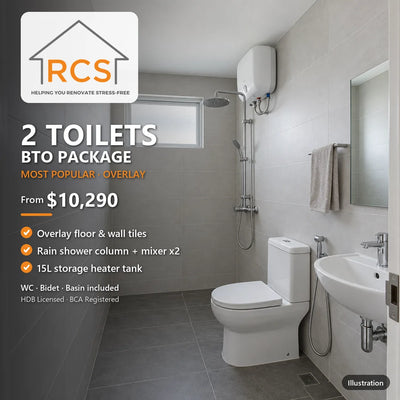
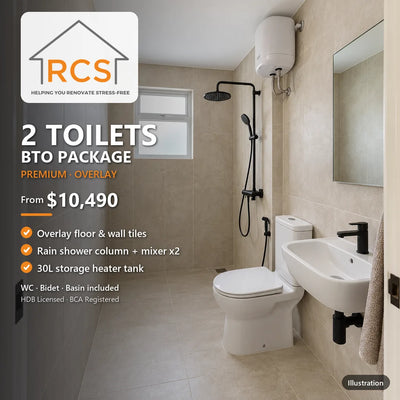
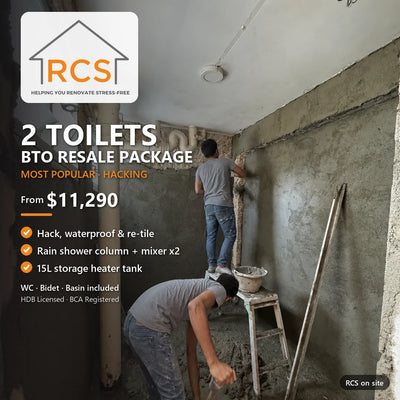
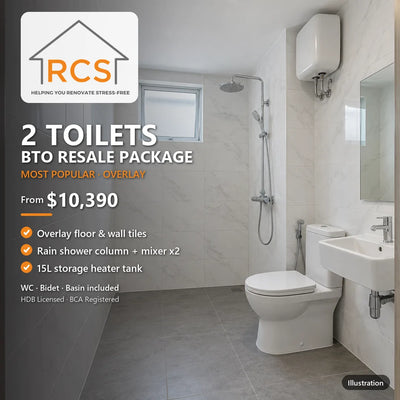
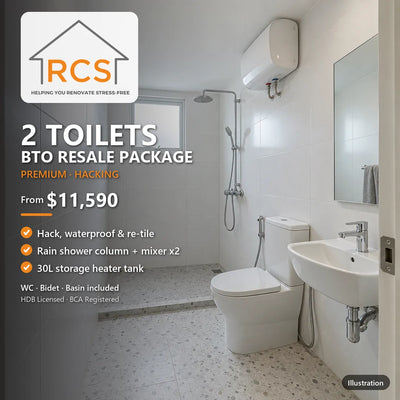
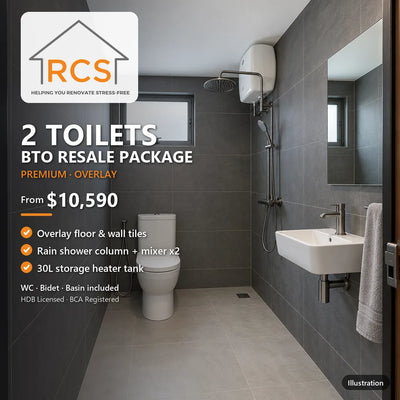
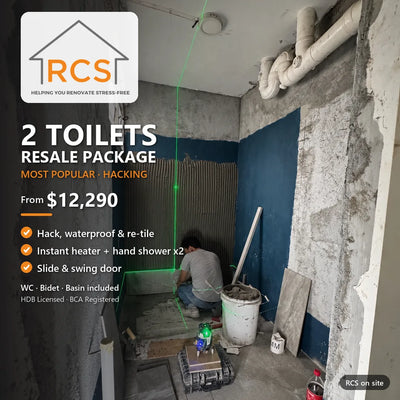
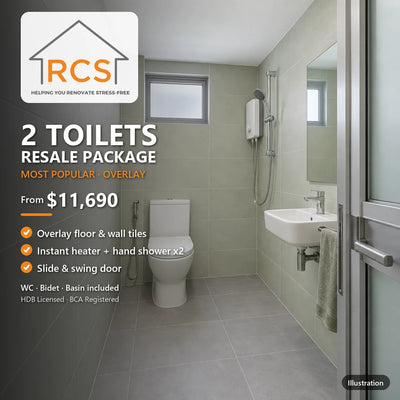
Toilet renovation is included in every RCS whole house package: hacking or overlay, waterproofing, tiling, sanitary ware installation and plumbing. Homeowners searching toilet renovation Singapore separately should compare the standalone price against the whole house price before deciding.
The logic is simple. If only the toilets need work, a standalone toilet package costs far less. If the kitchen and bedrooms need work too, folding the toilets into one contract removes a scheduling conflict, because wet works and floor levels interact across rooms.
Waterproofing deserves particular attention. It is the one element where a shortcut creates liability with the unit below, and it disappears from view once tiling covers it.
How to Choose a Renovation Company in Singapore
Choose a renovation company in Singapore on three verifiable criteria: a valid HDB renovation contractor registration, a stage-linked payment schedule, and a written room-by-room scope. Reviews and showroom quality matter less, because only these three are enforceable.
Price alone is a poor filter. Company longevity helps but does not guarantee current licensing. Verify the licence independently rather than trusting a logo on a website.
Budget discipline matters as much as contractor choice. Work through HDB Renovation Budget 2026: Real Costs & Hidden Fees before you shortlist anyone.
Whole Home Renovation by Estate
Package prices stay consistent across Singapore because RCS quotes on flat type and scope, not postcode. However, estate age changes which package family fits. Older estates skew towards resale packages; newer blocks skew towards BTO resale packages.
Estate breakdowns are available for Toa Payoh HDB Renovation 2026, Clementi HDB Renovation 2026 and Bukit Batok Renovation 2026.
Flat-Specific Cost Guides
Costs shift with layout as well as flat size. A 4-room flat in one estate can carry a different scope from the same flat type elsewhere, because original fittings and wall positions differ by build era.
For flat-level detail, see 4-Room Renovation Bedok 2026, 5-Room Renovation Bedok 2026 and 4-Room HDB Renovation Ang Mo Kio. A shorter overview sits in HDB Flat Whole House Renovation Cost.
Frequently Asked Questions
How much does a whole home renovation cost in Singapore?
RCS whole house packages run from S$22,990 to S$41,590. The lowest covers a 3-room BTO resale flat with vinyl overlay on the Most Popular tier. The highest covers a 5-room resale flat with hacking on the Premium tier.
Is hacking always better than vinyl overlay?
No. Hacking is remedial, not an upgrade. It is necessary when floors are uneven, waterproofing has failed, floor height is constrained, or walls are moving. Where the substrate is sound, vinyl overlay delivers the same finish for S$4,900 to S$9,000 less.
What is the difference between a resale package and a BTO resale package?
Resale packages cover older flats needing full stripping. BTO resale packages cover newer flats in sound condition, where less demolition is required. The BTO resale equivalent costs roughly S$6,000 less at the same flat size and tier.
What is not included in a whole home renovation package?
Packages exclude appliances, loose furniture and temporary accommodation. They cover built-in works only: hacking or overlay, tiling, carpentry, plumbing, electrical, painting and cleaning. Confirm the written scope room by room before signing.
Do I need an HDB permit?
Works falling within HDB's controlled categories require a permit. Your contractor normally applies on your behalf, but the flat owner carries responsibility. Verify current requirements with HDB directly before works commence.
How much more does the Premium tier cost?
On a 4-room resale vinyl package, Premium costs S$31,880 against S$30,199 for Most Popular. That is S$1,681, approximately 5.6%. The tier affects material specification, not which rooms are covered.
Do you have whole home packages for BTO or condo?
The 24 published prices cover resale and BTO resale flats. BTO, condominium and landed projects are scoped individually because layouts and management rules differ. Contact RCS for a quotation on those.
Which flat saves the most by choosing overlay?
A 5-room BTO resale flat saves the most in both absolute and percentage terms: S$9,000, or 26.5% off the hacking price. A 3-room resale flat on the Premium tier saves the least at S$4,900, or 13.8%. Larger flats and newer floors both push the saving higher.
Can I renovate only some rooms instead?
Yes, and it is often the better choice. Whole house packages suit homeowners renovating most or all rooms. For a single kitchen or bathroom, a standalone package costs considerably less.
Book a Whole Home Renovation Consultation
Bring your flat type, your target move-in date and photographs of your existing floors. RCS will confirm whether your floors genuinely need hacking, or whether vinyl overlay saves you the S$4,900 to S$9,000 difference. That assessment happens before any figure is committed.
Start at the 3-room Whole House BTO Resale Package from S$22,990, then speak to the RCS team about your specific unit.
Disclaimer
All package prices were verified against the RCS online store on 28 July 2026 and are subject to change. Final pricing depends on site conditions, measured scope and material selection confirmed after a site assessment. HDB renovation rules, permit categories, plumbing licensing requirements and submission procedures are set by the relevant Singapore authorities and may be revised. Verify current requirements with HDB, BCA and PUB directly. This article provides general guidance and does not constitute a quotation or a contract.
Renovation Contractor Singapore (RCS) — HDB Licence HB-11-5877Z, BizSafe Level 3.