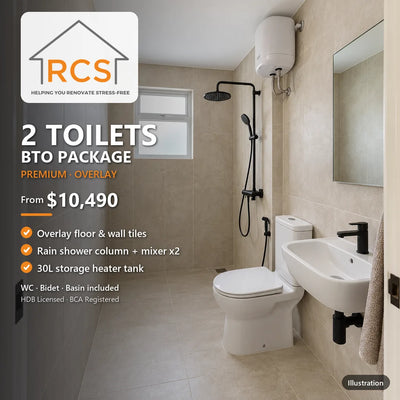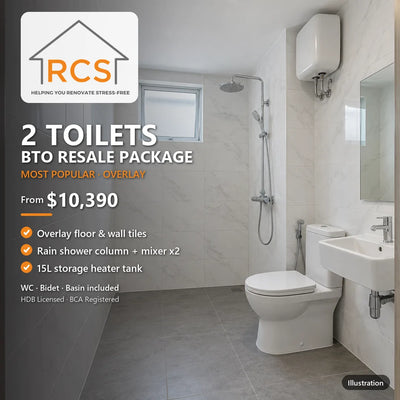

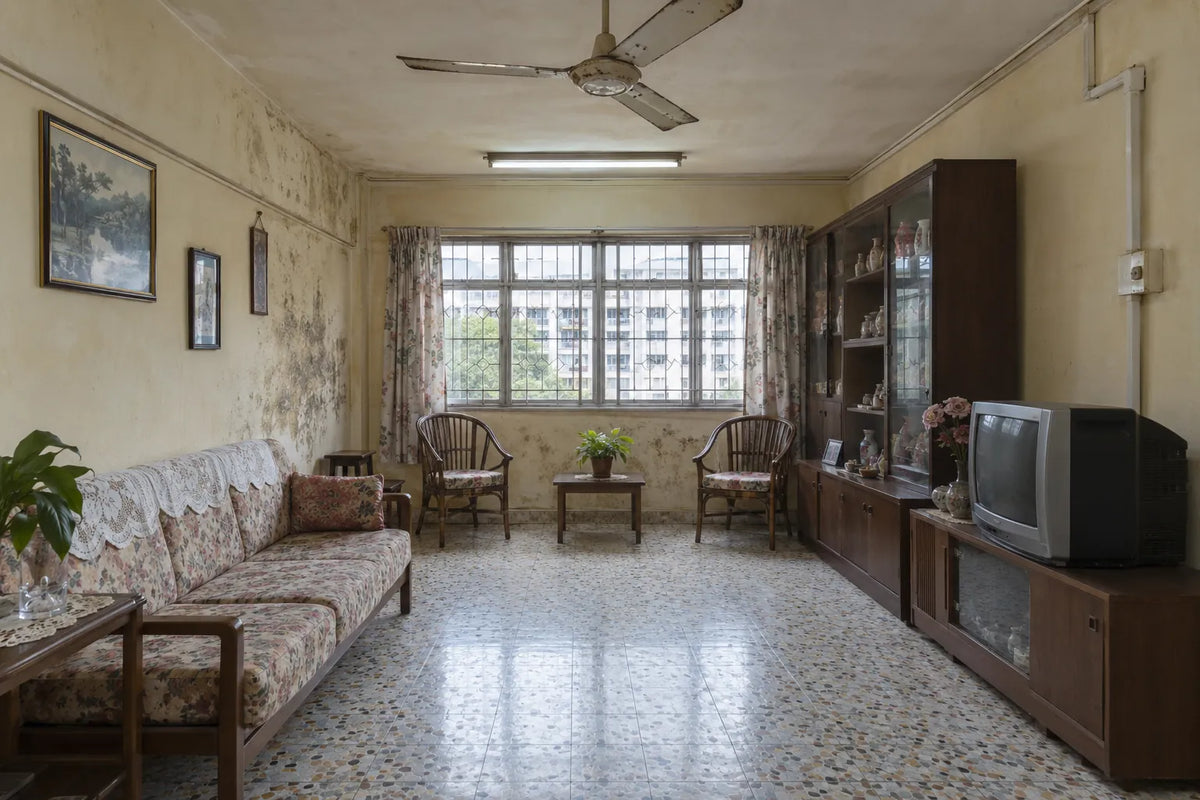

Two Clementi flats in the same block can need very different renovations, and the reason is usually not condition. It is whether the block has been through HDB's Home Improvement Programme. Ask that question before you accept any quotation, because it changes which items you should be paying for and which have already been done at public expense.
It also matters for the opposite reason. There is one major item HIP does not cover, and most owners assume it does.
Check the HIP status before you budget anything
The Home Improvement Programme is HDB's upgrading scheme for older flats. It has three components: Essential improvements, Optional improvements, and EASE — Enhancement for Active Seniors. Details are on HDB's Home Improvement Programme page.
The reason it matters commercially: if HIP has already replaced certain elements in your flat, paying a contractor to replace them again is money spent twice. If HIP has not reached your block, those items are yours to plan for. Same flat type, same estate, materially different scope. Confirm the status of your specific block with HDB, and ask the seller what was done and when.
What HIP covers — and the big thing it does not
Essential improvements are compulsory, considered necessary for public health, safety or technical reasons, and are fully funded by the Government for Singapore citizen households. They include:
- Replacement of cast iron soil and waste pipes
- Repair of spalling concrete
- Replacement of existing pipe sockets with new clothes-drying racks
Optional improvements are subsidised, and you pay only for the items you choose. They include toilet upgrading, replacement of the entrance door and gate, and the refuse hopper.
Now the important part. HIP does not upgrade your electrical installation. Rewiring, additional circuits and a new distribution board are not part of the programme — they remain entirely your cost. If you assumed the wiring was handled because the block was upgraded, that assumption will cost you.
Equally, HIP does not renovate your flat. It will not give you new cabinetry, re-tile floors to your taste, change your layout, or replace fittings for aesthetic reasons.
So the useful mental model: HIP may have handled some of the pipework and structural repair. The wiring and everything you actually wanted to change are still your renovation.
Rewiring an older 3-room: load, points and the distribution board
Since HIP will not have touched this, treat it as a full line item.
- List your appliances. Induction hob, oven, storage or instant water heater, air-conditioning, washer-dryer. Each carries a load and, in some cases, wants its own circuit.
- Map where you actually need points. Then compare against what exists. In older 3-room layouts, the gap is usually in the kitchen and the bedrooms.
- Confirm the distribution board. Circuit count and protective devices, not just capacity.
The sequencing rule matters as much as the cost: electrical work means opening walls, so it belongs before finishes, not after. Deciding to add points once the tiling is done means breaking and repairing what you just paid for.
Bathrooms: check whether the optional toilet upgrade was taken
This is where HIP status changes the bathroom conversation directly.
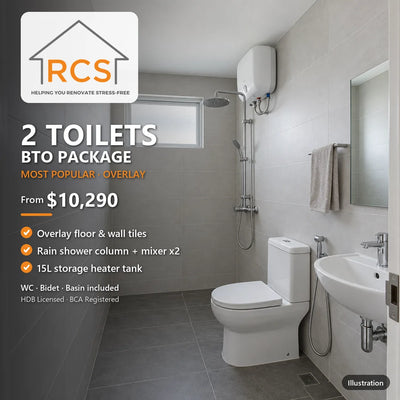
Toilet upgrading sits in HIP's optional list, which means it was the previous owner's choice. If they took it, the bathroom may be in far better condition than the block's age suggests. If they declined it, you are looking at an original bathroom of that vintage.
Where the original bathroom remains, expect the full treatment rather than an overlay. Two reasons: the membrane has been in service for decades, and many older bathrooms have already been overlaid once by a previous owner — raising the floor, reducing headroom, and sealing the original problem underneath.
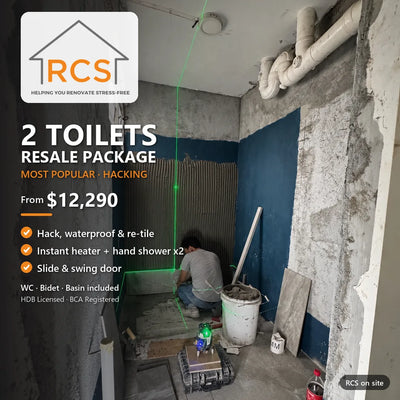
In that condition the honest scope is: hack out the accumulated layers, apply a new membrane, cure it, then flood the bathroom for a 48-hour water ponding test before tiling. Skipping the test is how a leak reappears in the neighbour's ceiling a year later — at which point rectification cost may be shared under HDB's inter-floor leakage framework. Detail in toilet waterproofing standards.
Note that HIP's cast iron pipe replacement is a genuine saving inside this scope — but replacing pipes is not the same as replacing waterproofing.
Where west-side logistics affect scheduling
Clementi is a mature estate with established block layouts, which is generally easier than a new town: loading areas exist, access is known, lift arrangements are predictable.
The constraint here is not access but noise. In a fully occupied mature block, your neighbours are home. Noisy works are permitted only from 9am to 5pm on weekdays and must be completed within three consecutive days, with none on Sundays or public holidays. In a resale strip-out, hacking is the noisiest phase and that three-day cap is a hard planning limit.
Practical courtesy that also prevents complaints: tell the immediate neighbours before hacking week, and keep to the permitted hours strictly. Our HDB renovation noise rules and working hours sets out the full position.
The permit set for an older flat
- Permit required: hacking, floor finishing, plumbing relocation, water heater installation, removal of a non-structural wall.
- No permit: painting, carpentry installation, like-for-like fixture replacement.
- Never permitted: hacking a structural wall.
Only a contractor listed in HDB's Directory of Renovation Contractors can file the application, and approval can take up to three weeks. RCS files these under HDB Licence HB-11-5877Z.
A realistic budget order of operations
- Establish HIP status for the block, and which optional items were taken
- Survey the flat and agree scope against what is actually present
- Subtract anything HIP has already replaced — pipes, spalling repair
- Add back what HIP never covered — electrical, in full
- Allocate to the remaining hidden systems: waterproofing, floor levelling
- Then allocate to finishes and carpentry with what remains
Owners who work in that order tend to be satisfied five years later. Owners who choose tiles first tend to be back in the bathroom. For the item-level cost picture, see our 3-room resale renovation cost guide.
How do I find out if my Clementi block has completed HIP?
Check with HDB directly for the block's upgrading status, and ask the seller what was done and when — including which optional items they selected. Any documentation from the programme is worth obtaining before you finalise scope with a contractor.
Does HIP rewire the flat?
No. HIP's essential improvements cover cast iron soil and waste pipe replacement, spalling concrete repair, and replacing pipe sockets with clothes-drying racks. Electrical rewiring, additional circuits and a new distribution board are not part of the programme and remain the owner's cost.
If HIP replaced my pipes, do I still need to hack the bathroom?
Possibly yes. Pipework and waterproofing are separate matters. Replaced pipes are a saving, but if the original membrane remains and the floor has been overlaid previously, the bathroom still needs to come back to substrate.
Before you commit
RCS is an HDB-licensed renovation contractor (Licence HB-11-5877Z), BCA-registered, PMI and BizSafe Level 3 certified. Our content strategy partner is SingRank. Related: Clementi HDB renovation, HDB Home Improvement Programme guide, and Bishan 3-room resale renovation.
Programme details are HDB's and are subject to change — confirm the current scope and your block's status with HDB. Scope, permits and costs vary by unit condition, flat type and HDB or BCA approval; figures are indicative and should be confirmed through a site consultation before committing to works.