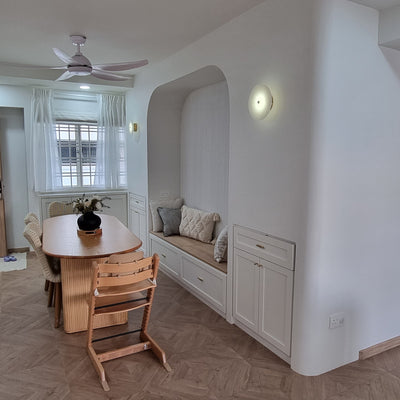

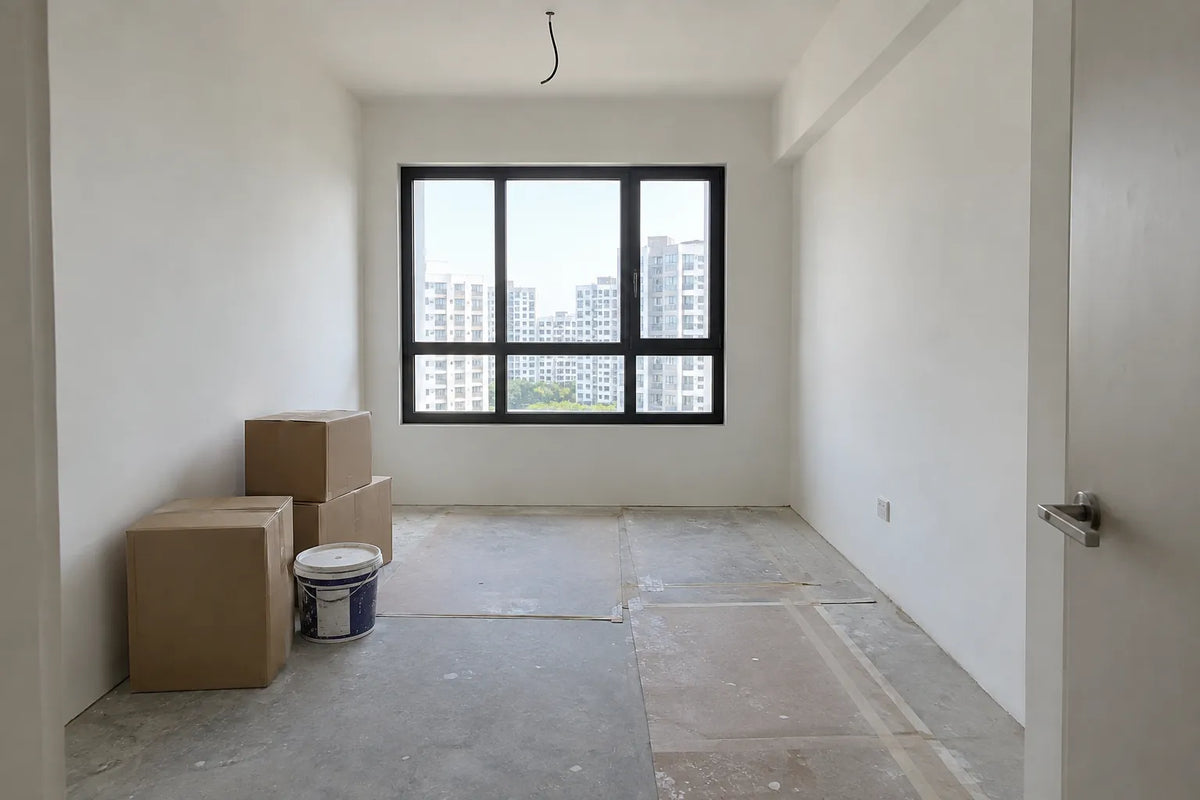


A 4-room BTO is the most common new flat configuration in Singapore, and renovating one is the largest single decision most first-time homeowners will make in the year they collect their keys. The choice that drives almost every other choice — paint, carpentry, flooring spec, timeline, contingency — is the one many homeowners do not realise they are making: a Move-In package or a Bare Unit package. Each has a different scope, a different price, and a different fit for the kind of life you plan to live in the flat.
This guide is the conversation we have with our 4-room BTO clients before any quotation is signed. It compares the two package families honestly, against actual RCS pricing published on our 4-room BTO collection, and alongside the HDB rules that govern what you can and cannot do in a new BTO flat.
We are RCS Renovation Specialists — HDB Licence HB-11-5877Z, BCA registered, BizSafe Level 3. The prices below are taken directly from our published 4-room BTO collection.
What 4-Room BTO Actually Means in 2026
A 4-room HDB BTO flat in Singapore today typically has an internal floor area of around 86 to 93 square metres, with three bedrooms, two bathrooms, a service yard, and a kitchen. According to HDB's own published sales brochures, the approximate floor area for a 4-room flat is 93 sqm at developments such as Bartley GreenRise, and 90 sqm at developments such as Crawford Heights — inclusive of the air-conditioner ledge.
This matters for renovation, because the cost of renovating a 4-room is driven less by the bedroom count and more by the floor area, the number of wet rooms, and the carpentry scope.
The Two Renovation Pathways
Every 4-room BTO renovation falls into one of two families:
-
Move-In package — a focused scope to make the flat liveable: kitchen and bathroom essentials, basic finishing, and the carpentry needed for daily life. Designed for homeowners who want to move in quickly and budget-consciously.
-
Bare Unit package — the complete starter renovation, including walls and flooring across the whole flat. Designed for homeowners who want the flat finished to a settled, full-spec standard from day one.
These are not better-or-worse choices. They are different fits for different timelines and different budgets.
Why a New BTO Is Different from a Resale Renovation
A new BTO flat arrives with developer-supplied flooring, painted walls, and a freshly-laid bathroom waterproofing membrane. A resale flat arrives with whatever the previous owner left behind, and almost always needs hacking, retiling, and rewiring before it is liveable. The two starting points produce different scopes, different price points, and different rules. The 3-year wet-area restriction discussed below is unique to BTO; resale flats do not face it. Understanding this difference at the outset prevents a homeowner from over-buying scope they do not need or under-buying scope they will need within a year.
RCS 4-Room BTO Renovation Packages — Verified 2026 Pricing
The pricing below is taken directly from RCS's published 4-room BTO collection. Every figure is the regular published price as listed on our site at the date of this guide.
Move-In Packages
Bare Unit Packages
GST at 9 percent applies to all goods and services in Singapore from 1 January 2024 onwards (IRAS GST). A reputable contractor itemises GST on the quotation rather than embedding it ambiguously.
The exact scope of inclusions in each package is confirmed at the consultation stage, as scope can vary with unit-specific conditions (orientation, layout, family preferences). What follows is a discussion of how the two package families differ in approach.
Move-In Package vs Bare Unit Package — The Honest Comparison
What a Move-In Package Is For
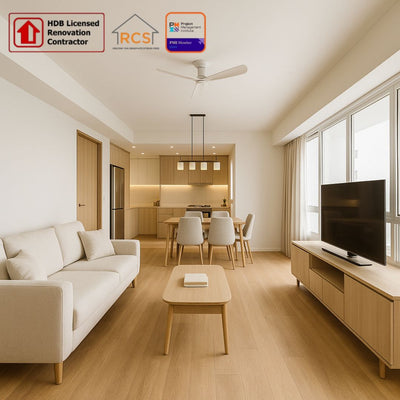
A Move-In package is structured for homeowners who want a livable, finished flat without renovating the entire envelope. The renovation focuses on the high-impact zones — kitchen and bathrooms — and the essential carpentry that turns an empty flat into a working home. The flat's developer-supplied floor and wall finishes generally remain in place.
The right fit for a Move-In package is the homeowner who:
-
Wants to move in within 6 to 8 weeks of starting renovation.
-
Is comfortable with the developer's flooring and wall finishes for the foreseeable future.
-
Has a tighter budget at the point of key collection.
-
Plans to upgrade flooring or paint later, when finances allow.
What a Bare Unit Package Is For
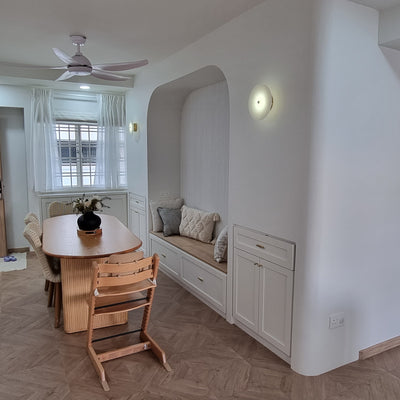
A Bare Unit package is structured for homeowners who want the renovation to deliver a fully finished home from day one. Walls and flooring across the whole flat are addressed within the renovation, alongside the same kitchen and bathroom scope as Move-In.
The right fit for a Bare Unit package is the homeowner who:
-
Wants a single, complete renovation rather than two phases over time.
-
Prefers vinyl or tile flooring throughout the flat over the developer's finish.
-
Is settling for the medium-to-long term and wants the spec to match.
-
Has the budget at the point of key collection to do it once and properly.
Vinyl vs Tiles — The Variant That Matters
Within the Bare Unit family, the choice between vinyl and tiles is real. Tiles cost more (an additional S$2,000 in the RCS Bare Unit pricing — S$14,990 vinyl Most Popular vs S$16,990 tiles Most Popular) and offer durability and a finished aesthetic that tiles deliver well. Vinyl is faster to install, gentler on the budget, and more forgiving for the homeowner who plans to refresh in five to seven years. Both are valid for a 4-room BTO. The right answer depends on how long you plan to stay and how much wear the flat will see.
Most Popular vs Premium — What the Tier Difference Means
Across both package families, there is a Most Popular tier and a Premium tier. The price gap is S$700 (Move-In) or S$1,000 (Bare Unit). The Premium tier reflects a higher-spec material selection within the same overall scope. For a 4-room BTO that you plan to live in for 10 years and beyond, the Premium tier often represents the better long-term value — but the Most Popular tier is genuinely Most Popular for a reason.
A Quick Side-by-Side at a Glance
A homeowner who reads this table and recognises themselves in one row can usually narrow the package decision in a single conversation. The remaining details — Most Popular vs Premium, vinyl vs tiles — are smaller decisions inside the package family.
What HDB Rules Apply to a 4-Room BTO Renovation
A new BTO flat is governed by the same renovation framework as any HDB unit, with one important addition: the BTO 3-year rule on wet area finishes.
Renovation Permit and Approved Contractor
By regulation, only contractors listed on the HDB Directory of Renovation Contractors (DRC) can carry out renovation works in HDB flats and apply for permits on the homeowner's behalf (HDB Directory of Renovation Contractors). The DRC is publicly searchable. RCS is HDB-registered under HB-11-5877Z.
Different renovation works carry different permit and approval requirements under HDB's framework. Whether a specific item in a Move-In or Bare Unit scope requires a permit depends on the exact work involved, and HDB publishes the categories on its application page (HDB Renovation Permit). The contractor confirms which permits apply to a specific project at the consultation and quotation stage and submits applications on the homeowner's behalf where required.
The BTO 3-Year Rule on Wet Areas
This is the rule that catches many first-time BTO homeowners by surprise. Under HDB's guidelines (HDB Renovation Guidelines for Building Works), newly built flats have a 3-year restriction on the removal of toilet wall and floor finishes. The waterproofing membrane laid by HDB's appointed contractor must remain undisturbed for the first 3 years from the date of key collection.
Practically, this means a 4-room BTO bathroom cannot be hacked and retiled in the first 3 years. The bathroom finish you receive at handover is the bathroom finish you will have until year 4. Move-In and Bare Unit packages both work around this rule by using overlay methods (floor and wall) for any bathroom upgrades during the 3-year window.
HDB's published page on important renovation information explains this restriction in plain terms (HDB Important Information on Renovations).
Working Hours and Noise
NEA's framework governs construction noise in residential areas under the Environmental Protection and Management (Control of Noise at Construction Sites) Regulations (NEA Construction Noise Control). Permitted hours, noise limits, and rules around weekends and public holidays vary with the type of work and the proximity to residential buildings, and homeowners should refer to NEA's published guidance for the precise rules applicable to their site.
For a 4-room BTO renovation, the practical effect is that noisy work is sequenced within the permitted window and quieter trades are scheduled around it. Town councils also publish their own renovation conduct guidelines on lift padding, common-corridor protection, and debris removal, and these are layered on top of the NEA framework. The contractor coordinates with the town council on these site-protection items as part of routine project setup.
Common-Area Conduct and Neighbour Considerations
A renovation in a BTO block is rarely the only renovation happening on the floor. Multiple units typically renovate within the same window because all owners collected keys at the same time. The practical implication is that lift access, corridor space, and shared loading bays are in higher demand, and dust travels between units. A renovation that respects the neighbour upstairs and downstairs — by sticking to permitted hours, by communicating before noisy days, and by cleaning the corridor at the end of each day — is the renovation that does not generate complaints. The cost of being a good neighbour is the cost of a tidy site, which is a cost worth bearing.
The Minimum Occupation Period
Worth noting for first-time BTO buyers — HDB's Minimum Occupation Period (MOP) governs when you can sell the flat, not when you can renovate it (HDB Conditions After Buying a New Flat). The MOP is typically five years (ten years for Plus and Prime flats). MOP and the 3-year wet-area renovation restriction are different rules with different purposes; both are worth understanding before you renovate.
How the Numbers Actually Work — A Realistic Walk-Through
Scenario 1: First-Time Couple, Tight Budget, Wants to Move In Fast
A first-time couple in their late twenties collecting keys to a 4-room BTO. They want to move in within two months. The RCS 4rm Move-In BTO Package — Most Popular at S$7,390 delivers the kitchen and bathroom essentials and the carpentry needed for daily life. Walls and flooring stay as the developer supplied. This couple plans to revisit flooring in five years.
Scenario 2: Family of Four, Settling for the Long Term
A family with two young children, planning to live in the flat for 10+ years. They want the flat finished from day one. The RCS 4rm Bare Unit BTO Package — Premium (Tiles) at S$17,990 delivers walls and flooring across the whole flat alongside the kitchen and bathroom scope. Tiles, not vinyl, because the children will be hard on the floor and the finish needs to last.
Scenario 3: Couple with Mid-Range Budget, Wants Vinyl Throughout
A couple who like the look and feel of vinyl flooring, want a finished flat from day one, and have a clear mid-range budget. The RCS 4rm Bare Unit BTO Package — Most Popular (Vinyl) at S$14,990 is the natural fit. The S$2,000 saving against tiles is real money that can go into a sofa, a fridge, or contingency.
Scenario 4: Single Owner, Premium Aesthetic, Wants Move-In Speed
A single professional who wants the flat finished beautifully but quickly, and who is willing to live with the developer's flooring while the kitchen and bathrooms are upgraded to a higher tier. The RCS 4rm Move-In BTO Package — Premium at S$8,090 delivers the higher-spec finishing within the focused Move-In scope.
Scenario 5: Family Migrating from a Resale Flat
A family moving from an older 4-room resale into their first new BTO. They are used to the higher finish quality of their previous home and want to maintain it. The RCS 4rm Bare Unit BTO Package — Premium (Tiles) at S$17,990 is the natural transition; the family already knows what living with tile flooring is like and prefers it.
What Drives the Total 4-Room BTO Renovation Spend Beyond the Package
The package is the foundation. Total project spend typically exceeds the package price by some margin once furniture, white goods, lighting, curtains, aircon, and any custom additions are included. The size of that margin varies considerably from one homeowner to the next, depending on lifestyle and how much is brought from a previous home.
Furniture and White Goods
Sofas, beds, dining sets, refrigerator, washing machine, oven, induction hob, and air conditioners are typically the largest non-renovation outlays for a 4-room BTO. The amount homeowners spend in this category varies widely depending on whether items are bought new, brought from a previous home, or sourced second-hand. This spend is separate from the renovation package and is sourced by the homeowner directly from retailers.
Lighting and Curtains
Pendant lights, downlights for additional zones, curtains, and blinds across multiple windows are typically purchased separately by the homeowner. Pricing depends on brand, finish, and the number of fixtures, and it is worth obtaining quotations from lighting and curtain specialists alongside the renovation quotation so the total picture is clear.
Air Conditioner Installation
Air conditioners for the master bedroom, additional bedrooms, and living room are typically purchased and installed separately by the homeowner from a licensed aircon installer. Pricing depends on the system type, brand, energy efficiency rating, and whether copper piping and concealed trunking are included. Homeowners should obtain a written quotation from the aircon installer that itemises units, installation labour, piping, and warranty terms.
Custom Carpentry Beyond the Package
If the package's standard carpentry does not cover a specific built-in (a study desk in a bedroom, a feature TV console, a foyer cabinet, a dressing table), additional carpentry can be added on top. Pricing varies with material, hardware, dimensions, and finish, and is confirmed item by item at the quotation stage.
Contingency
A 10 percent contingency on top of the package and ancillary spend is the discipline that keeps a renovation calm. Things go differently from plan in every project — a wall reveals an unexpected condition behind a developer finish, a delivery date for a chosen tile slips, the homeowner falls in love with a fitting that costs more than the standard. The contingency exists precisely to handle these moments without an emergency conversation. A renovation without a contingency is a renovation that becomes a finance problem the first time something needs adjusting.
What a Realistic Total-Project Budget Looks Like
Bringing the categories together produces a useful planning view. The Move-In homeowner pays less for the package and may spend more in the months after move-in if flooring or repainting is added later. The Bare Unit homeowner pays more for the package and addresses walls and flooring up front, leaving fewer renovation-style decisions to make in the years that follow. Neither approach is cheaper or more expensive in absolute terms — they are different cash-flow profiles for different life situations. The right framing is not “which is cheaper” but “which pattern of spending fits the household's plans for the next five to ten years.”
Six Questions to Ask Before Signing a 4-Room BTO Quotation
-
Is the contractor's HDB licence number listed on the Directory of Renovation Contractors today, and can I see it?
-
What is the exact scope of the package, item by item, in writing?
-
What is excluded that I should expect to encounter — and what is the typical cost range?
-
What is your project timeline for my package, and what causes delays?
-
What is your defects liability period, and how do I notify a defect?
-
How is GST handled on the quotation — broken out separately or embedded in the figure?
Every question is reasonable. Every answer should be in writing. A contractor confident in their position answers all six without hesitation.
Common Pitfalls in a 4-Room BTO Renovation
After many BTO projects, these are the patterns that turn a routine renovation into a stressful one.
1. Underestimating the BTO 3-Year Rule
Homeowners plan a full bathroom refurbishment in year one, only to learn that the 3-year rule prohibits hacking. The renovation either pivots to overlay (which is permitted and works well) or waits for year four.
2. Mixing Move-In and Bare Unit Scopes Without a Plan
A homeowner takes a Move-In package and asks for "just the floor in the living room". The pricing logic of Move-In is that floor work is excluded; adding a partial floor changes the trade sequence and the cost. Either commit to Bare Unit, or accept Move-In's scope as it stands.
3. Skipping Site Protection
A 4-room BTO renovation generates dust and debris. Lift padding, common-corridor protection, and unit-side floor protection are part of a compliant renovation. Cutting site protection to save cost is the most common cause of damage claims with the town council and neighbours.
4. Last-Minute Carpentry Additions
A homeowner adds a custom carpentry item well into the renovation. Custom carpentry has a fabrication lead time that depends on material, supplier, and current workshop schedule. A late addition can either delay the project or arrive after move-in. Planning carpentry at the start of the project, and locking the scope before fabrication begins, is the discipline that avoids this.
5. Treating GST as a Rounding Error
The prevailing GST rate in Singapore is 9 percent from 1 January 2024 onwards (IRAS GST). Whether GST appears on a specific quotation depends on the supplier's GST registration status. A quotation that does not state clearly whether GST is included or excluded is a quotation that can produce an unwelcome adjustment at the signing meeting. Asking the question early settles it cleanly.
6. Choosing the Cheapest Quote
The cheapest quote is rarely the cheapest renovation. Variation orders, scope creep, and rectification costs equalise the price by the end of the project. Choose the contractor whose scope is clearly written and whose track record is verifiable.
Your Rights If Something Goes Wrong
The Defects Liability Period
The contractor's defects liability period is the first line of recourse for workmanship issues. Defect notifications during the period are addressed by the contractor under the contract. The exact length of the defects liability period and the scope of cover are defined in the renovation contract — this is one of the items worth reviewing carefully before signing.
CASE Mediation
The Consumers Association of Singapore (CASE) provides mediation for renovation disputes (CASE). Coming to mediation with an organised file — contract, photographs, correspondence — substantially improves outcomes.
Fair Trading and CCCS
Renovation industry conduct sits under the Consumer Protection (Fair Trading) Act. The Competition and Consumer Commission of Singapore publishes guidance on fair trading practices in the renovation industry (CCCS Fair Trading).
Small Claims Tribunals
For monetary disputes within the limits, the Small Claims Tribunals can hear cases up to S$20,000 (or S$30,000 with mutual consent), with a filing window of two years from the date the cause of action arose (SCT eligibility).
Closing — A Small Honest Note from Us
A 4-room BTO renovation does not have to be complicated. The two big choices — Move-In or Bare Unit, and Tiles or Vinyl on the Bare Unit family — drive almost everything else. Once those are settled, the rest of the project flows along a known sequence.
The best 4-room BTO renovations we have delivered share a pattern. The homeowner picked the package that genuinely fit their life rather than the one their friends or social media said was best. They asked the six questions in writing. They added a 10 percent contingency. They engaged early with the bathroom design so that the 3-year rule did not surprise them later. And they trusted the process to play out.
If you are weighing 4-room BTO quotations and the quote does not address scope, GST, defects liability, and the contractor's HDB licence in writing, that is the right moment to ask harder questions. The cost of clarity is small. The cost of a renovation that drifts from the brief is not.
We are happy to walk through the 4-room BTO collection with you, with the published prices in front of us. That conversation costs nothing and it is the most useful 30 minutes you will spend on the renovation.
Frequently Asked Questions
What is the price of a 4-room BTO renovation in 2026?
Based on RCS's published 4-room BTO collection, Move-In packages start at S$7,390 (Most Popular) and S$8,090 (Premium). Bare Unit packages start at S$14,990 (Most Popular Vinyl) and reach S$17,990 (Premium Tiles). Pricing reflects regular published rates on the RCS 4-room BTO collection page.
What is the difference between a Move-In and a Bare Unit package?
A Move-In package focuses on kitchen, bathrooms, and essential carpentry — the developer's flooring and walls remain. A Bare Unit package adds walls and flooring across the whole flat to the same kitchen and bathroom scope. Move-In suits homeowners who want speed and a tighter budget. Bare Unit suits homeowners who want the flat fully finished from day one.
Should I choose tiles or vinyl flooring for a 4-room BTO?
Tiles cost approximately S$2,000 more than vinyl in the RCS Bare Unit BTO pricing and offer longer durability with a more finished aesthetic. Vinyl is faster to install, gentler on the budget, and a strong fit for homeowners who plan to refresh in five to seven years. Both work well for a 4-room BTO; the right answer depends on how long you plan to stay.
Can I hack and retile my BTO bathroom in the first year?
Generally not. HDB's renovation guidelines state that newly built flats have a 3-year restriction on the removal of toilet wall and floor finishes. The waterproofing membrane installed by HDB's appointed contractor must remain undisturbed for the first 3 years from key collection. Bathroom upgrades within the 3-year window are typically done using overlay methods.
Do I need an HDB-registered contractor for my BTO renovation?
Yes. By regulation, only contractors listed on the HDB Directory of Renovation Contractors can carry out renovation works in HDB flats and apply for permits. RCS is HDB-registered under HB-11-5877Z.
Does HDB charge a fee for the renovation permit?
HDB does not charge the homeowner a direct fee for the renovation permit itself. Permit-related administration is handled by the contractor as part of the project. Costs that homeowners do encounter are the contractor's quote and any ancillary professional fees.
How much GST applies to the renovation cost?
The prevailing GST rate in Singapore is 9 percent from 1 January 2024 onwards, as published by IRAS. Whether GST applies to a specific transaction depends on the supplier's GST registration status. A reputable contractor states clearly on the quotation whether GST is included or excluded, and itemises it where applicable.
What is HDB's Minimum Occupation Period (MOP)?
The MOP is the period during which you must occupy the flat before you can sell it. For most BTO flats, the MOP is five years from key collection; for Plus and Prime flats, the MOP is ten years. The MOP does not affect when you can renovate — it affects when you can sell.
How long does a 4-room BTO renovation typically take?
Project timelines depend on the package and any custom additions. As a guide, Move-In packages are shorter than Bare Unit packages, and Bare Unit with carpentry-heavy scope is the longest. Confirm the timeline with your contractor in writing before signing.
What happens if my contractor delays the project?
The renovation contract should specify timelines and the consequences of delay. CASE provides mediation for unresolved disputes, and the Small Claims Tribunals hear monetary claims within the eligibility limits. A clearly written contract and a documented timeline are the foundation of a calm dispute resolution if it becomes necessary.
Related Reading from RCS
If you are planning a 4-room BTO renovation, these companion guides may help:
-
HDB Wall Hacking Permit & PE Endorsement Singapore 2026
-
Toilet Waterproofing Singapore 2026: HDB 3-Year Rule and BCA Standards
-
Kitchen Carpentry Cost Per Foot Run Singapore 2026
-
Renovation Contract Template Singapore 2026
-
Renovation Loan Singapore 2026 Comparison Guide
Internal links to be inserted by RCS publisher matching live URLs on the RCS blog.
Sources and Further Reading
Singapore Government and Statutory Bodies
Statutory Consumer Protection
Disclaimer. This article is for general informational purposes only and does not constitute legal, engineering, or financial advice. All RCS pricing reflects current published RCS Renovation Specialists package rates on the 4-room BTO renovation packages collection as of May 2026; rates are subject to change with material costs and project scope, and the exact inclusions of each package are confirmed at the consultation stage. Where regulations are summarised, readers should refer to the relevant authority — HDB, NEA, IRAS, CCCS, or CASE — for the official, up-to-date wording. RCS Renovation Specialists has no commercial relationship with any of the brands or third-party entities named in this guide.
RCS Renovation Specialists | HDB Licence HB-11-5877Z | BCA Registered | BizSafe Level 3