
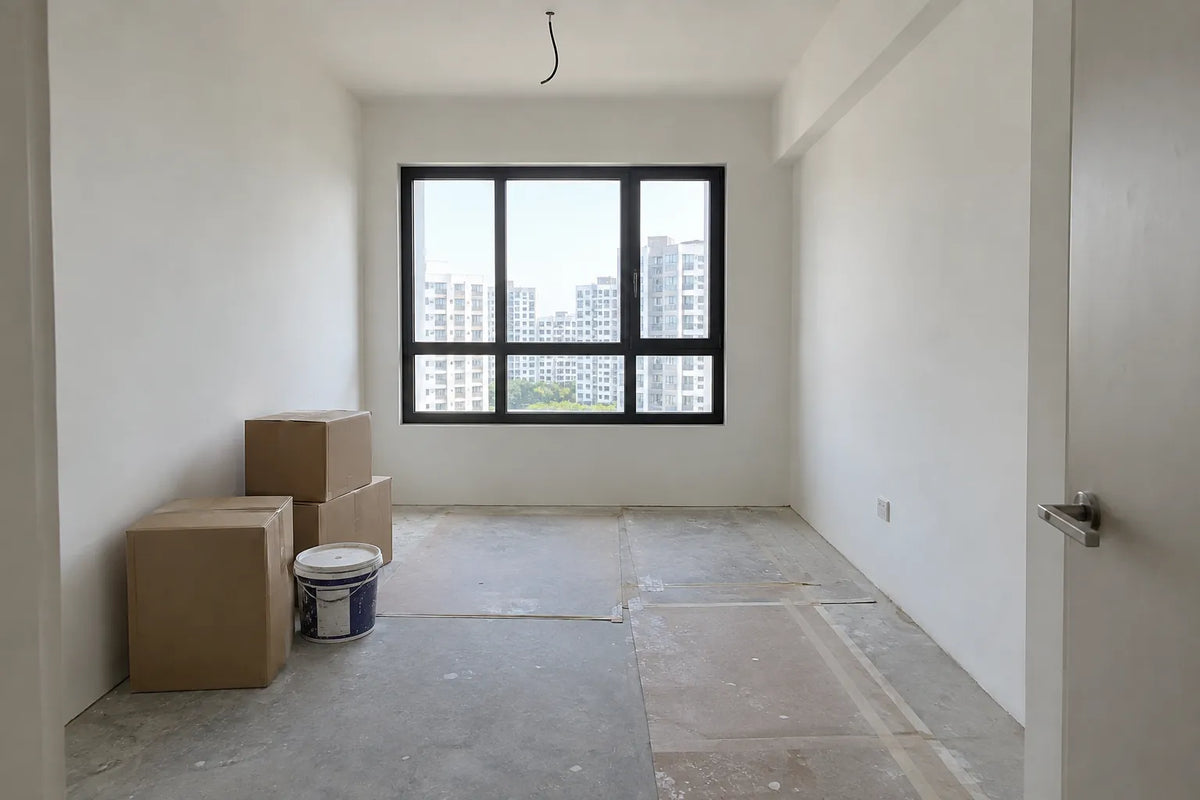


Tile popping happens when floor tiles lose their bond to the screed beneath and lift upward, often with a loud crack. Singapore's climate drives it: tiles, adhesive and screed expand at different rates, and without adequate movement joints that pressure has nowhere to go. Older HDB flats see it most.
Key Takeaways
- Tile popping is a bonding failure, not a cosmetic defect. One popped tile usually signals more to come.
- The main drivers are differential thermal movement, moisture under the tile, and weak or diluted adhesive.
- Full hacking and re-tiling is the thorough fix, and the most disruptive one.
- Vinyl overlay resolves the same problem without demolition, saving S$4,900 to S$9,000 across RCS packages.
- Raised tiles are a genuine trip hazard. Cordon the area before deciding anything.
- RCS holds HDB Licence HB-11-5877Z and BizSafe Level 3 certification.
What Tile Popping Actually Is
Tile popping, also called tenting or debonding, occurs when the adhesive layer between tile and screed fails. Compressive stress builds across the floor, and the weakest point releases upward. In severe cases tiles lift several centimetres clear of the ground.
The sound gives it away. Homeowners describe a loud crack, sometimes at night, followed by a hollow patch that was solid the day before.
It is a structural bonding problem, not a surface blemish. Treating it as cosmetic is why so many repairs fail twice.
Why Does It Happen in Singapore Homes?
Four mechanisms account for nearly every case. Usually two or three act together.
Differential Thermal Movement
Tiles, adhesive and concrete screed all expand and contract, but at different rates. The Ministry of National Development has attributed dislodged HDB floor tiles to differential thermal expansion and contraction, alongside natural deterioration of the bond between tile and screed.
Temperature swings matter more than absolute heat. In a written parliamentary reply, then-Minister for National Development Lawrence Wong linked a rise in dislodged tiles during December 2019 to colder weather and temperature fluctuations that month, which caused tiles and substrate to move at different rates.
Missing or Inadequate Movement Joints
Movement joints give an expanding floor somewhere to go. Where they are omitted, undersized, or filled with rigid grout, the floor becomes one continuous rigid sheet. Pressure then releases the only way it can, which is upward.
Moisture Beneath the Tile
Water reaching the adhesive layer weakens the bond progressively. Sources include failed bathroom waterproofing, a slow pipe leak, or seepage through the slab. Moisture-driven debonding usually spreads outward from one area rather than appearing randomly.
Weak Substrate or Diluted Adhesive
An uneven screed leaves voids under the tile, and a hollow tile has no bond to lose. Separately, adhesive thinned with extra water or cement to stretch the material sets weaker than specified. Both are installation faults, and both surface years later.
How to Tell If More Tiles Will Pop
Tap across the floor with a coin or a knuckle. A solid tile returns a dull, dense sound. A debonded tile sounds hollow because there is air beneath it.
Map the hollow area before deciding on a repair. Homeowners who replace one tile and stop almost always return within a year, because the surrounding tiles were already hollow.
Pay attention to where the hollow zone sits. Along a west-facing wall suggests thermal movement. Around a bathroom door suggests moisture.
Is Tile Popping Dangerous?
Yes, in three specific ways. Raised tiles create a trip hazard, and a lifted edge can be sharp enough to cut. Broken tiles can shatter under weight.
Gaps also let water reach the layer below. That turns a flooring problem into a waterproofing problem, and in an upper-floor flat it can become a neighbour's problem too. See HDB Ceiling Leak Between Floors: Who Pays.
Cordon the affected area first. Decide on the repair second.
Who Pays to Fix Popped Tiles?
Flat owners are responsible for maintaining the interior of their own flats, including repairs arising from general wear and tear. MND has stated this position in response to parliamentary questions about dislodged floor tiles.
Newer flats may still fall within a defects liability period, and separate goodwill assistance arrangements have been referenced for older flats. Terms and eligibility change, so confirm your specific situation directly with the Housing and Development Board rather than relying on secondhand accounts.
Tiles in common areas such as lift lobbies and void decks are a town council matter, not a flat owner's.
The Three Repair Options
Every quotation you receive will be a version of one of these. The right choice depends on how much of the floor has debonded and what caused it.
Option One: Replace Individual Tiles
The affected tiles come out and new ones go in. It is the cheapest and fastest route, and it works only when the hollow zone is genuinely isolated.
Two problems recur. Matching a discontinued tile is often impossible, so the patch is visible. More importantly, if the underlying cause is still present, the neighbouring tiles follow within months.
Option Two: Hack and Re-Tile
All affected tiles come up, the screed is inspected and corrected, proper movement joints are installed, and the area is re-tiled with fresh adhesive. This is the thorough fix.
It is also the loudest and dustiest, and it generates debris that must be carted away. Where the screed is actually sound, hacking spends money recreating a condition you already had.
Option Three: Vinyl Overlay
Loose tiles are removed, the subfloor is levelled, and the area is overlaid with vinyl. No wholesale demolition, far less noise, and no tile-matching problem because the entire surface is new.
Overlay suits floors where the screed is intact and dry. It does not suit a floor that is debonding because water is coming through, since covering that traps the fault.
Overlay Versus Hacking: The Real Cost Difference
Where overlay is viable, the saving is substantial and documented. Across RCS whole house packages the gap runs from S$4,900 to S$9,000 depending on flat size and package family.
| Flat | Package family | Vinyl overlay | With hacking | Difference |
|---|---|---|---|---|
| 3-room | BTO resale | 22,990 | 28,990 | 6,000 |
| 3-room | Resale | 28,990 | 33,990 | 5,000 |
| 4-room | BTO resale | 23,990 | 31,990 | 8,000 |
| 4-room | Resale | 30,199 | 36,990 | 6,791 |
| 5-room | BTO resale | 24,990 | 33,990 | 9,000 |
| 5-room | Resale | 31,290 | 39,990 | 8,700 |
Expressed proportionally, overlay removes between 13.8% and 26.5% of the package price. The largest saving lands on a 5-room BTO resale flat at S$9,000, or 26.5%.
Those figures cover whole house scope. For a single room, ask RCS for a room-scoped quotation instead.
When Hacking Is Genuinely Necessary
Four conditions rule overlay out. Ignoring them turns a repair into a repeat repair.
- The screed itself is cracked, uneven or crumbling
- Waterproofing has failed and moisture is still reaching the bond layer
- Floor height cannot absorb the added thickness of an overlay
- Walls are moving, which exposes the slab regardless
The full decision framework sits in Kitchen Overlay vs Hacking Singapore 2026 and Overlay vs Hacking HDB Bathroom Singapore.
How to Prevent Tile Popping in a New Renovation
Prevention is entirely a specification and supervision matter. Four controls cover it.
Insist on Movement Joints
Ask where the movement joints will go and what will fill them. A tiler who cannot answer is planning a continuous rigid floor, which is the condition that produces popping.
Check Substrate Preparation
The screed must be level, cured and clean before tiling starts. Rushing this stage creates the voids that debond later.
Specify the Adhesive
Name the adhesive product in the quotation. Naming it makes dilution to save cost far harder to hide.
Do Not Compress the Programme
Screed curing and adhesive curing both need time. Schedule pressure is the single most common reason those windows get shortened. Read How to Read a Renovation Quotation Singapore 2026 before signing.
Does Tile Choice Make a Difference?
Tile type affects moisture behaviour. Porcelain is denser and less porous than ceramic, so it absorbs less water.
Format matters too. Large-format tiles concentrate more stress across fewer joints, which raises the demand on both adhesive coverage and movement joint placement.
No tile prevents popping on its own. Installation quality decides the outcome far more than the tile specification does.
Tile Popping in Older Flats
Bond deterioration accumulates. An adhesive layer that has cycled through thousands of daily temperature swings is weaker than one installed last year, regardless of how well it was laid.
That is why popping clusters in older stock. For resale buyers this belongs on the pre-purchase checklist, since it changes the renovation scope before you have signed anything. See the HDB resale renovation guide.
What to Do Right Now
- Cordon the raised area so nobody trips on it.
- Tap the surrounding tiles and mark every hollow one.
- Photograph the affected zone with a date visible.
- Check for a moisture source: bathroom, kitchen, or a pipe run nearby.
- Get the hollow area assessed before accepting any single-tile quotation.
Step five is where money is saved. A contractor who quotes without mapping the hollow zone is quoting for the symptom.
Frequently Asked Questions
Why do HDB floor tiles pop?
Tiles, adhesive and screed expand at different rates. Without adequate movement joints, that pressure lifts the tile. MND has attributed dislodged HDB tiles to differential thermal expansion and contraction and to natural deterioration of the tile-to-screed bond.
Will more tiles pop after the first one?
Usually yes. A popped tile indicates the bond has failed across an area, not at a single point. Tap the surrounding tiles and map every hollow one before repairing.
Can I just replace the popped tile?
You can, but it treats the symptom. If the cause is still present, neighbouring tiles follow. Matching a discontinued tile is also frequently impossible.
Is vinyl overlay a real fix or a cover-up?
It is a real fix where the screed is sound and dry, because loose tiles are removed and the subfloor is levelled first. It is a cover-up if moisture is still reaching the bond layer, which is why the cause must be diagnosed first.
How much does overlay save compared with hacking?
Across RCS whole house packages, between S$4,900 and S$9,000, or 13.8% to 26.5% of the package price. The largest saving is S$9,000 on a 5-room BTO resale flat.
Who pays if tiles pop in an HDB flat?
Flat owners are responsible for maintaining their own interiors, including wear and tear repairs. Newer flats may fall within a defects liability period. Confirm your specific eligibility with HDB directly.
What about tiles popping in the lift lobby?
Common areas are maintained by the town council. Report it to them rather than arranging a private repair.
Does air-conditioning reduce the risk?
Stable indoor temperature reduces the size of the thermal swings that drive movement. It does not compensate for missing movement joints or weak adhesive.
Get the Hollow Area Mapped First
Send RCS photographs of the popped tiles and note which rooms sound hollow. That determines whether you are looking at a localised repair or a floor that needs replacing, and it decides between overlay and hacking before any figure is committed.
Compare the full range at the 3-room Whole House BTO Resale Package from S$22,990, or read the complete ladder in Whole Home Renovation Singapore: Full Cost Guide.
Disclaimer
Statements about causes of dislodged HDB floor tiles reflect published positions of the Ministry of National Development in response to parliamentary questions. Defects liability periods, goodwill repair arrangements and eligibility criteria are set by HDB and are revised from time to time; verify your specific situation with HDB directly. RCS package prices were verified against the RCS online store on 28 July 2026 and are subject to change. Repair scope and final pricing depend on site assessment. This article is general guidance and does not constitute a quotation.
Renovation Contractor Singapore (RCS) — HDB Licence HB-11-5877Z, BizSafe Level 3.